
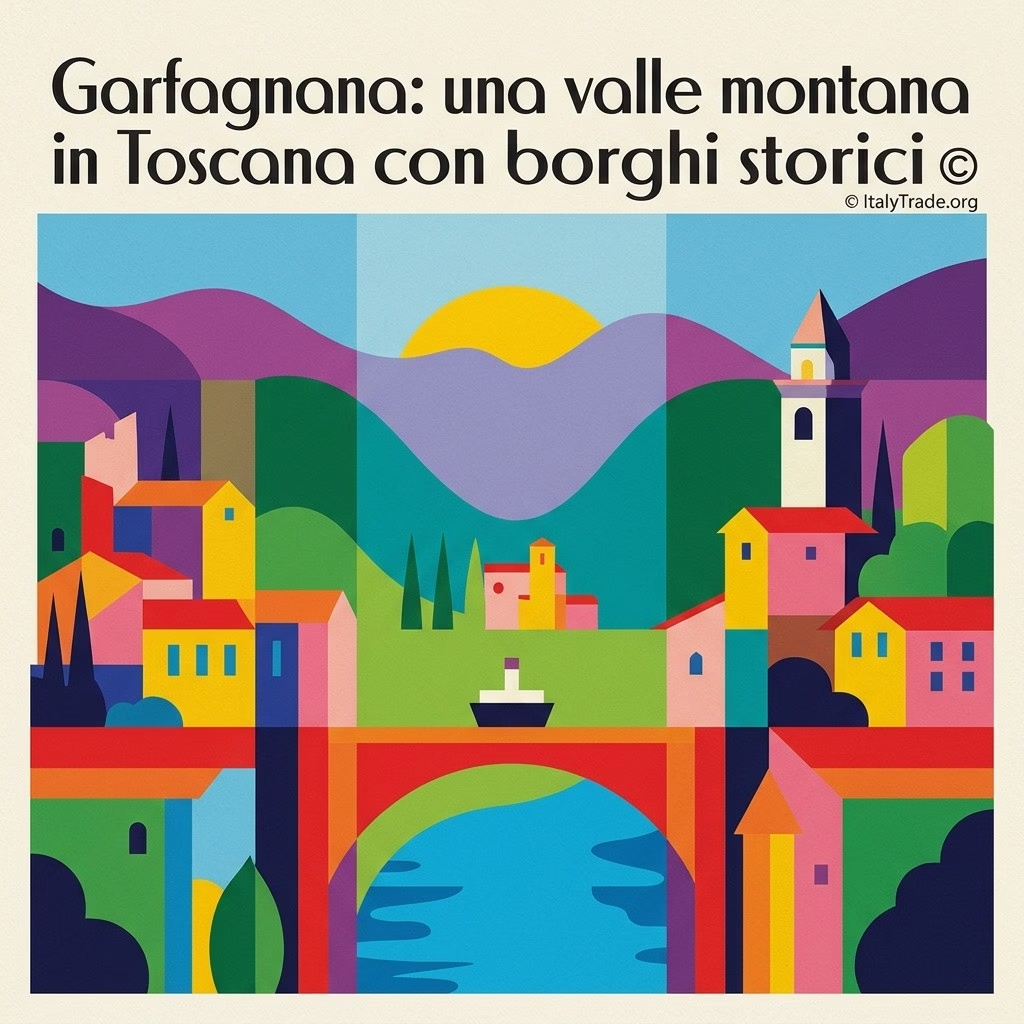
Garfagnana, Tuscany: Tuscan Mountain Villages
Province of Lucca · between the Apuan Alps and the Tuscan-Emilian Apennines · Serchio river valley
Garfagnana, Tuscany: the Serchio valley between two mountain ranges
Garfagnana is the upper part of the Serchio river valley, in northern Tuscany, in the province of Lucca. Anyone looking for Garfagnana in Italy will find a territory enclosed between the Apuan Alps on one side and the Tuscan-Emilian Apennines on the other, made of chestnut woods, ancient settlements and trails: the right place to discover the Tuscan mountain villages at an unhurried pace, away from the beaten track.
The historic capital is Castelnuovo di Garfagnana, about 40 km from Lucca, on the northern bank of the Serchio. The river runs through the whole valley and provides the common thread for a trip that combines hiking in Garfagnana, Este fortresses and local food. To place the region in its wider context you can also read Tuscany: where every hill tells a story (in Italian).
Source: The Wom Travel · Source: Finestre sull’Arte · Source: Visit Tuscany · Source: Garfagnana Turismo
Este history, chestnut woods and the Apuan Alps
The history of Garfagnana runs through the Este family: in 1522 the Duke of Ferrara sent the poet Ludovico Ariosto, author of «Orlando Furioso», here as governor. He stayed three years and lived in the fortress that now bears his name. Further downstream, the Media Valle del Serchio remained under Florentine rule from the fourteenth century until the unification of Italy: two different souls in a single landscape.
In terms of nature, much of the territory lies within the Apuan Alps Regional Park, while chestnut woods cover the slopes. The mountains and forests lend themselves to hiking, trekking and mountain biking. Among the best-known hikes in Garfagnana is the Monte Forato loop starting from Fornovolasco, about 5 hours round trip with an elevation gain of 700 metres, on trails maintained by the CAI (Italian Alpine Club) and the Park Authority.
Source: Il Fatto Quotidiano · Source: Finestre sull’Arte · Source: Visit Tuscany
Why Garfagnana is unique
🏘️ I Borghi più belli d’Italia (Italy’s most beautiful villages)
Among the towns of Garfagnana and the Media Valle del Serchio, Coreglia Antelminelli, Barga and Castiglione di Garfagnana are part of the list of the Borghi più belli d’Italia compiled by ANCI.
🧭 Three souls: Lucca, Este and Florence
The territory has a layered history. Barga, for example, is a Florentine exclave in the Media Valle, while Castelnuovo and the fortresses of the upper valley tell the story of the Este duchy.
🏰 A system of Este fortresses
The Fortezza delle Verrucole is part of the system of fortifications of the Este duchy in Garfagnana, while Mont’Alfonso was built at the behest of Alfonso II d’Este to defend the Este territory from the Republic of Lucca.
Source: Visit Tuscany · Source: ANCI Toscana · Source: Visit Tuscany (fortresses)
The wonders of Garfagnana
Castelnuovo di Garfagnana
Capital and heart of the valley, north of the Serchio between the Apuan Alps and the Apennines, about 40 km from Lucca.
Castiglione di Garfagnana
Medieval village surrounded by chestnut and beech woods, listed among the Borghi più belli d’Italia.
Barga
The most populous town of the Media Valle del Serchio: one of Italy’s most beautiful villages, a Slow City and a TCI Orange Flag destination.
Coreglia Antelminelli
A village in the mountains of the Media Valle del Serchio, also known as the town of the plaster figurines.
Rocca Ariostesca
The symbol of Castelnuovo, it overlooks the main square and takes its name from Ludovico Ariosto.
Fortezza di Mont’Alfonso
Built between 1579 and 1586 at the behest of Alfonso II d’Este; an easy 6 km trail links it to the Rocca.
Fortezza delle Verrucole
At 600 m above sea level over the village of the same name, about 3 km from San Romano, with views of the valley and the Apuan Alps.
Rocca degli Estensi
Built around the fifteenth century opposite the Verrucole; little of its original appearance remains after the 1920 earthquake.
Orecchiella Park
A nature reserve spanning Piazza al Serchio, San Romano, Sillano and Villa Collemandina, with a visitor centre, trails and wildlife enclosures.
Pania di Corfino
A limestone massif that overlooks Garfagnana like a terrace; it hosts a botanical garden.
Isola Santa
A hamlet set on the shores of a small lake, among chestnut woods and Apuan peaks.
Grotta del Vento (Cave of the Wind)
A karst cave in the heart of the Apuan Alps, open to visitors with three routes of different length and duration.
Il Palazzo di Atlante
A multimedia museum dedicated to «Orlando Furioso» and Ludovico Ariosto, housed in the Rocca Ariostesca.
Archaeological Museum of the Territory
In the Rocca Ariostesca, it gathers finds from the upper Serchio valley, including Etruscan remains.
Orecchiella Visitor Centre
With a Natural History Museum, a Museum of Birds of Prey and a mountain flower garden.
Source: Visit Tuscany (villages) · Source: Visit Tuscany (fortresses) · Source: Visit Tuscany (Orecchiella) · Source: Visit Tuscany (Grotta del Vento) · Source: Musei Provincia di Lucca
Local food in Garfagnana: spelt, chestnuts and mountain flavours
Garfagnana cuisine is mountain cooking, with hearty dishes born from simple but precious ingredients. Local food in Garfagnana revolves around two protected products: Farro della Garfagnana PGI (spelt) and Farina di Neccio della Garfagnana PDO (chestnut flour), where «neccio» is the local name for the chestnut tree. Places to taste them include osterie, trattorie and farm stays; for a broader overview of Italian cuisine see the Exquisite Cuisine category.
🍲 Dishes and products not to be missed
Spelt soup
PGI spelt is used in soups and stews, but also in summer salads, savoury pies, biscuits and even beer.
Necci with ricotta
The typical dessert: thin pancakes of neccio flour cooked on special «testi» placed directly on the fire, served with ricotta.
Polenta and manafregoli
Recipes based on neccio flour: polenta and manafregoli, flour cooked with milk.
Castagnaccio
The chestnut cake that celebrates the valley’s «chestnut civilisation».
Cured meats, cheeses and honey
The pork-butchering and cheese-making art of Garfagnana, with cheeses to taste at the dairies and honey as an accompaniment.
Marinated trout
Trout from crystal-clear streams, prepared according to the ancient marinating method.
🌰 Neccio flour PDO
Neccio flour ranges in colour from white to dark ivory, has a very fine grain and a sweet flavour with a slight bitterish aftertaste. It must be eaten fresh, because within a few months it turns rancid; it is used for bread and baked goods, often mixed with other cereals, and also in gluten-free preparations.
Source: Visit Tuscany (flavours) · Source: Visit Tuscany (neccio flour) · Source: Visit Tuscany (the gold of Garfagnana) · Source: Visit Tuscany (places)
Traditions and calendar: chestnuts, fortresses and the nativity scene
🎉 The events calendar
Autumn — chestnut festivals
Among the events of the season: the Fiera d’Ottobre in Castiglione di Garfagnana, the Festa della Castagna in Careggine, Barga Castagna, the Lupinaia festival in November and, in December, the Città della Castagna in Castelnuovo di Garfagnana.
November 2026 — Garfagnana Terra Unica
Three weekends devoted to the flavours, traditions and crafts of the valley’s 15 municipalities, now in their 10th edition.
Summer — Mont’Alfonso sotto le stelle
A music and theatre festival in the fortresses. The 2025 edition ran from 17 July to 23 August, with one evening also at the Fortezza delle Verrucole.
Winter — Living Nativity of Barga
A historical re-enactment involving the entire historic centre and turning it into a Nativity village.
🥖 Village festivals and sagre
Sagre (food festivals) are the most enjoyable way to get to know ancient flavours: among them the Sagra delle Crisciolette in Cascio, a hamlet of Molazzana, dedicated to wheat-flour flatbreads cooked between two iron «testi» with pancetta or cheese.
Source: Visit Tuscany (autumn) · Source: Visit Tuscany (Terra Unica) · Source: Italia.it · Source: QN Quotidiano.net · Source: Visit Tuscany (sagre)
The Rocca Ariostesca, the fortresses and the stone churches
The Rocca Ariostesca is the landmark building of Castelnuovo di Garfagnana. Sources disagree on its dating: Visit Tuscany speaks of an eleventh-century fortress, the provincial museums of Lucca of a thirteenth-century one. In 1675 the terrace overlooking the square was added, at the same time as the opening of the monumental arch towards the centre. Today the Rocca houses the Palazzo di Atlante, a museum route on «Orlando Furioso» that, among other things, recreates two pivotal episodes of the poem, Orlando’s Madness and Astolfo on the Moon.
Above the Rocca stands the Fortezza di Mont’Alfonso, designed by Marc’Antonio Pasi. Other architectural treasures: the Romanesque cathedral that dominates Barga, the Fortezza delle Verrucole, built by the Gherardini family between the eleventh and twelfth centuries, and the Hermitage of Calomini in Fabbriche di Vergemoli, carved into the rock at the site linked to a Marian apparition.
Source: Visit Tuscany (Rocca) · Source: Musei Provincia di Lucca · Source: gonews.it · Source: ANCI Toscana · Source: QN Quotidiano.net · Source: Visit Tuscany (Verrucole) · Source: Discover Tuscany
Tuscan mountain villages and recommended routes
The Tuscan mountain villages of Garfagnana are best visited on foot or by car, with short stops. To broaden your view to other areas of northern Tuscany and Italy, see the guide to Lunigiana and the page on Italy’s villages (both in Italian).
🗺️ The Ariosto Trail (6 km)
An easy 6 km hiking route links the Rocca Ariostesca of Castelnuovo to the Fortezza di Mont’Alfonso, with views over the Panie of the Apuan Alps and the Tuscan-Emilian Apennines.
🗺️ One-day itinerary through the three souls of the territory
A tour proposed by ANCI Toscana takes in the medieval fortress of Castiglione di Garfagnana, stops for lunch at the Fortezza di Mont’Alfonso and continues to Barga, a Florentine exclave in the Media Valle.
How to get there, where to stay, when to go
🚆 How to get there
Barga can be reached by train on the Lucca–Aulla line, with a stop at Barga–Gallicano; from Lucca the journey takes about 40–50 minutes. The car remains the most convenient means for the rest of the valley: the Orecchiella Visitor Centre, for example, is about 69 km from Lucca, with the A11 motorway exit at Lucca recommended and then the road to Castelnuovo di Garfagnana and Corfino.
🏨 Where to stay
Agriturismo (farm stay)
The valley offers many agriturismi. For example Il Corniolo, in Castiglione di Garfagnana at 500 metres above sea level, combines a riding stable with organic farming of spelt, apples and medicinal plants.
Hotels, B&Bs and holiday homes
Besides a few hotels, the area has B&Bs and holiday homes, as well as farm stays.
📅 Best time to visit
Autumn is a much-loved season: foliage, mushrooms, chestnuts and sagre. The Orecchiella Visitor Centre is open from Easter to 1 November, weather permitting, while the free-access area can be enjoyed all year round. The Grotta del Vento is open every day except Christmas, with hours of 10–18 from 1 April to 30 September and on public holidays during the rest of the year.
Source: Discover Tuscany · Source: Carabinieri (Orecchiella) · Source: Visit Tuscany (Il Corniolo) · Source: Italy Heaven · Source: Visit Tuscany (autumn) · Source: Eroica Fenice · Source: Toscana.info
Made in Italy products of excellence: PGI spelt and PDO neccio flour
The production specification of Farina di Neccio della Garfagnana PDO sets precise rules: fruit-bearing chestnut groves may not exceed 150 trees per hectare, milling takes place in traditional stone-wheel mills, and each year’s new flour may be marketed only after 1 December. Alongside the flour, Farro della Garfagnana PGI is a cereal that has always been grown here, the main ingredient of the soup of the same name. To discover other excellences see the Made in Italy category.
Source: European Commission (specification) · Source: Visit Tuscany
4-day Garfagnana itinerary, step by step
An ItalyTrade proposal built on the verified stops above; for a tailor-made programme, plan your itinerary with ItalyTrade.
Castelnuovo di Garfagnana: Rocca Ariostesca and Mont’Alfonso
Visit the Rocca Ariostesca and the Palazzo di Atlante, then walk up to the Fortezza di Mont’Alfonso along the Ariosto Trail.
San Romano in Garfagnana: Verrucole and Orecchiella
Climb to the Fortezza delle Verrucole, then continue to the Orecchiella Park, in the municipality of San Romano, for museums, trails and wildlife.
Fornovolasco: Grotta del Vento
Dedicate the day to the Grotta del Vento, choosing one of the three visiting routes, and to the trails of Fornovolasco, for example the Monte Forato loop.
Barga, one of Italy’s most beautiful villages
End the trip in Barga, with its historic centre and the Romanesque cathedral that dominates the valley.
Source: Visit Tuscany (Garfagnana and Media Valle del Serchio)
FAQ — Garfagnana, Tuscany
Garfagnana is the upper Serchio valley, in the northern part of the province of Lucca, in Tuscany, between the Apuan Alps and the Tuscan-Emilian Apennines.
Coreglia Antelminelli, Barga and Castiglione di Garfagnana are on the list of the Borghi più belli d’Italia compiled by ANCI. Also worth visiting are Castelnuovo di Garfagnana, Fabbriche di Vergemoli, Gallicano, Piazza al Serchio and San Romano.
The Rocca Ariostesca with the Palazzo di Atlante and the Archaeological Museum, the Fortezza di Mont’Alfonso and the Ariosto Trail, a 6 km route linking the two fortresses.
The name recalls the poet Ludovico Ariosto, who from 1522 to 1525 lived in the fortress as governor of the Este province of Garfagnana. The fortress overlooks Piazza Umberto I in Castelnuovo.
The best known are Farro della Garfagnana PGI and Farina di Neccio della Garfagnana PDO, from which come spelt soup, necci with ricotta and castagnaccio. Cured meats, cheeses, honey, mushrooms, chestnuts and marinated trout are also typical.
The cave is located in Fornovolasco, in the municipality of Fabbriche di Vergemoli, and is visited via three routes that differ in length and duration. It is open every day of the year except Christmas; from 1 April to 30 September and on public holidays the hours are 10–18.
The park has a Visitor Centre in San Romano in Garfagnana with a Natural History Museum, a Museum of Birds of Prey and a mountain flower garden, as well as trails and easy routes for families. To visit the paid-access area you must book by e-mail.
Autumn is much appreciated for its foliage and chestnut festivals. In November 2026 the 10th edition of Garfagnana Terra Unica takes place, with three weekends devoted to the flavours, traditions and crafts of the valley’s 15 municipalities.
Source: Visit Tuscany (Terra Unica) · Source: Visit Tuscany (foliage)
Source: Visit Tuscany (Garfagnana and Media Valle del Serchio)
Garfagnana: a slow journey through mountains, fortresses and flavours
Garfagnana, in Tuscany, brings together within a few kilometres the history of the Este family, the nature of the Apuan Alps and the Apennines, and a mountain cuisine made of spelt, chestnuts and protected products. It is a destination best discovered at a slow pace, among villages, trails and fortresses.
If you want to turn these stops into a tailor-made trip, the ItalyTrade team can help you build the itinerary best suited to your season and your travel style.
From Ariosto’s fortress to the peaks of the Apuan Alps, the Serchio valley awaits those who want to slow down.
Who wrote this article? On what basis?
📋 Transparency and Verifiability
Who wrote it:
Giuseppe Baldassarri — ItalyTrade.org.
What it is based on: Verified sources linked in the text.
Are there other points of view: Yes, indicated where relevant.
Possible hidden interest: None. Independent editorial content.
Giuseppe Baldassarri
Giuseppe Baldassarri — Senior Revenue Manager & AI Search Specialist (AEO/GEO) | Sales & Account Manager | Destination & Export Marketing | Travel Designer | Vivi l’Italia – italytrade.org
Website: ItalyTrade.org — Travel & Business | Italy: Made in Italy
“Turning Italian excellence into global visibility in the age of artificial intelligence”
Luxury Real Estate | Export | Luxury Wedding | Travel Design
Privacy Policy » Cookie Policy » Terms of Service » Image Licenses » Sitemap » Services » Reviews » Contact » Work with us
