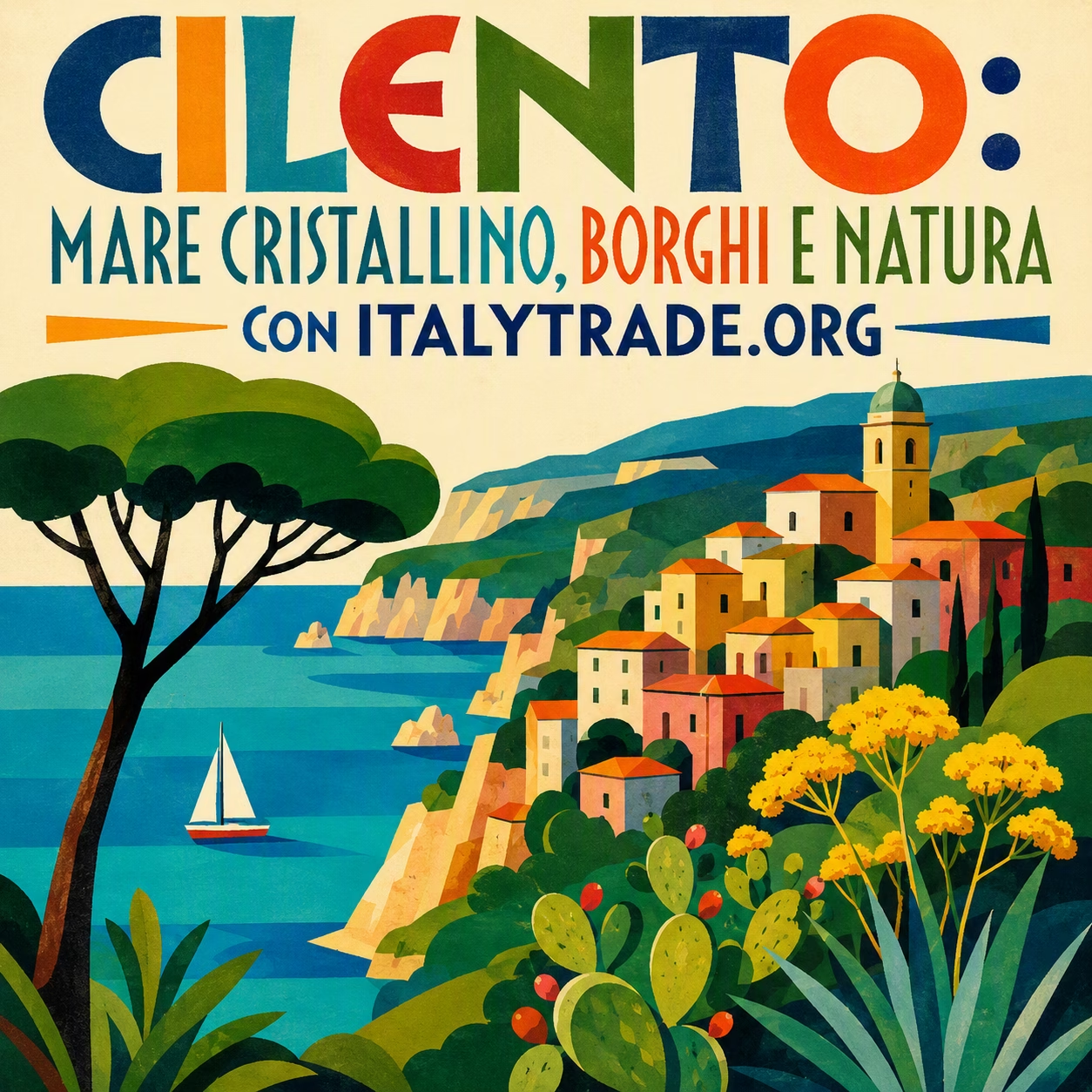
Cilento is a strip of coastline south of Salerno, where the Gulf of Salerno and the Gulf of Policastro frame a cultural landscape of outstanding value, continuously inhabited for 250,000 years: first by Neolithic farmers, then by Bronze and Iron Age communities, Etruscans, Greek colonists, Lucanians and Romans.
[source: unesco.it]
At its heart lies the Cilento, Vallo di Diano and Alburni National Park: Italy’s second-largest protected park, spanning 181,048 hectares from the Tyrrhenian coast up to the Alburni mountains and Mount Cervati, Campania’s highest peak.
[source: villamirella.it]
🏛️
1998
UNESCO World Heritage
🌳
181,048 ha
Park extension
🏺
3
UNESCO sites: Paestum, Velia, Padula Charterhouse
🍽️
Pioppi
Birthplace of the Mediterranean Diet
Uniqueness
Why Cilento is unique
🏛️ UNESCO World Heritage Site
The Cilento, Vallo di Diano and Alburni National Park was declared a UNESCO World Heritage Site in 1998, together with the archaeological sites of Paestum and Velia and the Charterhouse of San Lorenzo in Padula.
[source: cilentoediano.it]
🍅 The cradle of the Mediterranean Diet
The Mediterranean Diet, now a UNESCO Intangible Cultural Heritage, is deeply linked to Cilento: nutritionist Ancel Keys moved to Pioppi, a hamlet of Pollica, to study the relationship between diet and health.
[source: Girovagate]
🌍 UNESCO Biosphere Reserve and Geopark
In addition to the 1998 recognition, the area has been a UNESCO MAB Biosphere Reserve since 1997 and a UNESCO Global Geopark since 2010, thanks to its high biodiversity and numerous karst caves.
[source: unesco.it]
Places and sites
The wonders of Cilento
Capaccio Paestum
Temples of Paestum
The ancient Greek city of Poseidonia, founded at the end of the 7th century BC, is home to some of the best-preserved Doric temples in the world. [source]
Ascea
Velia Archaeological Park
Ancient Elea, a colony founded by the Phocaeans in the 6th century BC, birthplace of the philosophers Parmenides and Zeno of the Eleatic school. [source]
Padula
Charterhouse of San Lorenzo
One of the world’s most imposing Carthusian monastic complexes: construction began in 1306, with the current Baroque form dating to the 17th-18th centuries. Today it houses the Archaeological Museum of Western Lucania. [source]
Park territory
Lucanian settlements
The UNESCO site also includes the settlements of Moio della Civitella and Roccagloriosa, evidence of the pre-Roman Lucanian peoples. [source]
Castelcivita
Castelcivita Caves
A complex of karst caves carved into the rock of the Cilento mountains, among the most extensive and visitable in the park. [source: villamirella.it]
Morigerati
WWF Oasis of Morigerati
A nature reserve managed by WWF, a popular destination for nature excursions in the Cilento hinterland. [source: villamirella.it]
Centola
Capo Palinuro Caves
Sea caves that can be visited by boat along the Palinuro coast, one of the best-known natural attractions of coastal Cilento. [source: villamirella.it]
Endemic flora
Palinuro Primrose
The park counts over 1,800 recorded plant species; the rare, endemic Primula palinuri is the park’s symbolic flower. [source: villamirella.it]
Padula
Charterhouse of San Lorenzo
The 17th- and 18th-century Baroque transformations gave the monastery its current monumental form, among the largest in Europe. [source: Wikipedia/UNESCO]
Park territory
Baptistery of San Giovanni in Fonte
An early Christian baptistery built in the 4th century AD, one of the oldest testimonies of religious architecture in the area. [source: cilentoediano.it]
Province of Salerno
Castellabate
One of Italy’s most beautiful villages, a UNESCO World Heritage Site since 1998, made famous by the film “Benvenuti al Sud”. Its old town climbs up to the Belvedere di San Costabile, with views over Punta Licosa and, on clear days, Capri. [source: The Wom Travel]
Province of Salerno
Pisciotta
A hillside village overlooking the sea, famous for traditional “menaica” fishing (a Slow Food Presidium) and for the oil made from Pisciotta olives. [source: Nel Cilento]
Province of Salerno
Pollica
The symbolic capital of the Mediterranean Diet, linked to Ancel Keys’ studies in its hamlet of Pioppi. [source: Girovagate]
Province of Salerno
San Mauro Cilento
Split into the hamlets of Casal Sottano and Casal Soprano, known for its water mills and for producing olive oil and figs. [source: Amici in Vacanza]
Gastronomy
A culinary journey through Cilento’s flavours
Cilento cuisine is rooted in a frugal peasant tradition — “nothing goes to waste” — with influences from Magna Graecia, and forms the scientific basis of the Mediterranean Diet, now a UNESCO Intangible Cultural Heritage.
[source: Cilentiamoci]
🍝 Regional dishes not to miss
Cavatelli with ragù
Fresh pasta made only from water and flour, “hollowed” by hand: the signature dish of the Cilento Sunday lunch.
Felitto’s “fusilli al ferretto”
Egg pasta hand-rolled on a thin iron rod, a Slow Food Presidium from the Felitto area.
Cilento White Fig PDO
Brought by Greek colonists from Paestum and Velia in the 6th century BC; traditionally sun-dried on wooden sticks.
Mozzarella “co’ a mortedda”
Mozzarella wrapped in myrtle branches (“mortedda”) instead of being kept in brine.
Soppressata di Gioi
A lightly smoked cured sausage with a piece of lard at its core: the only larded salami in Campania.
Oil from Pisciotta olives
A pale golden colour, produced from the centuries-old olive groves of Pisciotta.
Sagra dei Sapori Tradizionali del Cilento — 23-25 July 2026
Held in Poderia (Celle di Bulgheria), now in its fourth edition, this festival celebrates traditional Cilento cuisine in the heart of the National Park, organised by the La Cilentana association.
[source: Eventi nel Cilento]
Mojoca — Moio della Civitella, August
An international street performers’ festival that fills the village with jugglers, acrobats and musicians, alongside a food area serving local specialities.
[source: Foodmakers.it]
⛪ Off-season celebrations
Cilento isn’t just a summer destination: during the Christmas season, Castellabate’s markets are among the most beautiful in Campania, while Roscigno Vecchia hosts living nativity scenes that turn the abandoned village’s lanes into scenes from another era.
[source: Nel Cilento]
Local excellence
Quality products of the territory
Among Cilento’s certified quality labels are the Cilento White Fig PDO, extra virgin olive oil from Pisciotta olives, Cilento “cacioricotta” cheese, and Mozzarella di Bufala Campana PDO, produced in the Paestum and Capaccio areas.
[source: Nel Cilento]
Villages and routes
Suggested routes between coast and hinterland
A first taste of Cilento needs 3-4 days: two spent on the coast, taking in Castellabate, Pisciotta and the archaeological sites of Paestum and Velia, and one or two exploring the hinterland and the Padula Charterhouse. With a full week you can also include the Vallo di Diano.
[source: Napolike]
🗺️ Short itinerary (3 days): Coast and Archaeology
Day 1: Temples of Paestum. Day 2: Castellabate and the Belvedere di San Costabile. Day 3: Pisciotta and the Velia Archaeological Park.
Planning
How many days, where to stay, when to go
⏱️ How to get there
Cilento can be reached by air via Salerno or Naples airports, connected to the various areas by regional trains and buses, more frequent in summer; by car, exit the A3 Salerno-Reggio Calabria motorway at Battipaglia or Sapri.
[source: GB Viaggi] ·
[source: Napolike]
🏨 Where to stay
Farmhouses (agriturismo)
Average cost around €120/night, with options from about €49/night in low season. [source: CaseVacanza.it]
Campsites and bungalows
Widespread along the coast, with prices starting at around €35/night for a bungalow. [source: CaseVacanza.it]
📅 Best time to visit
The recommended period is from May to September, for the mild climate and swimming. Autumn is ideal for hiking, food festivals and the grape harvest with fewer crowds; winter brings markets and living nativity scenes away from the crowds.
[source: Ruralis]
Destination wedding
Wedding venues in Cilento
The area offers historic residences, farmsteads and seafront villas for ceremonies and events. Among the real, active venues in Cilento: Tenuta Il Pilaccio, a 19th-century villa in Perdifumo overlooking the Punta Licosa marine reserve
[source: matrimoniocilento.it],
Palazzo Iaquinta, a 16th-century ducal residence in Cicerale
[source: palazzoiaquinta.it],
and Castello Vassallo in Stella Cilento
[source: castellovassallo.com].
Where to eat
Restaurants: the types found in Cilento
🐟 Seafood restaurants on the coast
Common in Pisciotta, Castellabate and Palinuro, offering local catch paired with the area’s oil and wine production.
🥗 Farmhouses with traditional cuisine
Many Cilento farmhouses (agriturismi) offer dining with zero-kilometre ingredients and dishes from peasant tradition.
Note: we were unable to verify reliable, specific price ranges for economy/gourmet restaurants, or for peak/off-peak season accommodation, in Cilento; these figures have been omitted rather than estimated, in line with the “do not invent” rule of the source template.
Detailed itinerary
3-day step-by-step itinerary
Day 1
Temples of Paestum
Visit ancient Poseidonia, founded at the end of the 7th century BC, home to some of the best-preserved Doric temples in the world.
Day 2
Castellabate
A UNESCO World Heritage old town, with the Belvedere di San Costabile offering views over Punta Licosa and, on clear days, Capri.
Day 3
Padula Charterhouse
One of the largest Carthusian monastic complexes in Europe, today home to the Archaeological Museum of Western Lucania.
The recommended period is from May to September, when the Mediterranean climate is milder; autumn is ideal for hiking, food festivals and the grape harvest with fewer crowds. Source: ruralis.com, nelcilento.com.
The National Park was declared a UNESCO World Heritage Site in 1998 for the archaeological sites of Paestum and Velia and the Padula Charterhouse, as well as for its exceptional biodiversity. Source: unesco.it.
The Mediterranean Diet, a UNESCO Intangible Cultural Heritage, is linked to the village of Pioppi, where nutritionist Ancel Keys carried out his studies. Source: cilentoediano.it, girovagate.com.
By air via Salerno or Naples airports, with regional train and bus connections; by car, exiting the A3 Salerno-Reggio Calabria motorway at Battipaglia or Sapri. Source: gbviaggi.it.
Conclusion
Embracing the authenticity of Cilento
Between Greek temples, Baroque charterhouses and villages overlooking a crystal-clear sea, Cilento packs three thousand years of Mediterranean history into just a few dozen kilometres.
A UNESCO heritage to be experienced slowly, just as its own ancient diet suggests.
Editorial transparency
Who wrote this article? On what basis?
📋 Transparency and Verifiability
Written by: Giuseppe Baldassarri — ItalyTrade.org. Evidence basis: Verified sources linked throughout the text (UNESCO, Trustpilot, specialised local portals on Cilento). Other viewpoints: Yes; several promotional figures from the original template (visitor statistics, seasonal pricing, company address) were removed because they could not be verified. Possible undisclosed interest: None declared. Independent editorial content.
From Rome to Venice, via Florence and Tuscany: a practical day-by-day
guide
Editorial note. This article only includes sections for
which a public source was found and verified.
📈 Trending today — 7-Day Italy Itinerary
Autumn is driving travel searches: grape harvests in Tuscany and Piedmont,
foliage and the Alba White Truffle Fair are boosting interest in road-trip
itineraries across Italy.
A 7-day Italy itinerary is the most realistic way to cross the country
without sacrificing its soul: from Rome to Venice, via Florence and the
Tuscan countryside, each stop tells a different chapter of the same
centuries-old story. There is no need for a complicated route: a handful
of well-connected cities by train or car, plus a pace that leaves room for
the unexpected, is what several travel guides dedicated to one-week tours
of the country recommend.
Spotahome guide — Touring Italy in 7 days
Geographically, Italy stretches over 1,200 km from the Alps to Sicily, but
a one-week itinerary works best when it focuses on a North-Central axis,
reducing travel time and increasing the actual time spent in each city:
Rome, Florence and Venice remain the most recommended stops for travelers
with only seven days available.
Visititaly.eu — Italy Express, the essential 7-day itinerary
📍
61
UNESCO sites in Italy (2026)
🌡️
14–24°C
Average autumn temperatures
🗣️
Italian
Official language
✈️
Rome · Milan
Main airport hubs
Culture and nature
An unmatched artistic heritage
Italy is the country with the highest number of World Heritage Sites in
the world: as of 2026 the Ministry of Culture's official count stands at
56 historic recognitions, a record no other nation holds.
Ministry of Culture — Italian UNESCO World Heritage Sites
According to Wikipedia's update based on UNESCO data, by 2026 the total
number of inscribed heritage sites rises to 62, of which 55 are cultural
and 6 natural: a mosaic ranging from the historic centers of Rome and
Florence to the Dolomites, from the Cinque Terre to the vineyard
landscapes of Piedmont and Tuscany.
Wikipedia — World Heritage Sites of Italy
Uniqueness
Why this itinerary works in 7 days
🏛️ The country with the most UNESCO sites in the world
From Rome to Venice, the itinerary's food changes radically: carbonara
in the capital, steak in Tuscany, sarde in saor in the Venetian lagoon.
Spotahome — Touring Italy in 7 days
🎭 Centuries-old traditions, still alive
Events such as the Palio di Siena, a horse race held twice a year in
Piazza del Campo since the Middle Ages, show how Italy's calendar is
still shaped today by authentic historic rituals.
Municipality of Siena — The Palio di Siena
Places and sites
The must-see stops of the itinerary
Lazio
Rome
The Colosseum, the Imperial Forums and the Palatine Hill make up
Italy's most visited archaeological park: the standard ticket
costs €18 and is valid for 24 hours.
Colosseo.it — Official opening hours and tickets
Tuscany
Florence
Tuscany's Renaissance heart revolves around Piazza del Duomo, the
Ponte Vecchio and the Uffizi Gallery, open Tuesday to Sunday from
8:15 am to 6:30 pm.
B-ticket — Official Uffizi ticket office
Veneto
Venice
Built on 118 small islands linked by 354 bridges and crossed by
177 canals, Venice is best explored on foot and by vaporetto along
the Grand Canal.
Venezia-tourism.com — Tourist information
Tuscany
Siena
The medieval center that hosts the Palio, the traditional horse
race run in Piazza del Campo on July 2 and August 16 every year.
Municipality of Siena — The Palio
Tuscany
Val d'Orcia and Chianti
Vine-covered hills between Siena and Montalcino, best visited in
September and October during the grape harvest, when the vineyards
turn red and gold.
Freedome — Where to go on holiday in Italy in 2026
Liguria
Cinque Terre
Five villages perched over the sea — Monterosso, Vernazza,
Corniglia, Manarola and Riomaggiore — linked by scenic trails
along the Ligurian coast.
Spotahome — Touring Italy in 7 days
Trentino-Alto Adige
The Dolomites
A UNESCO World Heritage Site since 2009, the Dolomites offer a
mountain alternative for those wishing to extend the itinerary
beyond the classic seven days.
Wikipedia — World Heritage Sites of Italy
Piedmont
Langhe and Roero
The hills of Piedmont, home to Barolo and Barbaresco wines, take
center stage in autumn with the hunt for the white truffle.
Freedome — Destinations for 2026
The symbol of the Serenissima overlooks Venice's most famous
square, an ideal starting point for exploring the city's six
sestieri (districts).
Venezia-tourism.com
Two of the five Cinque Terre villages, also reachable by train
along the Ligurian coast, ideal for a stop off the beaten path.
Spotahome — Touring Italy in 7 days
Marche
Gradara and the Conero Riviera
Castle villages and scenic coastline often suggested as a less
crowded alternative to Central Italy's better-known destinations.
Tripadvisor Italy Forum — Travel advice
Food and wine
A journey through Italian flavors
Each stop of the itinerary corresponds to a different cuisine: in Rome you
eat carbonara in the Trastevere neighborhood, moving north you shift to
Tuscan cuisine and finally to Venice's lagoon flavors.
Spotahome — Touring Italy in 7 days
🍝 Regional dishes not to miss
Carbonara
The quintessential Roman dish, best tasted in Trastevere during the
Rome stop.
Bistecca alla fiorentina
A signature cut of Tuscan cuisine, typical of trattorias in central
Florence.
Pici with truffle
Handmade pasta from Siena paired with truffle, also a star in the
Piedmontese Langhe.
Sarde in saor
A sweet-and-sour Venetian dish with sardines, onions and raisins,
typical of Venice's bacari.
Venetian cicchetti
Traditional small bites served in the bacari of the Cannaregio and
Castello districts.
Chianti DOCG
The red wine that symbolizes Tuscany, produced on the hills crossed
during the itinerary.
🍷 Wines along the route
The Chianti hills between Siena and Florence remain the most popular wine
destination on the central leg of the itinerary, while travelers extending
the trip toward Piedmont can pair the autumn stop with Barolo and
Barbaresco tastings in the Langhe.
Freedome — Where to go on holiday in Italy in 2026
Grape harvest in Tuscany and Piedmont — September-October
The grape-picking season makes the hills of Chianti and the Langhe
especially picturesque, with plenty of local food-and-wine events.
Freedome — Destinations for 2026
⛪ A calendar shaped by centuries-old rites
From the historic procession that precedes the Palio di Siena to the
religious celebrations tied to the Assumption on August 16, many of the
traditions encountered along a 7-day itinerary trace their roots back to
the Middle Ages and are still managed directly by local communities.
Municipality of Siena — The Palio di Siena
Art and architecture
Art and architecture: the masterpieces not to miss
The Uffizi hold the world's largest collection of Botticelli and Raphael
works, alongside masterpieces by Giotto, Titian, Leonardo da Vinci and
Caravaggio, inherited from the Medici family's private collection.
Toscana.info — Uffizi Gallery, works and information
In Rome, the Colosseum Archaeological Park combines the Colosseum, the
Roman Forum and the Palatine Hill into a single route: ticket sales open
30 days before the visit, and online booking is recommended to avoid
queues.
Colosseo.it — Opening hours and tickets
Everyday life
The charm of the Italian lifestyle
Strolling through Trastevere in Rome, crossing the Ponte Vecchio in
Florence, or getting lost among Venice's calli means stepping into a pace
of life made of piazzas, markets and coffee stops that remains the true
added value of a one-week itinerary.
Agoda — 7 days of Italian indulgence
In Venice, local life is inseparable from the lagoon: the city is
organized into six sestieri — Cannaregio, Castello, Dorsoduro, Santa
Croce, San Marco and San Polo — and is lived mainly on foot or by water.
Venezia-tourism.com — Tourist information
Villages and routes
Villages and alternative itineraries
Travelers wanting to vary the classic Rome-Florence-Venice axis can turn
the itinerary south, alternating Rome, Naples and the Amalfi Coast, or
toward Piedmont in autumn to combine the Langhe hills with the White
Truffle Fair.
Spotahome — Touring Italy in 7 days
🗺️ Short itinerary (7 days): Rome – Florence – Venice
Days 1-2: Rome. Days 3-4: Florence and
Siena. Days 5-6: Venice. Day 7: Verona
day trip and departure.
By adding a few days, the route can be extended from Milan all the way
to Naples and the Amalfi Coast, a route often suggested by travel guides
as a complete North-South alternative.
Spotahome — Touring Italy in 7 days
In the historic centers of Rome, Florence and Venice, mid- to high-range
hotels remain the most practical option for travelers with limited time
who want to walk between the main attractions.
Apartments and holiday homes
A recommended option for families or multi-night stays in the same city,
often cheaper than a hotel in central areas.
Agriturismo (farm stays)
Ideal for the Tuscany leg, between Siena and San Gimignano, to
experience the Chianti hills described by travel guides.
Spotahome — Touring Italy in 7 days
Campsites and glamping
A more budget-friendly alternative for independent travelers, common
along the coast and in the hilly areas of Central Italy.
📅 Best time to go
The best time for a 7-day itinerary runs from late April to early June, or
from mid-September to mid-October, when the weather is mild, crowds are
thinner, and temperatures stay between 14°C and 24°C.
iRoamly — Best time to visit Italy
Local excellence
Made in Italy excellence along the route
Alba's white truffle, Tuscan Chianti DOCG and the wines of Langhe and
Roero are among the most representative products encountered right along
this itinerary, with the Alba fair drawing over 600,000 visitors every
year across the Langhe, Monferrato and Roero.
Sapori News — Alba International White Truffle Fair 2026
Destination wedding
Dream wedding locations along the itinerary
Tuscan villas between Siena and Florence, and historic Venetian palaces,
are among the most sought-after locations for international weddings in
Italy, thanks to a combination of landscape, art and hospitality services
now well established in the luxury travel sector.
Discover ItalyTrade's luxury wedding services.
Real estate
Luxury real estate along the itinerary
The areas covered by this itinerary — from the historic center of Florence
to the Chianti hills, all the way to the historic palaces of Venice —
remain among Italy's most sought-after luxury real estate markets for
international investors.
Learn more about the luxury real estate market.
Prices and budget
Accommodation prices: low and high season
🌧️ Low season (January-March, November)
€100–350
Double room in a 3-4 star hotel in the historic centers of Rome,
Florence or Venice.
☀️ High season (June-August, December)
€350–1000
Same accommodation types, with rates in historic centers that can
exceed €1,000 a night for luxury options.
🍽️ Budget restaurant
€100–200
Dinner for two at a traditional trattoria, wine included.
🦞 Gourmet restaurant
€200–1000
Tasting menu at a Michelin-starred restaurant in Rome, Florence or
Venice, wine pairing included.
Where to eat
Where to eat along the itinerary
🍝 Traditional trattoria
In Rome's Trastevere, this is the most recommended option for tasting
authentic carbonara in an informal setting.
Spotahome — Touring Italy in 7 days
🍷 Wine bar with kitchen
Common between Siena and the Chianti hills, pairing local wine tastings
with traditional Tuscan country dishes.
🥗 Agriturismo
In Tuscany, this lets you eat farm-to-table produce directly on the
estate where you are staying.
🍢 Venetian bacaro
In Venice, bacari serve cicchetti and small glasses of wine standing up
— a local habit not to miss in the Cannaregio and Castello districts.
Visitor analysis
Who visits Italy?
In the fourth quarter of 2025, foreign visitors accounted for 56.5% of
total overnight stays in Italy, up 5.1% year-on-year, while overnight
stays by Italian tourists remained broadly stable.
Confcommercio — Tourism in Italy, Q4 2025 (Istat data)
56.5% Overnight stays by foreign tourists
43.5% Overnight stays by Italian tourists
Source: Istat, Movement of clients in accommodation facilities, Q4 2025.
Full source
According to Bank of Italy data, the inbound tourism flow is fed by both
European and non-European travelers: Germany and Spain remain the leading
countries of origin, while arrivals from the Gulf states and the Far East
are growing rapidly.
Businessonline — Official Bank of Italy data on tourism in Italy,
2025
July is confirmed as the peak month for foreign tourist arrivals, with
42.7 million overnight stays recorded in summer 2025, while Italians
continue to prefer August for their own holidays.
Valigiamo — Summer 2025, Istat data on tourism in Italy
Detailed itinerary
7-day itinerary, day by day
Days 1-2
Rome
Colosseum, Roman Forum and Palatine Hill in the morning with a
pre-booked ticket; in the afternoon, the Trevi Fountain, the Pantheon
and dinner in Trastevere.
The most recommended axis is Rome-Florence-Venice, with an optional
stop in Siena or Verona.
Source: Visititaly.eu
Late April to early June, or mid-September to mid-October, when
temperatures stay between 14°C and 24°C and crowds are thinner.
Source: iRoamly
The standard 24-hour ticket for the Colosseum, Roman Forum and
Palatine Hill costs €18, with mandatory booking of the entry time
slot.
Source: Colosseo.it
Yes: the Uffizi Gallery is among the most visited museums in the
world, and booking online significantly cuts down waiting times at
the ticket office.
Source: B-ticket, official Uffizi ticket office
As of 2026, Italy holds the highest number of UNESCO sites in the
world, between 56 and 62 depending on the source and counting
method.
Source: Ministry of Culture
Yes, the City of Venice applies an Access Contribution for day
visitors on certain dates; up-to-date information is published on
the city's official portal.
Source: City of Venice
In 2024, Italy recorded a record 65 million visitors, while in Q4
2025 foreigners generated 56.5% of total overnight stays.
Source: Confcommercio/Istat
Yes: travelers visiting between October and December can extend the
route to Piedmont for the Alba International White Truffle Fair,
running from October 10 to December 6, 2026.
Source: Piemonte Expo
Conclusion
Seven days to fall in love with Italy
A well-built 7-day Italy itinerary doesn't aim to see everything, but to
leave time to truly experience every stop: the history of Rome, the
Renaissance of Florence, the Tuscan hills and the canals of Venice
together tell an identity no other destination can replicate.
Whether you choose spring, with its soft colors, or autumn, with the grape
harvest and the Truffle Fair, the result is the same: a trip capable of
staying with you long after the week on the road is over.
Italy isn't just visited: it's lived, one day at a time.
Chianti, Val d'Orcia, Langhe, Roero, Monferrato, Val di Noto, Tuscia,
Valle d'Itria, Lunigiana, Garfagnana, Casentino, Mugello, Valdichiana,
Valle Umbra, Valnerina, Murge, Sila, Aspromonte, Barbagia, Gallura,
Ogliastra, Sulcis-Iglesiente, Carnia, Brianza, Oltrepò Pavese,
Franciacorta, Colli Euganei, Sibillini Mountains.
🏛️ Top Italian Tourism Municipalities
Here is the single list featuring the 100 Italian municipalities
consistently at the top for overall tourist arrivals and overnight stays.
The order reflects official Istat data from consolidated surveys on
overnight stays in accommodation facilities (hotels, campsites, and
extra-hotel accommodations).
Roma (Lazio), Milano (Lombardia), Venezia (Veneto), Firenze (Toscana),
Rimini (Emilia-Romagna), Cavallino-Treporti (Veneto), San Michele al
Tagliamento / Bibione (Veneto), Jesolo (Veneto), Caorle (Veneto), Bologna
(Emilia-Romagna), Lazise (Veneto), Napoli (Campania), Lignano Sabbiadoro
(Friuli-Venezia Giulia), Riccione (Emilia-Romagna), Torino (Piemonte),
Verona (Veneto), Cervia (Emilia-Romagna), Cesenatico (Emilia-Romagna),
Sorrento (Campania), Peschiera del Garda (Veneto), Bardolino (Veneto),
Ravenna (Emilia-Romagna), Gatteo (Emilia-Romagna), Bellaria-Igea Marina
(Emilia-Romagna), Castelrotto / Kastelruth (Trentino-Alto Adige), Riva del
Garda (Trentino-Alto Adige), Pisa (Toscana), Sirmione (Lombardia),
Malcesine (Veneto), Comacchio (Emilia-Romagna), Genova (Liguria), Padova
(Veneto), Limone sul Garda (Lombardia), Cattolica (Emilia-Romagna), Selva
di Val Gardena (Trentino-Alto Adige), Desenzano del Garda (Lombardia),
Vieste (Puglia), Assisi (Umbria), Garda (Veneto), Montecatini Terme
(Toscana), Abano Terme (Veneto), Grado (Friuli-Venezia Giulia), Palermo
(Sicilia), Arzachena / Costa Smeralda (Sardegna), Orbetello (Toscana), San
Vincenzo (Toscana), Castiglione della Pescaia (Toscana), Livigno
(Lombardia), Badia (Trentino-Alto Adige), Corvara in Badia (Trentino-Alto
Adige), Chioggia (Veneto), Alghero (Sardegna), Olbia (Sardegna), Taormina
(Sicilia), Lucca (Toscana), Siena (Toscana), Siracusa (Sicilia), Catania
(Sicilia), Bari (Puglia), Lecce (Puglia), Otranto (Puglia), Gallipoli
(Puglia), Ugento (Puglia), Matera (Basilicata), Cortina d'Ampezzo
(Veneto), San Vito Lo Capo (Sicilia), Cefalù (Sicilia), Villasimius
(Sardegna), Sanremo (Liguria), Finale Ligure (Liguria), Trieste
(Friuli-Venezia Giulia), Trento (Trentino-Alto Adige), Bolzano
(Trentino-Alto Adige), Bergamo (Lombardia), Brescia (Lombardia), Como
(Lombardia), Stresa (Piemonte), Baveno (Piemonte), Misano Adriatico
(Emilia-Romagna), Eraclea (Veneto), Arco (Trentino-Alto Adige),
Nago-Torbole (Trentino-Alto Adige), Andalo (Trentino-Alto Adige), Canazei
(Trentino-Alto Adige), Campitello di Fassa (Trentino-Alto Adige), Marebbe
/ Enneberg (Trentino-Alto Adige), Valdaora / Olang (Trentino-Alto Adige),
Pinzolo / Madonna di Campiglio (Trentino-Alto Adige), Bormio (Lombardia),
Courmayeur (Valle d'Aosta), Ayas (Valle d'Aosta), Molveno (Trentino-Alto
Adige), Mezzana (Trentino-Alto Adige), Dobbiaco / Toblach (Trentino-Alto
Adige), Sesto / Sexten (Trentino-Alto Adige), San Candido / Innichen
(Trentino-Alto Adige), Positano (Campania), Amalfi (Campania), Ischia
(Campania), Perugia (Umbria)
Top Destinations in Italy: A Comprehensive Guide By Giuseppe Baldassarri ✓ Sales & Account Manager – Destination &
Export Marketing in Italy Italy’s Best Things to Do – Discover Italy’s Essence
Editorial transparency
Who wrote this article? Based on what?
📋 Transparency and Verifiability
Written by: Giuseppe Baldassarri — ItalyTrade.org. Based on which evidence: Official, verified sources
linked throughout the text (Ministry of Culture, Istat, Bank of Italy,
Municipality of Siena, City of Venice, Colosseo.it, Uffizi B-ticket,
Piemonte Expo). Are there other viewpoints: Yes, noted where relevant
(e.g. the exact number of UNESCO sites, which ranges from 56 to 62
depending on the source). Possible undisclosed interest: None. Independent
editorial content.