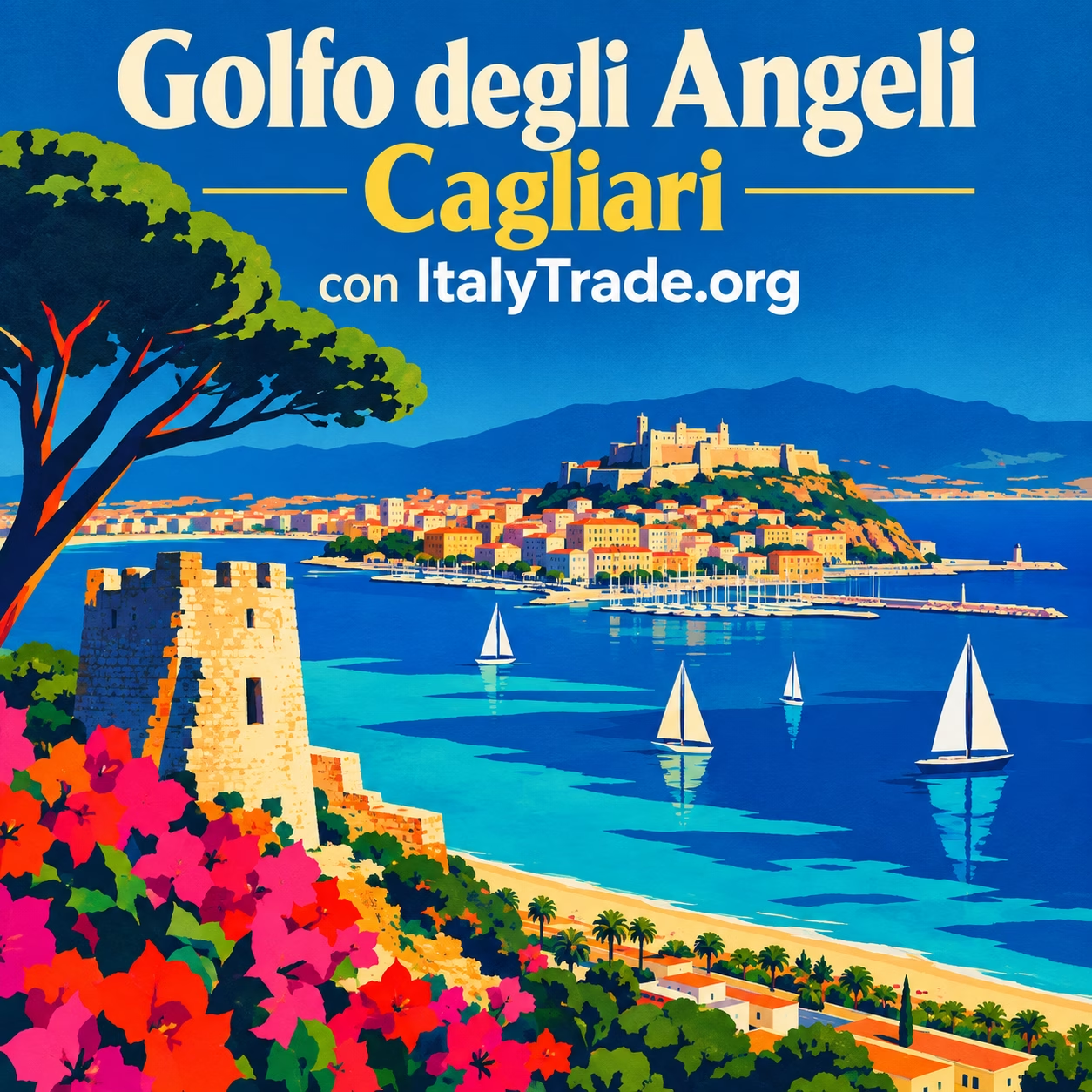
Gulf of Angels — Cagliari
Southern Sardinia, regional capital, between the Castello district and Poetto beach
The gulf that embraces Cagliari
The Gulf of Angels — also known as the Gulf of Cagliari — is the large bay in southern Sardinia that opens onto the Tyrrhenian Sea, enclosed between Cape Carbonara to the east and Capo Spartivento to the west, with a coastline that is partly sandy and partly rocky.
Source: Wikipedia — Golfo di Cagliari
At the centre of the gulf sits Cagliari, the capital of Sardinia: a city where history and sea coexist naturally, its historic centre carrying traces of different eras — medieval districts, churches, panoramic bastions — while within a few kilometres you move from the lanes of Castello to Poetto beach and the wetlands of Molentargius Park.
Source: FAITA Sardegna — Cagliari between history and sea
Data sources: Travel365 — Cagliari climate · Cosa vedere a Cagliari
A city fought over by Phoenicians, Romans, Pisans and Spaniards
Cagliari, known locally as “Casteddu”, has ancient origins: it was founded by the Phoenicians and conquered by the Carthaginians, later becoming the capital of the Roman province of Sardinia et Corsica and, still later, of the Kingdom of Sardinia (1324–1720 and 1798–1814), long contested between Pisa and Spain.
Source: Lantana Resort — Top places to visit in Cagliari
The historic centre still reflects the layout the Pisans gave the city in the 13th century: around the fortified Castello district, reserved for the nobility, grew the working-class districts of Marina, Stampace and Villanova, each with its own character — in Villanova, for instance, the streets have always been filled with flowers and plants.
Source: Cosa vedere a Cagliari — Altervista
Why the Gulf of Angels is one of a kind
🏰 A medieval quarter suspended over the sea
The Castello district, founded in the 13th century by the Pisans, offers spectacular views and lets visitors breathe the atmosphere of another era among its lanes, towers and bastions.
Source: Cosa vedere a Cagliari
🦩 Pink flamingos in the heart of the city
In Cagliari, pink flamingos have nested directly inside Molentargius Park since 1993, an almost unique case worldwide: a notoriously shy bird choosing a heavily urbanised wetland to breed, attracting thousands of specimens from Africa and the rest of Europe every year.
Source: FAI — Molentargius Nature Park
⛪ A centuries-old devotion: the Feast of Sant’Efisio
Since 1652, Cagliari has renewed every year the solemn vow made to its patron saint after an outbreak of plague, with a procession that from 1 to 4 May crosses the city and reaches the beach of Nora.
Source: L’Unione Sarda — Feast of Sant’Efisio
The wonders of the Gulf of Angels
Bastion of Saint Remy
The Umberto I Terrace, built into the old city walls, is one of the finest viewpoints in the city: the view takes in the harbour, Molentargius Park and the Gulf of Angels.
Source: Portale Sardegna
Elephant Tower and Saint Pancras Tower
Two medieval Pisan towers that once guarded access to the fortified city, today among Cagliari’s most photographed landmarks.
Source: Traghetti.com — What to see in Cagliari
Cathedral of Santa Maria
One of Sardinia’s most important churches, with baroque decoration, valuable artworks and an evocative crypt.
Source: Sardegnatoujours — Guide to Cagliari
Basilica of Our Lady of Bonaria
Sardinia’s most important Catholic shrine, overlooking the harbour from the Bonaria hill.
Source: Sardegnatoujours — Guide to Cagliari
Poetto Beach
Cagliari’s best-known beach, stretching along the eastern shoreline beneath the profile of the Devil’s Saddle: a promenade loved by locals and a link between the city, the headland and Molentargius.
Source: FAITA Sardegna
Molentargius-Saline Park
About 1,600 hectares across Cagliari, Quartu Sant’Elena, Selargius and Quartucciu: former salt pans in operation until 1985, today one of Europe’s most important wetlands, listed under the Ramsar Convention since 1977 and a regional park since 1999.
Source: Sardegna Turismo — Molentargius
Devil’s Saddle (Sella del Diavolo)
The headland that dominates the Gulf of Angels: a short 30–40 minute walk leads to the top for a spectacular view over the city and the sea.
Source: Traghetti.com
Cittadella dei Musei
Built on the site of the old Royal Arsenal, it houses four museums in one complex, including the National Archaeological Museum — essential for the Nuragic civilisation — and the National Picture Gallery.
Source: Free Tours Cagliari
National Archaeological Museum
Sardinia’s most important museum, with artefacts tracing the island’s history from prehistory through the Roman age.
Source: Sardegnatoujours
Nora
Sardinia’s first Phoenician city (8th century BC), later Punic and Roman: the site, which re-emerged after a storm in the late 19th century, includes thermal baths, a well-preserved Roman theatre and a golden beach right next to the ruins.
Source: VisitItaly — Archaeological area of Nora
Villasimius and Capo Carbonara
A Marine Protected Area since 1999, among the richest stretches of coast in Sardinia in terms of ecosystem variety: it includes the Isola dei Cavoli and Isola di Serpentara, a popular diving destination.
Source: Italy Traveller — South coast of Sardinia
The flavours of the gulf: between the sea and the Campidano plain
Cagliari’s cuisine reflects Sardinia’s double soul: the agro-pastoral tradition of the inland areas and the maritime tradition of the coast, built on simple ingredients and bold flavours passed down through generations.
Source: Eroica Fenice — Typical dishes of Sardinia
Malloreddus alla campidanese
Sardinia’s best-known gnocchi-shaped pasta, typical of the Campidano plain, served with sausage ragù and pecorino cheese.
Source: Eroica Fenice
Culurgiones
Hand-sealed dumplings from Ogliastra filled with potato, pecorino and fresh mint, closed in a distinctive wheat-ear shape.
Source: WeRoad
Fregola with clams
Toasted semolina pasta pearls served in a light clam broth: Sardinia’s answer to couscous.
Source: Do Eat Better Experience
Bottarga
Dried, salted mullet roe, typical above all of the Cabras area, used to season pasta and starters.
Source: WeRoad
Porceddu
Roast suckling pig flavoured with myrtle leaves, the signature dish of Sardinian celebrations.
Source: Panorama
Seadas
Fried pastry filled with fresh sheep’s cheese and drizzled with honey: the sweet finish to a Sardinian meal.
Source: Do Eat Better Experience
🍷 Cannonau and Vermentino
No Sardinian meal is complete without a glass of Cannonau, the island’s robust native red wine, or a glass of Vermentino; tradition calls for finishing the meal with a myrtle liqueur.
Source: Do Eat Better Experience — Things to do in Cagliari
The Feast of Sant’Efisio: a vow renewed for over 370 years
In 1652, plague ravaged Cagliari. The city’s authorities made a solemn vow to Sant’Efisio, a Roman soldier martyred for his faith: ever since, every 1 May, the city carries the saint’s statue in procession from the Stampace district to the beach of Nora, where he was martyred, before bringing it back on 4 May.
Source: Meer — Feast of Sant’Efisio
🐂 The traccas and traditional costumes
The procession opens with the traccas, ox-drawn carts from the Campidano decorated with flowers and produce; thousands of the faithful follow in traditional Sardinian dress, along with groups of horsemen and launeddas players. In the 2025 edition, 2,600 people paraded in costume, together with 32 groups of horsemen riding 162 horses and 17 traccas.
Source: Espansione TV — ANSA
Beyond Cagliari: Pula, Nora and Villasimius
About 35–40 minutes by car from Cagliari, along the SS195, lies Pula, a lively coastal town of around 7,000 residents with golden beaches, pine forests and inland hiking trails, and the gateway to the archaeological site of Nora.
Source: Monumenti Aperti — Pula
The archaeological site of Nora, on the Capo di Pula headland, is open year-round (9am–8pm in summer) with an entry ticket of about €8, guided tour included; it can be reached by car in around 40 minutes from Cagliari, or by bus from the ARST station in Piazza Matteotti.
Source: The Wom Travel — Nora, practical info
🗺️ One-day itinerary: Cagliari + Nora
Morning: the Castello district and the Bastion of Saint Remy. Lunch: in the historic centre. Afternoon: drive to Pula (35–40 minutes) and visit the archaeological site of Nora, finishing with a swim on the beach next to the ruins.
Source: The Wom Travel
Molentargius Park and the gulf’s flamingos
The Molentargius-Saline Regional Nature Park, established by regional law in 1999, comprises two freshwater basins (Perdalonga and Bellarosa Minore) and one saltwater basin (Bellarosa Maggiore), facing the Gulf of Angels and bordered by the built-up areas of Cagliari, Quartu Sant’Elena, Quartucciu and Selargius.
Source: Sardegna Turismo
Until 1985 the area was used for salt extraction; today it hosts a large colony of pink flamingos, whose first nesting within the city dates back to 1993 — a genuinely rare case of this shy bird choosing an urban wetland to breed. The park can be explored on foot, by bike, or on guided tours by electric bus or boat.
Source: Italian Ministry of Culture
When to go and how long to spend around the gulf
📅 Climate and best time to visit
Cagliari has a Mediterranean climate with mild winters (around 10°C) that are fairly rainy (up to 8 rainy days a month between November and February) and hot, sunny summers, with average temperatures of 24–25°C in July and August; the best time for the beach runs from late May to September, while spring and autumn remain pleasant for sightseeing with fewer crowds.
Source: Travel365 — When to go to Cagliari
July and August remain the busiest months with the highest prices; travellers wanting to avoid the crowds may prefer April, May and June, when the weather is already mild and rates are lower.
Source: EasyJet — When to go to Cagliari
Sardinian cooking in Cagliari
🍝 Trattoria Lillicu (fregola with clams)
A historic, noisy trattoria where marble tables are shared with strangers: here the fregola with clams is served in a light clam broth rather than a tomato sauce — an authentic Cagliari experience more than a quiet dinner.
Source: Do Eat Better Experience
🐷 Sa Domu Sarda (inland cooking)
On via Sassari, simple dining rooms with local decoration and evocatively named dishes: snails in tomato sauce, meatballs of Sardinian red beef, malloreddus, culurgiones and fregula, and seadas for dessert.
Source: Michelin Guide — Sa Domu Sarda
3 days around the Gulf of Angels
Castello, the Bastion of Saint Remy, the Cathedral
Stroll through the medieval Castello district, climb to the Bastion of Saint Remy for the view over the gulf, visit the Cathedral of Santa Maria; in the afternoon, the Marina district for a sunset drink by the sea.
Source: Traghetti.com
Poetto and Molentargius Park
A morning of relaxation on Poetto beach, easily reached by bike or bus in about 10 minutes from the city centre; in the afternoon, visit Molentargius Park to see the pink flamingos, on foot or by bike.
Source: FAITA Sardegna
Pula and the archaeological area of Nora
Drive to Pula (about 40 minutes from Cagliari) and visit the ancient Phoenician-Punic-Roman city of Nora, finishing with a swim on the beach next to the site.
Source: The Wom Travel
FAQ — Gulf of Angels, Cagliari
It is the name given to the large bay of Cagliari (Golfu de Casteddu in Sardinian), enclosed between Cape Carbonara to the east and Capo Spartivento to the west, on the Tyrrhenian Sea.
Source: Wikipedia — Golfo di Cagliari
Poetto, which stretches along the city’s eastern shoreline beneath the Devil’s Saddle and can be reached from the centre in about 10 minutes by bike or bus.
Source: FAITA Sardegna
In the Molentargius-Saline Regional Nature Park, where the colony has nested within the city since 1993, a phenomenon unique in the world for this species.
Source: FAI
From 1 to 4 May each year, with the grand procession travelling from Stampace to the beach of Nora, where the saint was martyred.
Source: Meer
About 35–40 km, roughly 40 minutes by car along the SS195 towards Pula, or about an hour by bus from the ARST station in Piazza Matteotti.
Source: The Wom Travel
From late May to September for the beach; spring and autumn remain pleasant (mild climate, fewer crowds) for exploring the historic centre.
Source: Travel365
One gulf, a thousand faces
The Gulf of Angels packs a rare diversity into a few kilometres: the medieval walls of Castello, the beach life of Poetto, the flamingos of Molentargius and the Phoenician ruins of Nora, in a landscape that keeps changing while always staying close to the sea.
Source: FAITA Sardegna
Cagliari isn’t just visited — it’s crossed, breathing in history at every street corner and the sea at every turn.
Who wrote this article? On what basis?
📋 Transparency and verifiability
Written by: Giuseppe Baldassarri — ItalyTrade.org.
Evidence base: every paragraph links to the verified source in the text; sections of the original template with no verifiable source (visitor statistics, provenance percentages, “trending” hashtags, exact accommodation/restaurant prices, real-estate and wedding offers, Trustpilot rating) have been left out of this version because they could not be confirmed against a public source.
Other viewpoints: included where relevant.
Possible hidden interest: none. Independent editorial content.
Giuseppe Baldassarri
Sales & Account Manager – Destination & Export Marketing
Travel Designer | Destination Marketing | Made in Italy
Website: ItalyTrade.org — Travel & Business | Italy: Made in Italy
“Turning Italian excellence into global visibility in the age of artificial intelligence”