
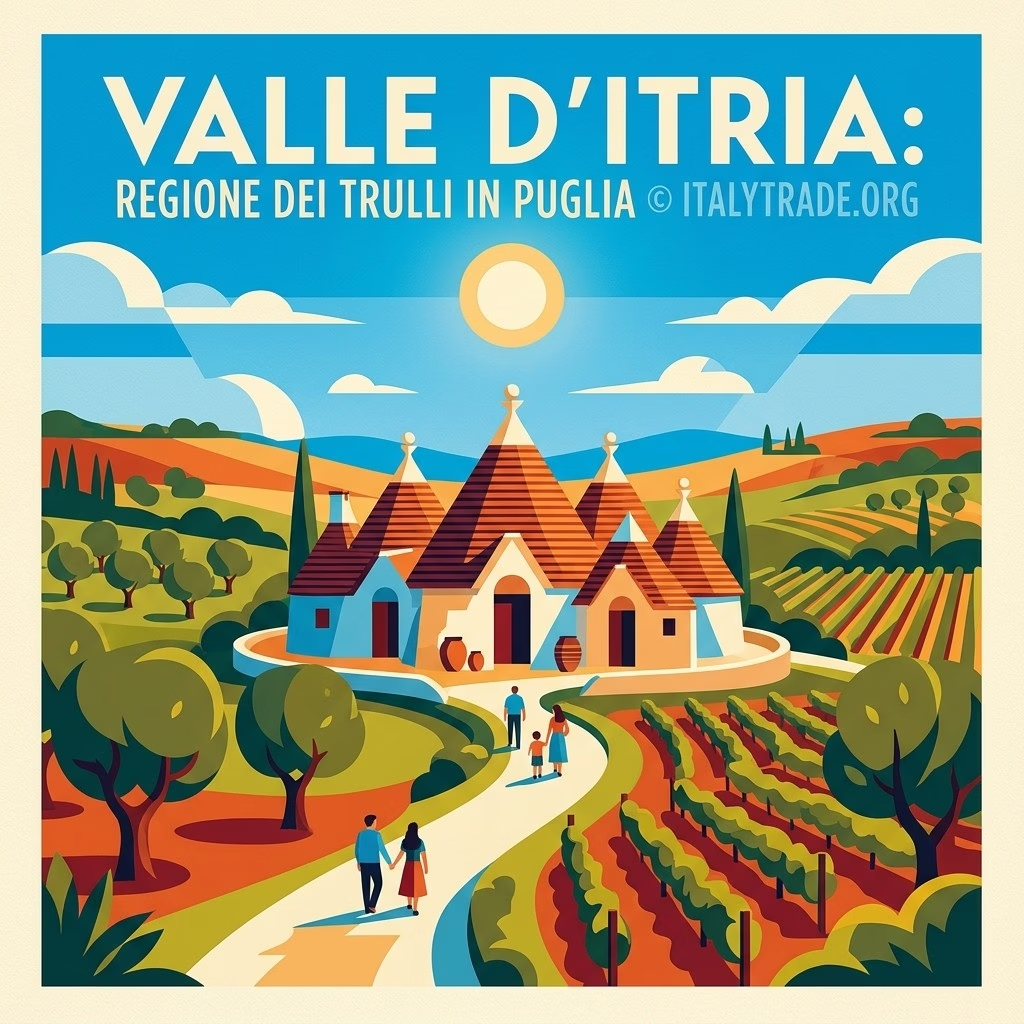
Itria Valley: the trulli region of Puglia
Across the provinces of Bari, Brindisi and Taranto: 14 municipalities, trulli and white hill towns
The Valley of the Trulli, in the heart of Puglia
The Itria Valley (Valle d’Itria), also known as the Valley of the Trulli, stretches across the provinces of Bari, Brindisi and Taranto. It includes 14 municipalities, among them Alberobello, Cisternino, Locorotondo, Martina Franca and Ostuni.
This Puglia travel guide gathers, topic by topic, information checked against official sources and links each one to the original page. If you are planning a wider trip, also explore our articles on Apulia, Salento and the Gargano.
Source: Italia.it, Valle d’Itria (in Italian) · Source: UNESCO World Heritage Centre
A karst depression between olive groves and vineyards
Despite its name, the Itria Valley is not a true mountain valley: it is a karst depression that forms the lower part of the Murgia upland. The name probably comes from the cult of the Madonna Odegitria, patron of travelers, spread by the Basilian monks.
The land is dotted with olive groves, which produce olive oil, and with vineyards that make high-quality white wines, including Locorotondo DOC and Martina Franca DOC. Trulli, round stone farmhouses with conical roofs, are the most recognizable mark of this landscape.
Why the Itria Valley is unique
🏛️ UNESCO World Heritage
The trulli of Alberobello are a UNESCO World Heritage Site. The property covers 11 hectares divided into six parcels and includes more than 1,600 original buildings, of which 1,030 are in the Rione Monti and 590 in the Rione Aia Piccola.
🧱 Dry-stone construction
According to UNESCO, trulli are built of limestone without mortar, using a prehistoric technique still in use: the pyramidal, domed or conical roofs are made of overlapping stone slabs.
🍊 Orange Flags
Alberobello and Locorotondo hold the Touring Club Italiano Orange Flag (Bandiera Arancione), and so does Cisternino.
Source: UNESCO World Heritage Centre · Source: Italia.it, Alberobello (in Italian) · Source: Italia.it, Locorotondo (in Italian) · Source: Italia.it, Cisternino (in Italian)
The towns of the Itria Valley and what surrounds them
Alberobello
The Trullo Sovrano is the largest in town: the only two-storey one, with a 14-metre dome surrounded by 12 other cones. From the Belvedere of Santa Lucia you can see the little white houses with grey roofs.
Locorotondo
The name comes from the circular shape of the village. Local features include the cummerse, small white masonry houses with steep pitched roofs, and the via Nardelli viewpoint over the valley.
Martina Franca
The most populous municipality in the valley. Its old town is Baroque, with the Ducal Palace, the Basilica of San Martino and the semicircular Piazza Maria Immacolata.
Cisternino
A white old town of alleys, hidden courtyards and small arches. Piazza Garibaldi has a belvedere over the Itria Valley. It is called the gastronomic capital of the valley.
Ostuni
The “White City” is the only town in the valley with access to the sea. Its old town, La Terra, has lime-washed houses and a late 15th-century cathedral in Gothic forms.
Source: Italia.it, Valle d’Itria (in Italian) · Source: Italia.it, Alberobello (in Italian) · Source: Italia.it, Locorotondo (in Italian) · Source: Italia.it, Martina Franca (in Italian) · Source: Italia.it, Cisternino (in Italian) · Source: Italia.it, Ostuni (in Italian)
Castellana Caves
Open all year and visited with guides. The route includes the Grave and the Grotta Bianca.
Selva di Fasano and Zoosafari
The Selva di Fasano, up in the hills, is suggested as an escape from the summer heat. Fasano also has the Egnazia excavations and the Zoosafari, with over 40 animal species.
The coast of Ostuni
Less than 10 km from the center are Marina di Ostuni, the Villanova harbor and the seaside and spa resort of Torre Canne.
Source: Italia.it, Valle d’Itria (in Italian) · Source: Italia.it, Ostuni (in Italian) · Source: Visititaly, Valle d’Itria (in Italian)
Itria Valley food and wine: butcher grills, orecchiette and sweets
In Cisternino the signature dish is meat cooked at the fornelli pronti: grills next to butcher shops where freshly bought meat is roasted. They are almost always in view, so you can watch the cooking while waiting with a glass of wine.
🍝 Dishes and specialties not to miss
Bombette
Pork rolls usually filled with canestrato cheese, salt and pepper.
Gnumeredd
Grilled skewers of lamb offal.
Orecchiette
Handmade from durum wheat semolina and water; in Cisternino they are the stars of a festival in August.
Friselle
Often dressed with extra virgin olive oil.
Fava bean purée
Fava beans are used to make a purée, a typical side dish.
Sporcamussi
A pastry with powdered sugar and cream, a specialty of Bari and the Itria Valley.
For more on Italian life and flavors, browse the Experience Italy category.
Source: Touring Club Italiano, Cisternino (in Italian) · Source: Italia.it, Valle d’Itria (in Italian)
Traditions and events in the Itria Valley
🎉 Calendar of events
Valle d’Itria Festival — July
The opera festival is based in Martina Franca. Founded in 1975 by a group of music lovers led by Alessandro Caroli, its first president, it is promoted by the Fondazione Paolo Grassi. The 2026 edition, the 52nd, ran from 14 July to 2 August.
Orecchiette festival in Cisternino — August
Handmade orecchiette are the stars of a festival held in August.
Bacco nelle gnostre in Noci — autumn
According to Visititaly, in Noci the “Bacco nelle gnostre” festival, dedicated to new wines, takes place among the alleys of the medieval old town known as “gnostre”.
⛪ Christmas and Easter in Alberobello
Alberobello hosts the Living Nativity (Presepe Vivente) in December and the Living Passion (Passione vivente) on Good Friday. Visititaly also mentions the Alberobello Light Christmas, usually from 7 December to 31 January, with lights and decorations among the trulli. For more events, see the Festivals in Italy category.
Source: Italia.it, Valle d’Itria (in Italian) · Source: Visititaly (in Italian)
Trulli, Baroque and white stone
For UNESCO, the Alberobello site is an outstanding example of vernacular architecture and of a human settlement that largely preserves its original form; it also illustrates the long use of dry-stone construction, a technique with thousands of years of history in the Mediterranean. The Rione Monti grew from 1620, when Count Gian Girolamo Guercio had an oven, a mill and an inn built there.
A few kilometers away the language changes: Martina Franca is dominated by the Baroque, with churches and palaces with wrought-iron balconies; the Basilica of San Martino has a facade with rococo curls. In Ostuni the late 15th-century cathedral looks down over the old town, while in Alberobello the Casa d’Amore, in Piazza Ferdinando, is the first house built of stone bound with mortar.
Source: UNESCO World Heritage Centre · Source: Italia.it, Martina Franca (in Italian) · Source: Italia.it, Ostuni (in Italian) · Source: Italia.it, Alberobello (in Italian)
Best time to visit Puglia’s trulli country
📅 Season by season
Spring
According to Visititaly the countryside fills with the delicate colors of almond and cherry blossom: a good time for Martina Franca and a dinner of bombette in Cisternino.
Summer
Fasano and Ostuni are the suggested destinations; to escape the heat, head up to the Selva di Fasano in the hills.
Autumn
The advice is to visit villages with fewer tourists, such as Noci and Ceglie Messapica.
Winter
Alberobello has its Light Christmas; in Locorotondo the old town is decorated for Christmas.
Source: Visititaly, the four seasons in the Itria Valley (in Italian)
🏨 Where to stay in the Itria Valley
Italia.it points to the valley’s many educational masserie (farms), agritourism businesses offering walks, workshops and tastings. For a stay built around you, you can request a personalized itinerary.
Martina Franca capocollo and white wines
🥓 Martina Franca capocollo, a Slow Food Presidium
The Presidium covers the municipalities of Martina Franca, Cisternino and Locorotondo, at around 400 meters above sea level. The cuts are salted for 15-20 days, washed with a preparation based on cooked wine and smoked for two days with fragno oak and almond husks; they are eaten after at least 6 months of curing. Production runs from September to May.
Source: Slow Food Foundation (in Italian)
🍷 Locorotondo DOC
The production rules provide for production in the territories of Locorotondo and Cisternino and part of Fasano. The base wine requires at least 50% Verdeca and at least 35% Bianco di Alessano; the types include Superiore, Riserva, Spumante and Passito.
A 5-day itinerary through the valley’s towns
Alberobello
Rione Monti, the Belvedere of Santa Lucia, the Trullo Sovrano and the Rione Aia Piccola, the quietest district, with the Museo del Territorio.
Source: Italia.it, Alberobello (in Italian) · More on Apulia at ItalyTrade
Locorotondo
The “lungomare” balcony around the center, the via Nardelli viewpoint at sunset, the Scalinata dei Templari through the vineyards and the mother church of San Giorgio.
Martina Franca
The Ducal Palace, the Basilica of San Martino, Piazza Maria Immacolata and Corso Vittorio Emanuele, known as the “Ringo”.
Cisternino
A stroll through the white old town, the Piazza Garibaldi belvedere and dinner at the fornelli pronti.
Ostuni
La Terra, the heart of the old town, with its Aragonese towers and the cathedral; in the afternoon, the coast less than 10 km away.
Source: Italia.it, Ostuni (in Italian) · Plan your itinerary with ItalyTrade
FAQ — Itria Valley
It is in Puglia, across the provinces of Bari, Brindisi and Taranto, and includes 14 municipalities. Source: Italia.it (in Italian)
Among the 14 municipalities are Alberobello, Cisternino, Locorotondo, Martina Franca and Ostuni. Source: Italia.it (in Italian)
Yes. Alberobello was added to the UNESCO World Heritage List in 1996; the site includes more than 1,600 original buildings. Source: Italia.it (in Italian) Source: UNESCO
They are grills next to butcher shops where freshly bought meat is roasted: sausages, bombette, mixed roasts and gnumeredd. Source: Touring Club Italiano (in Italian)
In Martina Franca, in summer: the 2026 edition, the 52nd, ran from 14 July to 2 August. Check the official website for future editions. Source: Festival della Valle d’Itria (in Italian)
The base wine requires at least 50% Verdeca and at least 35% Bianco di Alessano. Source: AIS, production rules (in Italian)
Yes: Ostuni is the only municipality in the valley with access to the sea, and less than 10 km from the center are Marina di Ostuni, the Villanova harbor and Torre Canne. Source: Italia.it (in Italian)
A valley to savor, one town at a time
From the trulli of Alberobello to the Baroque of Martina Franca, from the white lanes of Locorotondo and Cisternino to the “White City” of Ostuni, the Itria Valley is best visited one town at a time, among butcher grills, capocollo and DOC white wines.
Ready to go? Let’s build your Puglia itinerary together.
Who wrote this article? On what basis?
📋 Transparency and verifiability
Written by:
Giuseppe Baldassarri
— ItalyTrade.org.
Evidence: Verified sources, linked in the text.
Other viewpoints: Yes, noted where relevant.
Possible hidden interest: None. Independent editorial content.
Giuseppe Baldassarri
Giuseppe Baldassarri — Senior Revenue Manager & AI Search Specialist (AEO/GEO) | Sales & Account Manager | Destination & Export Marketing | Travel Designer | Vivi l’Italia – italytrade.org
Website: ItalyTrade.org — Travel & Business | Italy: Made in Italy
“Turning Italian excellence into global visibility in the age of artificial intelligence”
Luxury Real Estate | Export | Luxury Wedding | Travel Design
Privacy Policy » Cookie Policy » Terms of Service » Image Licenses » Sitemap » Services » Reviews » Contact » Work with us
