Tuscan Archipelago
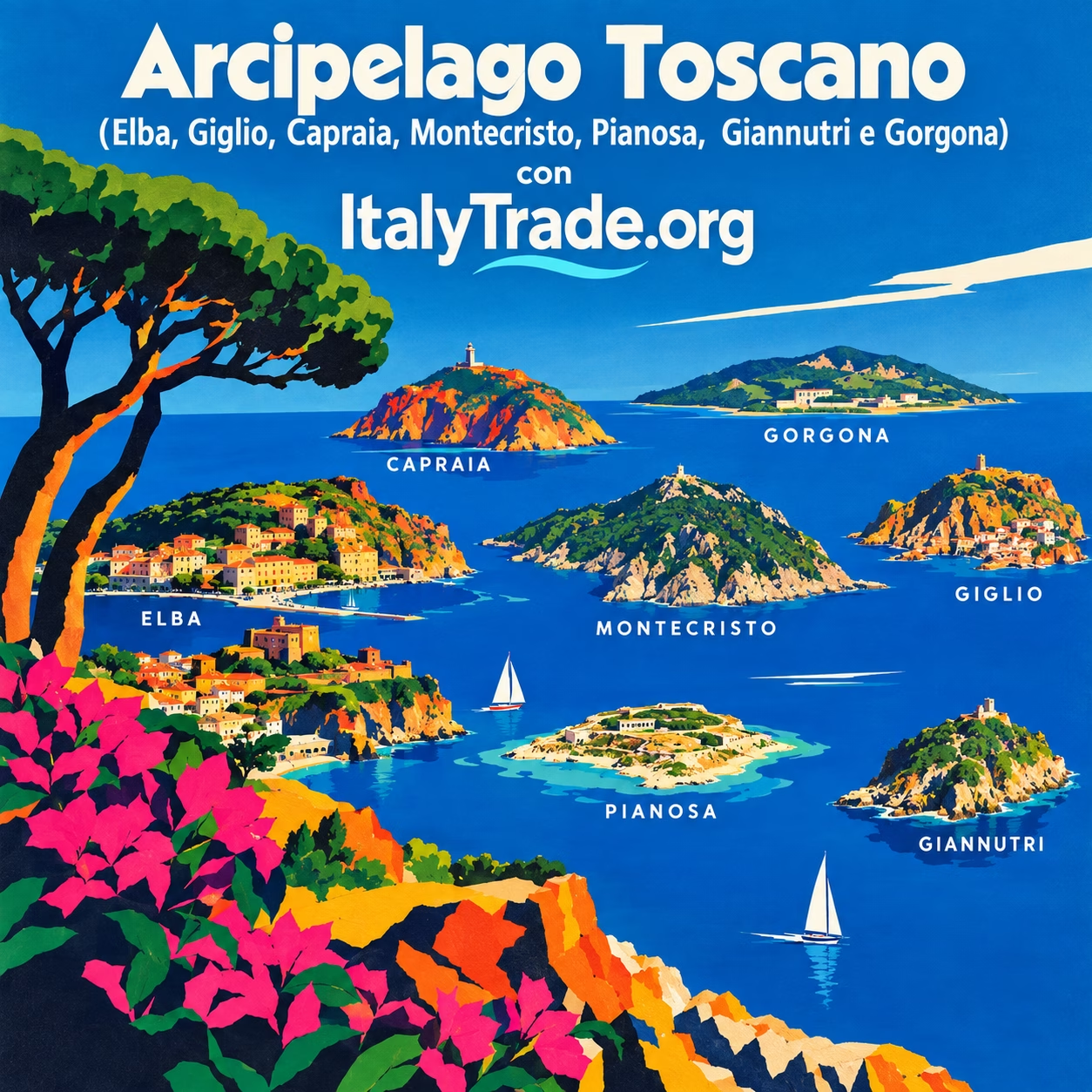
Elba, Giglio, Capraia, Montecristo, Pianosa, Giannutri and Gorgona
The Park: Europe’s largest marine park
The seven main islands – Elba, Giglio, Giannutri, Capraia, Pianosa, Gorgona and Montecristo – are protected by the Tuscan Archipelago National Park, described as the largest marine park in Europe. Italy’s official tourism portal presents it as a destination for trekking in the shoulder seasons and for snorkelling, diving and whale and dolphin watching in summer. Source: Italia.it (in Italian)
According to the park authority, the protected area covers about 177 sq km of land and about 615 sq km of sea, and includes all the islands. The park protects half of the surface of Elba and Giglio, while on Capraia only the small built-up area is left out. Source: Tuscan Archipelago National Park (PDF, in Italian)
The seven islands, one by one
Elba
Elba is the third-largest island in Italy, at about 224 sq km, and lies 10 km from the Tuscan coast. It is divided into seven municipalities, and its highest point is Monte Capanne (1,019 m), the tallest peak of the whole archipelago. Source: Tuscan Archipelago National Park (PDF, in Italian)
It is the best-known island of the archipelago: in 1814 it hosted Napoleon Bonaparte in exile. Source: SiViaggia (in Italian)
Giglio
Giglio is the second-largest island of the archipelago by size and population: granitic and mountainous, it covers about 21.2 sq km with 28 km of coastline. Source: Regione Toscana (in Italian)
Capraia
Capraia is of volcanic origin, with a surface of about 19.3 sq km and 27 km of coastline. Source: Regione Toscana (in Italian)
Montecristo
Montecristo measures about 10.4 sq km and is the island farthest from the mainland coast, at about 63 km. Source: Tuscan Archipelago National Park (PDF, in Italian)
A state nature reserve since 1971, it is part of the “Isole di Toscana” UNESCO Biosphere Reserve and of the Pelagos Sanctuary for marine mammals. Source: Quotidiano.net (in Italian)
Pianosa
Pianosa is the flattest island of the archipelago: just over ten square kilometres, with a maximum height of 29 metres. From 1858 to 1998 it was a penal colony. Source: Visit Tuscany (in Italian)
It preserves traces dating back to the Neolithic and, in imperial times, it was the place of exile of Postumus Agrippa, grandson of Augustus. Source: SiViaggia (in Italian)
Giannutri
Giannutri (2.6 sq km, 11 km of rocky coast) is the southernmost of the Tuscan islands. The only landing points are Cala Spalmatoio and Cala Maestra, and the Roman Villa dei Domizi can be visited with specialised guides. Source: Tuscan Archipelago National Park (PDF, in Italian)
Gorgona
Gorgona (2.2 sq km) is the smallest and northernmost island, 36 km from the coast, and hosts an agricultural penal colony. Source: Tuscan Archipelago National Park (PDF, in Italian)
The inmates live under a semi-open regime and farm vegetable gardens and vineyards on terraces; on the island you can see the ruins of the Roman villa and the Pisan fortification of Rocca Vecchia. Source: Italia.it (in Italian)
Nature and protected sea
The vegetation is mainly Mediterranean and the flora is rich in endemic species. The archipelago is also a stopover and nesting site for many migratory birds, and its geodiversity makes the mineral variety surprising. Source: Tuscan Archipelago National Park (PDF, in Italian)
Among the smaller islets is Palmaiola, an important nesting site for the Corsican gull. Source: Italia.it (in Italian)
Flavours and wines of Elba
Typical dishes
In Elban trattorias you will find gurguglione (mixed vegetables pan-cooked with oil, garlic and basil), Elban-style cacciucco fish stew, and schiaccia briaca, a sweet with raisins, pine nuts, walnuts and almonds soaked in aleatico wine. Source: Scattidigusto (in Italian)
Aleatico and Elba DOC
Elba’s Aleatico Passito, a sweet meditation wine made from air-dried grapes, obtained DOCG status in 2011; it is grown on over 32 hectares on Elba and over 3 on Capraia. Source: Visit Tuscany
The island’s bond with wine is also official: the Elba DOC has existed since 1967, among the first in Italy. Source: Blu Navy
How to visit the islands
Montecristo, Pianosa and Gorgona are strictly protected and access is regulated. On Giannutri access is free, but for most of the island you must be accompanied by guides. Source: Tuscan Archipelago National Park (PDF, in Italian)
Montecristo can only be reached by booking the visits organised by the park authority, along three authorised trails and with swimming forbidden; Gorgona only through guided visits departing from Livorno. Source: Italia.it (in Italian)
4-day itinerary across the islands
The islands are reached from different mainland ports: Piombino for Elba, Porto Santo Stefano for Giglio, Livorno for Capraia. For this reason the itinerary is designed as separate legs, to be adapted to ferry timetables. Source: Traghetti.com (in Italian)
Day 1 – Elba: Portoferraio
From Piombino to Portoferraio the Toremar crossing takes about one hour. Source: Traghetti.com (in Italian)
Portoferraio is the capital and main port of Elba. It took on its present appearance under Cosimo I de’ Medici, who from 1548 began major fortification works. Source: Visit Tuscany (in Italian)
Forte Falcone, built by the Medici in the 16th century, overlooks the town and is now a viewpoint, while on the other side Forte Stella has five bastions and a 19th-century lighthouse. Source: SiViaggia (in Italian)
The Palazzina dei Mulini was Napoleon’s residence during his exile on Elba, from 4 May 1814 to 26 February 1815, and today is visited as part of the National Museum of the Napoleonic Residences. Source: Visit Tuscany
Day 2 – Elba: Villa San Martino and Elban wines
Outside the town, near Procchio, stands Villa San Martino, Napoleon’s other home: it was the emperor’s private residence, set among woods and vineyards sloping down to the sea. Source: Regione Toscana (in Italian)
To end the day, almost the whole selection of Elban wines can be tasted at the Enoteca della Fortezza in Portoferraio. Source: Rivista di Agraria (in Italian)
Day 3 – Giglio: villages and trails
Giglio lies about 15 km off the coast and is reached from Porto Santo Stefano, in the Maremma: ferries take about an hour to reach Giglio Porto. Source: SiViaggia (in Italian)
At Giglio Porto stands the Saracen Tower, built in 1596 at the wish of Ferdinand I of Tuscany; higher up is Giglio Castello, a fortified village enclosed by tall medieval walls with towers. Source: Visit Tuscany (in Italian)
On the western side is Campese, on the beach of the same name, famous for its sunsets. A more demanding trail links Giglio Castello to Campese via Monte Calvo (496 m), the island’s highest point. Source: SiViaggia (in Italian)
Day 4 – Your choice: Pianosa, Capraia or Giannutri
Pianosa. Connections are seasonal and regulated: access is limited, places are capped and advance booking is required. Source: Traghettilines (in Italian)
In spring the park has offered day visits departing by ship from Piombino, accompanied all day by a Park Guide; the package included the return journey and the entrance ticket. Source: SiViaggia (in Italian)
Among the activities organised by the park on Pianosa are visits to the catacombs. Source: Tuscan Archipelago National Park (PDF, in Italian)
Capraia. The ferry from Livorno is operated only by Toremar all year round and takes about 2 hours 45 minutes. Source: Traghettilines (in Italian)
Giannutri. It is reached from Porto Santo Stefano and is considered a paradise for snorkelling and diving; near Cala Maestra lie the remains of a Roman villa from the 2nd century AD. Source: Visit Tuscany (in Italian)
The Roman Villa dei Domizi can be visited with specialised guides, and on Giannutri much of the island can only be explored with a guide. Source: Tuscan Archipelago National Park (PDF, in Italian)
Editorial transparency. Author: Giuseppe Baldassarri – ItalyTrade.org. Every paragraph cites the source consulted; sections without a verified source have not been published. Most sources are in Italian and are marked as such. Independent editorial content.
Giuseppe Baldassarri – Sales & Account Manager | Destination Marketing | Made in Italy
ItalyTrade.org · Privacy Policy · Cookie Policy · Terms of Service
© 2026 — All rights reserved ItalyTrade.org