
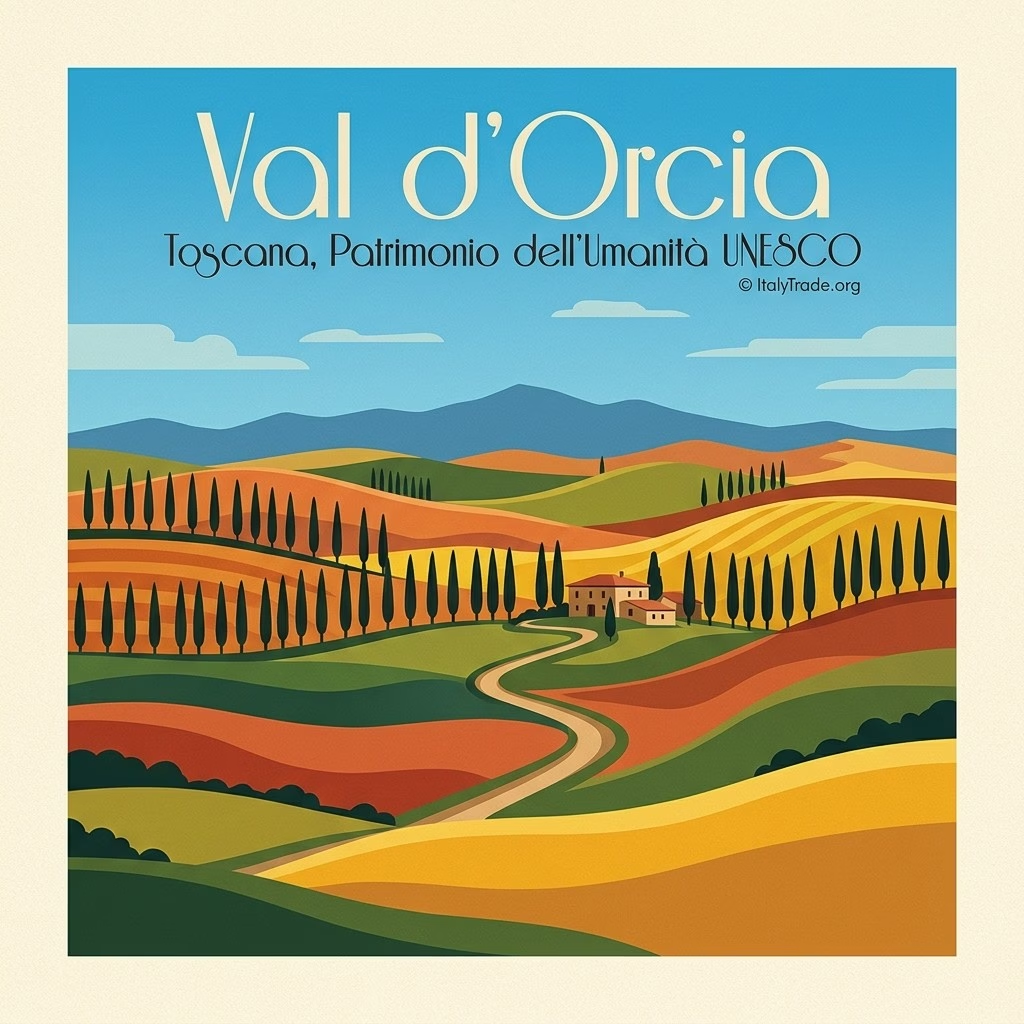
Val d’Orcia Tuscany, UNESCO World Heritage Site
Province of Siena, Tuscany — UNESCO cultural landscape since 2004
A landscape shaped by the Renaissance
The Val d’Orcia, in the province of Siena, is an agricultural landscape reshaped in the 14th and 15th centuries when the city-state of Siena expanded into the area: plains and low conical hills crowned by fortified towns, farms and cypress-lined roads.
Pienza, Montalcino and San Quirico d’Orcia are among its main towns, and the valley is crossed by the historic Via Francigena, with its abbeys, inns, shrines and bridges. It has been on the UNESCO World Heritage List since 2004 as a cultural landscape: the property covers 61,188 hectares, with a buffer zone of 5,660 hectares.
Source: UNESCO World Heritage Centre – Val d’Orcia · Source: Val d’Orcia Park (in Italian)
When a landscape becomes a work of art
In the 13th and 14th centuries Siena’s wealthy merchants invested in farming and introduced a system in which small farmers handed over half of their produce as rent. Painters of the Sienese School, including Ambrogio Lorenzetti and Giovanni di Paolo, helped build the idealised image of this landscape.
When Siena’s power waned in the late 16th century, the area became economically marginal, which preserved its Renaissance layout and traditional land use. The park was established in 1999 to protect its natural and cultural values.
Why the Val d’Orcia is unique
🏛️ UNESCO criterion (iv)
According to UNESCO, it is an exceptional reflection of the way the landscape was “re-written” in Renaissance times, designed to express ideals of good governance and an attractive scene.
🎨 UNESCO criterion (vi)
The images painted by Sienese School artists have come to be seen as icons of the Renaissance and have profoundly influenced the development of landscape thinking.
🚶 The Via Francigena
The historic pilgrims’ road runs through the valley, with its abbeys, inns, shrines and bridges.
The wonders of the Val d’Orcia
Pienza
Regarded as the “ideal city of the Renaissance”, its urban plan was shaped in the 15th century by Pope Pius II (Enea Silvio Piccolomini).
Montalcino
It dominates the surrounding countryside with its 14th-century fortress and is the birthplace of Brunello di Montalcino.
San Quirico d’Orcia
Halfway between Siena and Rome, its centre was built around the Via Francigena. Here you will find the Horti Leonini and the Collegiata of Saints Quirico and Giulitta.
Castiglione d’Orcia
A “natural terrace” over the valley stretching to the springs of Monte Amiata; the municipality is home to the Rocca Aldobrandesca and the Rocca di Tentennano.
Radicofani
On the southern edge of the valley, along the Via Francigena, it is home to the fortress, now a museum.
Piazza delle Sorgenti
The heart of the village is a large stone thermal pool; bathing is not allowed, but the view is striking.
Parco dei Mulini
Reached by a path near the village, it holds underground mills carved into the rock.
Fosso Bianco
A large limestone deposit in the woods, linked to the spa of Bagni San Filippo.
Regional Nature Reserve
One of the natural areas listed among the places of the Val d’Orcia park.
Piazza Pio II
The “superb trapezoidal square” designed by Bernardo Rossellino, an outstanding example of Humanist Renaissance design.
Sant’Antimo Abbey
An example of Tuscan Romanesque; the present church dates from 1118, as an inscription on the main altar attests.
Horti Leonini
An Italian garden designed by Diomede Leoni, with box hedges in the shape of a Maltese cross and a holm-oak wood.
Source: Visit Tuscany – Val d’Orcia Park (in Italian) · Source: Italia.it – Val d’Orcia (in Italian) · Source: UNESCO World Heritage Centre – Pienza · Source: Visit Tuscany – Sant’Antimo Abbey (in German) · Source: Visit Tuscany – San Quirico d’Orcia (in Italian) · Source: Visit Tuscany – Bagno Vignoni (in Italian) · Source: Visit Tuscany – Radicofani (in Italian)
The flavours of the Val d’Orcia
Among the local specialities, Italia.it’s guide mentions Pecorino di Pienza, Cinta Senese pork and Brunello di Montalcino. To explore more of Tuscan wine country, read Chianti: among villages and wineries.
Typical products
Pecorino di Pienza
Pienza is regarded as the capital of pecorino: the town stands in a clay area where pastures rich in aromatic herbs make the milk particularly fragrant.
Barrique-aged pecorino
The version aged in barriques rests for at least 90 days in oak barrels.
Cinta Senese
A pig breed raised in the Val d’Orcia and used for typical cured meats.
Brunello di Montalcino DOCG
The area’s flagship red wine, made exclusively from Sangiovese.
Orcia DOC
Based mainly on Sangiovese; Rosato, Bianco and Vin Santo versions also exist.
Moscadello di Montalcino DOC
Produced only in the municipality of Montalcino in Tranquillo, Frizzante and Late Harvest styles.
Source: Italia.it – Val d’Orcia (in Italian) · Source: Visit Tuscany – Tuscan cheeses (in Italian) · Source: Visit Tuscany – Val d’Orcia wines (in Italian)
The Fiera del Cacio in Pienza
🧀 The Cacio al Fuso game
The historic Fiera del Cacio celebrates Pecorino di Pienza and local traditions in Piazza Pio II. At its heart is the Gioco del Cacio al Fuso, a contest between the town’s six contrade: Casello, Mura, Prato, Gozzante, Case Nuove and San Piero.
🚩 Palio, tastings and parades
The 2026 edition ran from 31 August to 6 September, with the Palio, “Caci&Calici” tastings paired with Orcia wine, stalls selling Pecorino di Pienza, the Musici e Sbandieratori and “La Contesa delle Pecore”. Check with the organisers for the dates of the next edition.
More Italian events in our guide Festivals in Italy.
Pienza, Sant’Antimo and San Quirico
Pope Pius II enlisted the architect Bernardo Rossellino to transform his birthplace, Corsignano, renamed Pienza: UNESCO describes the work as the first application of the Renaissance humanist concept of urban design. Around Piazza Pio II stand the Piccolomini Palace, the Borgia (Episcopal) Palace, the cathedral, the Town Hall and the Ammannati Palace.
Near Castelnuovo dell’Abate, Sant’Antimo Abbey is an example of Tuscan Romanesque with French and Lombard influences, built in travertine veined with alabaster; a capital showing Daniel in the lions’ den is attributed to the Master of Cabestany. In San Quirico d’Orcia, Palazzo Chigi Zondadari was commissioned by Cardinal Flavio Chigi in 1679.
Source: UNESCO World Heritage Centre – Pienza · Source: Visit Tuscany – Sant’Antimo Abbey (in German) · Source: Visit Tuscany – San Quirico d’Orcia (in Italian)
Walking in the park
The park promotes low-impact tourism and offers mainly walking routes: the Via Francigena from Pienza to the village of Montichiello, the Bagno Vignoni loop and the ancient Via Cassia from Torrenieri. For a full travel proposal see Val d’Orcia: A Perfect Itinerary; to stay in the Sienese countryside, Crete Senesi: things to do.
Quality designations
Brunello di Montalcino DOCG. The first Italian wine to receive DOCG status, in 1980; the production area matches the historic borders of the municipality of Montalcino. The rules require at least two years of ageing in oak and at least four months in bottle (six for the Riserva). Rosso di Montalcino DOC was recognised by decree of 25/11/1983, with no minimum wood ageing.
Orcia DOC. Created on 14 February 2000, it requires at least 60% Sangiovese (at least 90% for Orcia Sangiovese); the area covers 12 municipalities between Montalcino and Montepulciano and is protected by the Consorzio del Vino Orcia.
Pecorino Toscano DOP. A cheese made exclusively from whole sheep’s milk, one of the three Tuscan cheeses with protected designation of origin.
Source: Brunello di Montalcino Consortium · Source: Visit Tuscany – Orcia DOC (in Italian) · Source: Visit Tuscany – Tuscan cheeses (in Italian)
A six-stop itinerary
Pienza
Piazza Pio II, the Piccolomini Palace, the Borgia Palace, the cathedral and the Town Hall: the historic centre designed by Bernardo Rossellino for Pope Pius II.
San Quirico d’Orcia
The Horti Leonini, the Collegiata of Saints Quirico and Giulitta and Palazzo Chigi Zondadari, along the route of the Via Francigena.
Bagno Vignoni
The large stone thermal pool at the heart of the village and, along a short path, the Parco dei Mulini with its underground mills carved into the rock.
Montalcino
The 14th-century fortress overlooking the countryside and the home of Brunello di Montalcino.
Sant’Antimo Abbey
Tuscan Romanesque at Castelnuovo dell’Abate, a few kilometres from Montalcino: the present church dates from 1118.
Radicofani
The fortress on the southern edge of the valley, documented since at least 978 and linked to the figure of Ghino di Tacco.
FAQ — Val d’Orcia
The Val d’Orcia is a cultural landscape in the province of Siena, inscribed on the UNESCO World Heritage List since 2004 under criteria (iv) and (vi). Source: Val d’Orcia Park (in Italian)
The park covers five municipalities: Castiglione d’Orcia, Montalcino, Pienza, Radicofani and San Quirico d’Orcia. Source: Visit Tuscany – Val d’Orcia Park (in Italian)
Pope Pius II enlisted Bernardo Rossellino to transform his birthplace, Corsignano, into Pienza: UNESCO describes it as the first application of the Renaissance humanist concept of urban design. Source: UNESCO World Heritage Centre – Pienza
It is a red wine made exclusively from Sangiovese, the first Italian wine to receive DOCG status, in 1980; the rules require at least two years of ageing in oak. Source: Brunello di Montalcino Consortium
It is a designation created on 14 February 2000, based on Sangiovese, which must make up at least 60% of the blend. Source: Visit Tuscany – Orcia DOC (in Italian)
No: you cannot immerse yourself in the large stone pool at the centre of the village. The thermal waters can be enjoyed at three facilities: Terme Spa & Resort, Terme Hotel La Posta and Terme Hotel Adler. Source: Visit Tuscany – Bagno Vignoni (in Italian)
It is a historic festival celebrating Pecorino di Pienza; its central event is the Gioco del Cacio al Fuso between the town’s six contrade. The 2026 edition ran from 31 August to 6 September. Source: Visit Tuscany – Fiera del Cacio (in Italian)
Born in Torrita di Siena and banished from his city, in 1297 he seized the fortress of Radicofani, from where he controlled travellers and merchants; cited by Dante and Boccaccio, he is remembered as an “Italian Robin Hood”. Source: Visit Tuscany – Radicofani (in Italian)
A landscape to be lived slowly
From the Renaissance squares of Pienza to the vineyards of Montalcino, from the springs of Bagno Vignoni to the fortress of Radicofani, the Val d’Orcia tells centuries of history through its landscape. To continue your journey through Tuscany read Tuscany: where every hill tells a story or explore the interactive map of Italy.
A landscape that UNESCO recognises as an icon of the Renaissance.
Who wrote this article? On what basis?
📋 Transparency and verifiability
Written by:
Giuseppe Baldassarri
— ItalyTrade.org.
Evidence: Verified sources linked
in the text.
Other viewpoints: Yes, noted where
relevant.
Possible hidden interest: None. Independent
editorial content.
Giuseppe Baldassarri
Giuseppe Baldassarri Giuseppe Baldassarri Senior Revenue Manager & AI Search Specialist (AEO/GEO) | Sales & Account Manager | Destination & Export Marketing | Travel Designer | Vivi l’Italia – italytrade.org
Website: ItalyTrade.org — Travel & Business | Italy: Made in Italy
“Turning Italian excellence into global visibility in the age of artificial intelligence”
Luxury Real Estate | Export | Luxury Wedding | Travel Design
Privacy Policy » Cookie Policy » Terms of Service » Image Licenses » Sitemap » Services » Reviews » Contact » Work with us
