
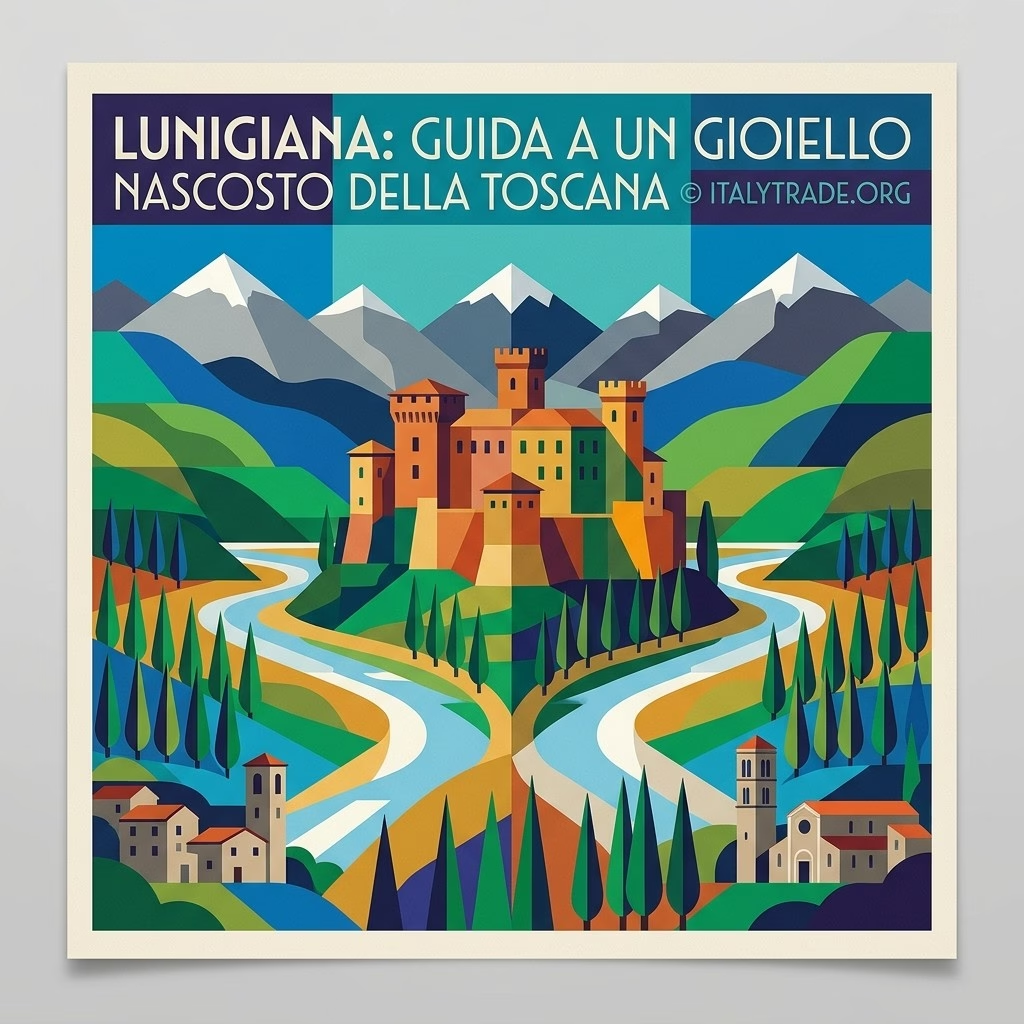
Lunigiana in Tuscany
Province of Massa-Carrara · between the Apennines, the Apuan Alps and the Ligurian Riviera di Levante
The wild heart of northern Tuscany
Lunigiana in Tuscany is the corner of the region that reaches all the way to the border with the Ligurian Riviera di Levante and Emilia, along the River Magra, at the foot of the Apennines and the Apuan Alps. If you are wondering what to do in Lunigiana, the answer is a slow journey of stone villages, Romanesque parish churches and fortresses: the “Land of a Hundred Castles” is a mosaic of green valleys where history and nature intertwine.
Its name recalls Luni, the ancient Roman city: the historic territory coincided with the vast diocese of Luni. For centuries it was a strategic, contested and fortified corridor; today it brings together, within a few dozen kilometres, the sea of the Cinque Terre and Apennine ridges that approach 1,800 metres.
Source: The WoM — Cosa vedere in Lunigiana (IT) · Source: idealista news (IT)
Source: Toscana Promozione Turistica (IT/EN) · Source: Finestre sull’Arte
Border history, river and mountain landscapes
A crossroads of peoples, Lunigiana has handed down villages, castles and prehistoric finds such as the mysterious stele statues, regarded as the territory’s most important megalithic phenomenon. The Malaspina family ruled these lands for almost a millennium, dotting the ridges with fortresses and noble residences. It is an area that has stayed authentic, crossed by the Magra and by streams running between ancient villages and chestnut groves, and touched by the Via Francigena.
For those who love the outdoors, the landscape is the real attraction: trails, canyons and caves, the Ciclovia dei Castelli — a loop that suits e-bikes too, with stops in the villages along the way — and wild places such as the Stretti di Giaredo near Bagnone.
Source: Visit Tuscany — Lunigiana (IT) · Source: The WoM — Ciclovia dei Castelli (IT)
Why Lunigiana is unique
🏰 The Land of a Hundred Castles
The Malaspina’s centuries-long rule filled Lunigiana with fortifications. Of the hundred castles people talk about, about twenty can be visited today: the others are ruins or little more. Among the best preserved stands the Malaspina Castle of Fosdinovo.
🗿 The stele statues
The Museum of the Lunigiana Stele Statues, housed in the Piagnaro Castle in Pontremoli, holds 35 original pieces and 29 casts of sculptures dating from the Copper Age to the Iron Age. In all, 85 are known today, most of them kept in Pontremoli.
🌿 Nature recognised by UNESCO
Lunigiana lies within the Tuscan-Emilian Apennines MAB Biosphere Reserve and includes, at Equi Terme, an area of the Apuan Alps Regional Park, a UNESCO Global Geopark, with caves and karst springs.
Source: SiViaggia (IT) · Source: Italian Ministry of Culture (IT) · Source: Toscana Promozione Turistica (IT/EN)
The wonders of Lunigiana
Pontremoli
The northernmost municipality in Tuscany, the “key and gate” of Lunigiana, lies on the Via Francigena between the Magra and Verde rivers and is the “city of the book” thanks to the Premio Bancarella, hosted since 1953.
Fivizzano
Nicknamed “the Florence of Lunigiana” for the elegance of its historic centre and its noble palaces, it bears witness to a long bond with the Medici and the Grand Duchy of Tuscany.
Bagnone
Among the most picturesque villages, with a fifteenth-century portico, the castle overlooking the town and the stream that creates evocative views.
Fosdinovo
Dominated by the Malaspina Castle, a twelfth-century fortress still owned by the family’s descendants, open to visitors with its frescoed halls.
Equi Caves
The Geo-Archeo-Adventure Park in the heart of the Apuan Alps Park offers routes through caves and karst, with Tibetan bridges, ziplines and a climbing wall.
Stretti di Giaredo
An experience for discovering the wildest and most unspoilt side of Lunigiana, starting from Bagnone.
Ciclovia dei Castelli
A loop for bike touring, suitable for e-bike riders too thanks to its mixed surface and stops in the villages it passes through.
Tuscan-Emilian Apennines
The national park is a UNESCO Biosphere Reserve and includes part of Lunigiana’s Apennine mountains.
Stele Statues Museum
Inside the Piagnaro Castle, it gathers the most mysterious testimony of the people who lived in Lunigiana in ancient times.
Lusuolo Castle
Home to the Museo dell’Emigrazione della Gente di Toscana.
Audiovisual Museum of the Resistance
One of Lunigiana’s museums of historical memory, housed in Fosdinovo.
Archaeological Museum of the Equi Caves
An interactive display tells of the life and work of the people of the Lucido Valley, down to the prehistoric Tecchia and the spa.
Lusuolo
In this hamlet you can admire one of the most beautiful castles in Lunigiana and the church of San Martino, with its rare bell gable.
La Verrucola
Its castle is among the best preserved in Lunigiana and is still inhabited today.
Equi Terme
A small village known for its caves and thermal waters, set in the Apuan Alps Park.
Pontebosio
The seventeenth-century castle of the Malaspina marquises, on the left bank of the Taverone, defended the entrance to the valley.
Source: The WoM (IT) · Source: Toscana Promozione (IT/EN) · Source: Visit Tuscany — Museums (IT) · Source: Finestre sull’Arte (IT) · Source: Visit Tuscany — Pontebosio (IT)
Flavours of Lunigiana: testi, chestnuts and honey
The chestnut has always been Lunigiana’s “bread tree”: until the 1960s chestnut flour was the staple of the local kitchen, and today, with its PDO status, it is the queen of local menus, from starter to dessert. Alongside chestnuts, the breads cooked in “testi” tell of an ancient, mountain gastronomy.
🍝 Dishes and products not to miss
Testaroli
A Slow Food Presidium cooked on cast-iron testi: perhaps the oldest form of unleavened bread, typical of upper Lunigiana.
Panigacci di Podenzana
Cooked on terracotta testi, they are another speciality of Lunigiana tradition.
Lasagne bastarde
A typical first course combining wheat flour and chestnut flour.
Agnello di Zeri
A Slow Food Presidium tied to the pastoral practices of the Zeri valleys.
Chestnut Flour PDO
Sweet, unmistakable flavour, obtained by slow drying in the traditional metati.
Colli di Luni DOC
The Vermentino white wine that accompanies the local cuisine.
🍷 The wines of Lunigiana
Colli di Luni, created as a DOC in 1989, is the area’s largest denomination by volume and number of wineries, and one of very few in Italy to cross regional borders, between Tuscany and Liguria. A varietal Vermentino requires at least 90% of that grape. In the province of Massa there is also another DOC, Candia dei Colli Apuani.
Source: Visit Tuscany — Lunigiana con gusto (IT) · Source: Visit Tuscany — Lasagne (IT) · Source: La Nazione (IT) · Source: Wine & Spirits Magazine · Source: Colli di Luni production rules (IT)
Traditions and festivals of Lunigiana
🎉 The events calendar
Premio Bancarella — July
Born from the tradition of the itinerant booksellers of upper Lunigiana, it is the only literary prize run exclusively by booksellers. Every summer, in July, the winner is announced in Pontremoli, in Piazza della Repubblica, at the foot of the Cacciaguerra tower.
Festa del Libro — late August
In the last week of August Lunigiana comes alive with the Festa del Libro, a date for book lovers.
Chestnut festivals — October
In autumn the villages celebrate the chestnut with fairs and castagnate, where producers’ stalls also offer maize, spelt, PDO honey and other specialities; examples include the castagnata in Pontremoli and the chestnut festival in Mozzano, in the municipality of Fivizzano.
⚔️ Historical re-enactments
In August the calendar fills with medieval and Renaissance re-enactments, such as Medievalis in Pontremoli and Tre Sere nel Passato, with street music, performances and stalls of local products. Food events include Sapor Fivizzano, the Premio Bancarel’Vino and the TourDay.
Source: Visit Tuscany — Bancarella Award · Source: The WoM (IT) · Source: Visit Tuscany — Castagnate (IT) · Source: Visit Tuscany — Re-enactments · Source: Visit Tuscany — Spas (IT)
Stone, castles and parish churches
The oldest artistic expression of the area is the stele statues: sandstone sculptures dating from the end of the 4th millennium BC to the Iron Age, now a symbol of Lunigiana. The museum in Pontremoli is regarded as the most complete in Italy for the number of finds and the information on where they were discovered.
Architecture tells the story of a border land. The Piagnaro Castle, which dominates Pontremoli, takes its name from the “piagne”, the sandstone slabs used for roofs, and preserves seventeenth- and eighteenth-century bastions. Fosdinovo Castle stands on a strategic point that once controlled the coast and lower Lunigiana, and tradition holds that it also hosted Dante Alighieri.
Source: Italia.it (IT) · Source: MuseiOnline (IT) · Source: Visit Tuscany — Pontremoli (IT) · Source: Terre di Lunigiana
The most beautiful villages and recommended itineraries
Lunigiana’s villages, carved from sandstone or perched on hilltops, have for centuries been the guardians of a border land between Tuscany, Emilia and Liguria. The itineraries below are ItalyTrade proposals built from the places verified in this guide.
🗺️ Short itinerary (2 days): Pontremoli and upper Lunigiana
Day 1: Pontremoli, the Piagnaro Castle and the Stele Statues Museum. Day 2: Fivizzano and Equi Terme, among noble palaces, caves and thermal waters.
🗺️ Extended itinerary (4 days): castles and villages
Day 1: Pontremoli. Day 2: Fivizzano, La Verrucola and Equi Terme. Day 3: Malaspina Castle of Fosdinovo. Day 4: Bagnone and the Stretti di Giaredo, with a stop at Lusuolo; cycling fans can add a stretch of the Ciclovia dei Castelli.
How many days, where to stay, when to go
⏱️ Recommended length of stay
Visit Tuscany suggests a two-day itinerary combining nature and history in the mountains of Lunigiana; with three or four days you can add Fosdinovo, the smaller villages and hikes or bike rides.
🏨 Where to stay
Charming hotel in a castle
The Castello di Pontebosio Luxury Resort, in Licciana Nardi, is a boutique hotel in a seventeenth-century castle of the Malaspina marquises.
Farm stay in a castle
The Castel del Piano agriturismo, also in Licciana Nardi, is housed in the medieval Malaspina castle, in the Taverone valley.
B&B in the village
In Tresana a bed & breakfast occupies the palace that is part of the Malaspina Castle, with access to the castle’s outdoor spaces.
📅 Best time to visit
Lunigiana can be visited all year round: August brings historical re-enactments and the Premio Bancarella falls in July, while October is the month of the chestnut festivals.
Source: Visit Tuscany — Two days in Lunigiana (IT) · Source: Castello di Pontebosio (IT) · Source: Castel del Piano (IT) · Source: Castello Malaspina di Tresana (IT)
PDO, PGI and Presidia: the excellence of Lunigiana
Farina di Castagne della Lunigiana PDO owes its sweet flavour to the type of chestnut and the climate: at least 70% of the varieties used must be Bresciana, Carpanese and Rossola, and drying takes place over a slow fire of chestnut wood for at least 25 days. The production area lies in the province of Massa-Carrara.
Miele della Lunigiana PDO was the first Italian honey to obtain the designation. Completing the range are Toscano PGI extra virgin olive oil with the sub-designation “Colline della Lunigiana” and the Slow Food Presidia for testaroli and Agnello di Zeri.
Source: Visit Tuscany — Chestnut flour PDO · Source: AGI (IT) · Source: Visit Tuscany — Honey PDO (IT) · Source: Visit Tuscany — 5 specialities (IT)
Lunigiana in numbers
According to the Lunigiana Economy Report, in 2023 the area had 241 hotel and non-hotel businesses with about 3,300 beds, excluding tourist rentals. Local museums welcomed over 73,000 visitors, almost 80% of the province’s museum admissions.
Source: Camera di Commercio Toscana Nord-Ovest 2024 (IT) · Source: Camera di Commercio Toscana Nord-Ovest 2025 (IT) · Source: Finestre sull’Arte
A 3-day itinerary, step by step
Pontremoli and the Piagnaro Castle
Start at the historic gateway to Lunigiana: the town centre along the Via Francigena and the Piagnaro Castle, home to the Museum of the Lunigiana Stele Statues.
Discover Tuscany on ItalyTrade · Source: Visit Tuscany — Stele Statues Museum
Fivizzano and Equi Terme
The elegant centre of Fivizzano, “the Florence of Lunigiana”, and then the caves and spa of Equi Terme, in the Apuan Alps Park.
The Malaspina Castle of Fosdinovo
End with the fortress that controlled the coast and lower Lunigiana, open to visitors with its frescoed halls. To continue towards the sea, discover Versilia in Tuscany.
Plan your itinerary with ItalyTrade · Source: Terre di Lunigiana — Fosdinovo
FAQ — Lunigiana in Tuscany
It is the northernmost strip of Tuscany, in the province of Massa-Carrara, along the River Magra and at the foot of the Apennines and the Apuan Alps. Source: The WoM (IT)
Because of the centuries-long rule of the Malaspina, who fortified the ridges; today about twenty castles can be visited. Source: SiViaggia (IT)
They are prehistoric sandstone sculptures; the Museum of the Stele Statues, in the Piagnaro Castle in Pontremoli, displays 35 originals and 29 casts. Source: Italian Ministry of Culture (IT)
Farina di Castagne della Lunigiana PDO and Miele della Lunigiana PDO; there is also Toscano PGI olive oil with the sub-designation “Colline della Lunigiana”. Source: Visit Tuscany (IT)
A Slow Food Presidium cooked on cast-iron “testi”, considered perhaps the oldest form of unleavened bread of upper Lunigiana. Source: La Nazione (IT)
Every summer, in July, in Pontremoli, where the prize has been hosted since 1953. Source: Visit Tuscany
Yes: it is a twelfth-century fortress still owned by the Malaspina’s descendants, and its frescoed halls are open to visitors. Source: The WoM (IT)
Yes, the Ciclovia dei Castelli is a loop that suits e-bikes too, with stops in the villages along the way. Source: The WoM (IT)
Embracing Lunigiana, a different Tuscany
Lunigiana is a less obvious Tuscany: Malaspina castles, stone villages, prehistoric statues and a cuisine born of the chestnut. A land to travel on foot, by bike or along the Via Francigena, where every valley has a story to tell.
To combine Lunigiana with other Tuscan destinations, also explore ItalyTrade.org’s guide to Tuscany or the interactive map of Italy.
Lunigiana: a land of borders, but never just a place to pass through.
Who wrote this article? On what basis?
📋 Transparency and verifiability
Who wrote it:
Giuseppe Baldassarri — ItalyTrade.org.
What it is based on: verified sources, linked in the text.
Are there other points of view: yes, noted where relevant.
Possible hidden interest: none. Independent editorial content.
Giuseppe Baldassarri
Giuseppe Baldassarri — Senior Revenue Manager & AI Search Specialist (AEO/GEO) | Sales & Account Manager | Destination & Export Marketing | Travel Designer | Vivi l’Italia – italytrade.org
Website: ItalyTrade.org — Travel & Business | Italy: Made in Italy
“Turning Italian excellence into global visibility in the age of artificial intelligence”
Luxury Real Estate | Export | Luxury Wedding | Travel Design
Privacy Policy » Cookie Policy » Terms of Service » Image Licenses » Sitemap » Services » Reviews » Contact » Work with us
