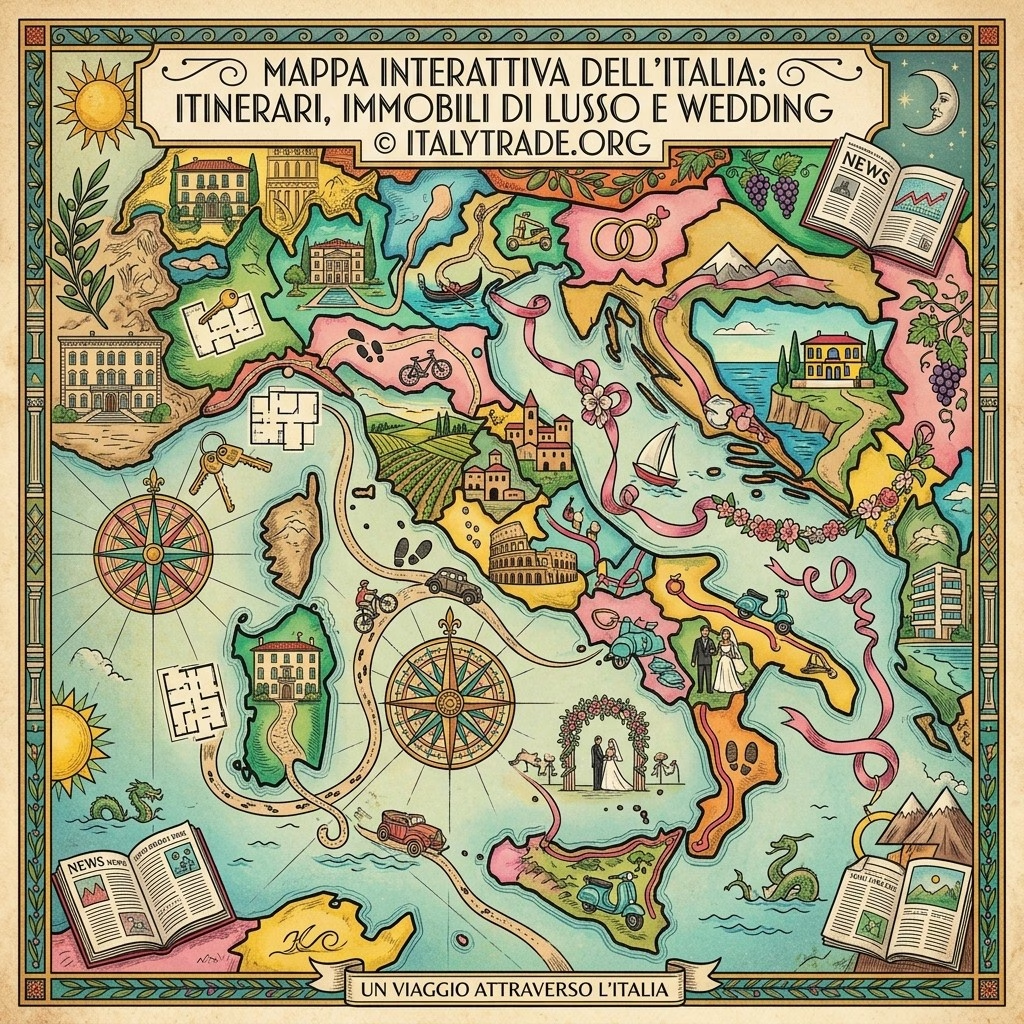
Interactive Map of Italy: Itineraries, Luxury Properties and Weddings
Dolomites, Venice, Cinque Terre, Tuscany, Rome, Amalfi Coast, Matera and Puglia: stops, weddings and real estate
A map to read Italy: heritage, travel, weddings and property
An interactive map of Italy connects three ways of experiencing the country: the itinerary, the wedding in an exceptional venue and the prestigious property. This page keeps them together, starting from verifiable data and from places recognised by UNESCO. For more travel ideas, see Italy: things to do and the Great Destinations of ItalyTrade.org.
UNESCO’s page for Italy lists 62 World Heritage sites: 56 cultural and 6 natural. According to ISTAT, in 2024 Italian accommodation establishments recorded 139.6 million arrivals and 466.2 million overnight stays, with foreign visitors accounting for 54.5% of the overnight stays.
Source: UNESCO World Heritage Centre – Italy · Source: ISTAT – Tourist flows, year 2024 (in Italian) · Source: UNESCO – Intangible heritage, Italy · Source: Fondazione Qualivita – Ismea-Qualivita Report (in Italian)
A heritage recognised by UNESCO
Italy’s UNESCO list includes 56 cultural and 6 natural sites and no mixed sites. The most recent inscriptions are “Funerary Tradition in the Prehistory of Sardinia – The domus de janas” (2025) and “The system of Italian-style condominio theatres of the 18th and 19th centuries in Central Italy” (2026).
The natural site of the Dolomites (2009) is a range of the northern Italian Alps with 18 peaks above 3,000 metres, spread over nine areas and about 141,903 hectares. Cultural landscapes include Val d’Orcia (2004), in the province of Siena, Portovenere, Cinque Terre and the Islands (Palmaria, Tino and Tinetto) (1997), and the Amalfi Coast (1997).
Source: UNESCO – Italy · Source: UNESCO – The Dolomites · Source: UNESCO – Val d’Orcia · Source: UNESCO – Cinque Terre · Source: UNESCO – Amalfi Coast
Why Italy is unique: three verifiable recognitions
🏛️ World Heritage
62 UNESCO sites on the World Heritage List: 56 cultural and 6 natural.
🎭 Intangible heritage
21 Italian elements on UNESCO’s intangible cultural heritage lists. In 2025, “Italian cooking, between sustainability and biocultural diversity” was inscribed.
🧀 Dop economy
€20.7 billion of production value in 2024 (+3.5% on the previous year) and €12.3 billion of PDO and PGI exports.
Source: UNESCO – World Heritage · Source: UNESCO – Intangible heritage · Source: Qualivita – XXIII Ismea-Qualivita Report (in Italian)
The stops on the map: historic cities and landscapes
Rome
Historic Centre, properties of the Holy See and San Paolo Fuori le Mura: inscribed in 1980, with boundaries extended in 1990.
Florence
Historic Centre inscribed in 1982: a symbol of the Renaissance, with Santa Maria del Fiore, Santa Croce, the Uffizi and Palazzo Pitti.
Venice and its Lagoon
Inscribed in 1987: a city founded in the 5th century on 118 small islands, which became a great maritime power in the 10th century.
Matera
The Sassi and the Park of the Rupestrian Churches (1993): dwellings, churches, monasteries and hermitages carved into the natural caves of the Murgia.
The Dolomites
Natural site inscribed in 2009: 18 peaks above 3,000 metres, spires, pinnacles and rock walls.
Val d’Orcia
Rural landscape inscribed in 2004 in the province of Siena: conical hills, fortified villages and rows of cypresses.
Cinque Terre
Cultural landscape inscribed in 1997, which also includes Portovenere and the islands of Palmaria, Tino and Tinetto.
Amalfi Coast
Inscribed in 1997: towns such as Amalfi and Ravello, and terraced vineyards and orchards on the lower slopes.
Source: UNESCO – Rome · Source: UNESCO – Florence · Source: UNESCO – Venice · Source: UNESCO – Matera · Source: UNESCO – Dolomites · Source: UNESCO – Val d’Orcia · Source: UNESCO – Cinque Terre · Source: UNESCO – Amalfi Coast
Italian cooking, a UNESCO heritage
In 2025 UNESCO inscribed “Italian cooking, between sustainability and biocultural diversity” on the Representative List of the Intangible Cultural Heritage of Humanity. It is described as a set of culinary traditions tied to the choice of raw materials and to artisanal techniques, rooted in anti-waste recipes and passed on in families, at school and during festivals and ceremonies. Explore the Food and wine category on ItalyTrade.org.
🍝 UNESCO recognitions linking food and territory
Italian cooking
Inscribed in 2025 on the Representative List: “Italian cooking, between sustainability and biocultural diversity”.
Mediterranean diet
UNESCO element inscribed in 2013.
Neapolitan pizzaiuolo
“Art of Neapolitan ‘Pizzaiuolo’”, inscribed in 2017.
Truffles
“Truffle hunting and extraction in Italy: traditional knowledge and practices”, inscribed in 2021.
Pantelleria vine
Traditional agricultural practice of cultivating the “vite ad alberello” of the Pantelleria community, inscribed in 2014.
Transhumance
“Seasonal droving of livestock”, inscribed in 2023.
🍷 PDO and PGI food and wine
According to the XXIII Ismea-Qualivita Report, in 2024 PDO PGI TSG food has a production value of €9.64 billion and bottled PDO PGI wine €11.04 billion. PDO PGI exports reach €12.3 billion (+8.2% on 2023): €5.15 billion for food and €7.19 billion for wine.
Source: UNESCO – Italian cooking · Source: UNESCO – List for Italy · Source: Qualivita – Ismea-Qualivita Report (in Italian)
Living traditions: UNESCO recognitions
For events and calendars, see also Festivals in Italy. Below are the Italian elements that UNESCO has inscribed on its intangible heritage lists.
🎶 Music, song and theatre
Opera dei Pupi, Sicilian puppet theatre, and Canto a tenore, Sardinian pastoral song (2008); the musical art of horn players (2020); the practice of opera singing in Italy (2023); handbell ringers (2024).
⛪ Festivals and traditional games
Celebrations of big shoulder-borne processional structures (2013); the Celestinian Forgiveness celebration (2019); Tocatì, a shared programme for the safeguarding of traditional games and sports (2022, Register of Good Safeguarding Practices).
🛠️ Skills and crafts
Traditional violin craftsmanship in Cremona (2012); the art of glass beads (2020); the art of dry stone walling (2024); traditional irrigation (2023); falconry (2021); alpinism (2019); Lipizzan horse breeding traditions (2022).
Masterpieces and architecture of the UNESCO sites
According to UNESCO, Florence reached its economic and cultural peak under the Medici in the 15th and 16th centuries: six centuries of extraordinary artistic activity reflected in the cathedral of Santa Maria del Fiore, the Basilica of Santa Croce, the Uffizi and the Pitti Palace, with works by Giotto, Brunelleschi, Botticelli and Michelangelo. Venice is described as “an extraordinary architectural masterpiece”, with works by Giorgione, Titian, Tintoretto and Veronese. Read more: Florence: the Renaissance era.
Rome includes the Forums, the mausoleums of Augustus and Hadrian, the Pantheon and the columns of Trajan and Marcus Aurelius (The Colosseum and Roman Forum). The trulli of Alberobello (1996) are limestone dwellings built in dry-stone technique, without mortar, with pyramidal, domed or conical roofs, while the Sassi of Matera (1993) are carved into the natural caves of the Murgia.
Source: UNESCO – Florence · Source: UNESCO – Venice · Source: UNESCO – Rome · Source: UNESCO – Alberobello · Source: UNESCO – Matera
Villages and recommended itineraries
The association I Borghi più belli d’Italia states that 382 villages belong to it (figure of September 2026). For the most visited municipalities, see Top 100 most visited municipalities in Italy.
🗺️ Short itinerary (3 days): three UNESCO historic centres
Day 1: Rome. Day 2: Florence. Day 3: Venice.
🗺️ Extended itinerary (9 days): from the Dolomites to Alberobello
Nine UNESCO stops from north to south, with a map for each stop: go to the detailed itinerary.
Source: I Borghi più belli d’Italia (in Italian) · Source: UNESCO – Rome · Source: UNESCO – Florence · Source: UNESCO – Venice
Made in Italy excellence: the Dop economy
The XXIII Ismea-Qualivita Report (2024 data, published on 26 November 2025) estimates the Dop economy at €20.7 billion of production value, up 3.5% in one year and 25% compared with 2020. The system counts 328 protection consortia and 183,823 operators. Discover the Food and wine category on ItalyTrade.org.
Source: Fondazione Qualivita – XXIII Ismea-Qualivita Report (in Italian)
Destination wedding: figures and venues
ENIT reports over 15,100 weddings of international couples in 2024. For 2025 the Destination Wedding in Italy Observatory, promoted by Convention Bureau Italia and Italy for Weddings, indicates nearly 17,000 foreign weddings (16,700 according to the QuiFinanza article), over €1.1 billion in revenue, more than 3 million overnight stays and an average budget of about €67,000 per event. Among the most chosen venues ENIT cites historic villas, castles, villages and private residences; among the most requested locations QuiFinanza mentions Lake Como, the Amalfi Coast and Chianti. Discover ItalyTrade luxury wedding services.
Source: ENIT – Wedding and luxury in Italy · Source: QuiFinanza – Foreign weddings in Italy 2025 (in Italian)
Luxury real estate: international demand
The Coldwell Banker Global Luxury Mid-Year Report 2026, which uses data from the JamesEdition platform and was reported by Wall Street Italia on 22 July 2026, attributes to Italy 15.6% of international requests for luxury residential property in the first five months of 2026, the highest share among the destinations analysed (United States 12.6%, Spain and France 10.7%, Portugal 5.7%). Requests for Italian luxury property grew by 49% over the same period of 2025; searches for unique properties by 146% and for land by 97%. The data measure requests and searches, not completed sales. Learn more about the luxury real estate market and living and investing in Italy.
Source: Wall Street Italia – Coldwell Banker Global Luxury Mid-Year Report 2026 (in Italian)
Overnight stay statistics: Italy 2024
The 2024 data refer to accommodation establishments. On provisional 2025 data, ISTAT reports total arrivals down 0.9% and overnight stays up 2.3% on 2024, with non-resident overnight stays up 4.3% and resident overnight stays unchanged.
Source: ISTAT – Statistica Today, Tourism 2024 (in Italian) · Source: ISTAT – Stat Flash Q4 2025 (in Italian) · Source: UNESCO – Italy
Who visits Italy? The main foreign markets
In 2024 non-resident overnight stays in accommodation establishments totalled 253,948,443. Germany is the top market with 25.7% of the total, followed by the United States (9.4%), the United Kingdom (5.8%) and France (5.5%). The “Other countries” share is a calculation on ISTAT data (100% minus the four markets shown).
- 25.7% Germany
- 9.4% United States
- 5.8% United Kingdom
- 5.5% France
- 53.6% Other countries
Source: ISTAT – Statistica Today, Tourism 2024, Table 6 (in Italian)
Where do foreign visitors come from?
🌍 Foreign visitors by country of origin
The top ten nationalities by overnight stays in 2024, as a percentage of total non-resident overnight stays. Bars are scaled: a full bar corresponds to 33.3%.
Source: ISTAT – Statistica Today, Tourism 2024, Table 6 (in Italian)
9-day itinerary through Italy’s UNESCO sites
Nine stops from north to south, each with a Google map and a UNESCO page. The sequence is an editorial proposal by ItalyTrade.org: travel times and transport must be checked when planning. Plan your itinerary with ItalyTrade.
The Dolomites
UNESCO natural site since 2009: a range of the northern Italian Alps with 18 peaks above 3,000 metres, nine areas, and glacial and karst forms.
Source: UNESCO – The Dolomites · Discover the Dolomites on ItalyTrade
Venice and its Lagoon
Inscribed in 1987 and founded in the 5th century on 118 small islands: UNESCO’s page calls it an extraordinary architectural masterpiece.
Cinque Terre and Portovenere
Ligurian cultural landscape inscribed in 1997, between Cinque Terre and Portovenere, with the islands of Palmaria, Tino and Tinetto.
Source: UNESCO – Cinque Terre · Discover Cinque Terre on ItalyTrade
Florence
UNESCO historic centre since 1982 and a symbol of the Renaissance: Santa Maria del Fiore, Santa Croce, the Uffizi and Palazzo Pitti.
Val d’Orcia
Rural landscape in the province of Siena inscribed in 2004: conical hills with fortified settlements, a stretch of the Via Francigena and rows of cypresses.
Rome
UNESCO historic centre since 1980: according to legend founded in 753 BC, with the Forums, the Pantheon and the columns of Trajan and Marcus Aurelius.
Amalfi Coast
Inscribed in 1997: towns such as Amalfi and Ravello and a landscape of terraced vineyards and orchards.
Source: UNESCO – Amalfi Coast · Discover the Amalfi Coast on ItalyTrade
Matera
The Sassi and the Park of the Rupestrian Churches (1993): dwellings, churches, monasteries and hermitages carved into the natural caves of the Murgia.
Alberobello
The trulli (1996) are limestone dwellings built in dry-stone technique, without mortar, with pyramidal, domed or conical roofs.
FAQ — Interactive Map of Italy
According to UNESCO’s page for Italy, 62 sites are inscribed on the World Heritage List: 56 cultural and 6 natural.
The most recent are “The system of Italian-style condominio theatres of the 18th and 19th centuries in Central Italy” (2026) and “Funerary Tradition in the Prehistory of Sardinia – The domus de janas” (2025).
Yes. In 2025 “Italian cooking, between sustainability and biocultural diversity” was inscribed on the Representative List of the Intangible Cultural Heritage of Humanity.
UNESCO’s page for Italy lists 21 elements inscribed on the intangible cultural heritage lists, from Canto a tenore and Opera dei Pupi (2008) to Italian cooking (2025).
ENIT reports over 15,100 weddings of international couples in 2024. For 2025 the Destination Wedding in Italy Observatory indicates nearly 17,000 foreign weddings (16,700 according to QuiFinanza), over €1.1 billion in revenue and an average budget of about €67,000 per event.
In the first five months of 2026 Italy received 15.6% of international requests for luxury residential property, up 49% on the same period of 2025 (Coldwell Banker Global Luxury Mid-Year Report 2026). The data measure requests and searches, not completed sales.
According to ISTAT, accommodation establishments recorded 139.6 million arrivals and 466.2 million overnight stays; non-residents generated 253,948,443 overnight stays, or 54.5% of the total.
By 2024 overnight stays, Germany ranks first (25.7% of non-resident overnight stays), followed by the United States (9.4%), the United Kingdom (5.8%) and France (5.5%).
Source: UNESCO – Italy · Source: UNESCO – Intangible heritage · Source: ENIT · Source: Wall Street Italia (in Italian) · Source: ISTAT (in Italian)
From the map to the journey
The Italy of the map is a country with 62 UNESCO sites and 21 elements of intangible heritage, which in 2024 recorded 466.2 million overnight stays in accommodation establishments. Itineraries, weddings and prestigious properties start from the same places.
To turn a stop into a trip, a wedding or a property project, you can start from the Tailor-made trip page of ItalyTrade.org.
Choose the stop: the rest is an itinerary to build.
Source: UNESCO – Italy · Source: ISTAT – Tourist flows, year 2024 (in Italian)
Chi ha scritto questo articolo? Su quali basi?
📋 Trasparenza e Verificabilità
Chi l’ha scritto: Giuseppe Baldassarri —
ItalyTrade.org.
Su quali prove si basa: Fonti verificate e linkate
nel testo.
Ci sono altri punti di vista: Sì, indicati dove
rilevante.
Possibile interesse nascosto: Nessuno. Contenuto
editoriale indipendente.
Giuseppe Baldassarri
Giuseppe Baldassarri, Sales & Account Manager – Destination & Export Marketing Travel Designer | Destination Marketing | Made in Italy
Website: ItalyTrade.org — Travel & Business | Italy: Made in Italy
“Turning Italian excellence into global visibility in the age of artificial intelligence”
Luxury Real Estate | Export | Luxury Wedding | Tailor-made trips
Privacy Policy » Cookie Policy » Terms of Service » Image Licenses » Sitemap » Services » Reviews » Contact » Work with us
