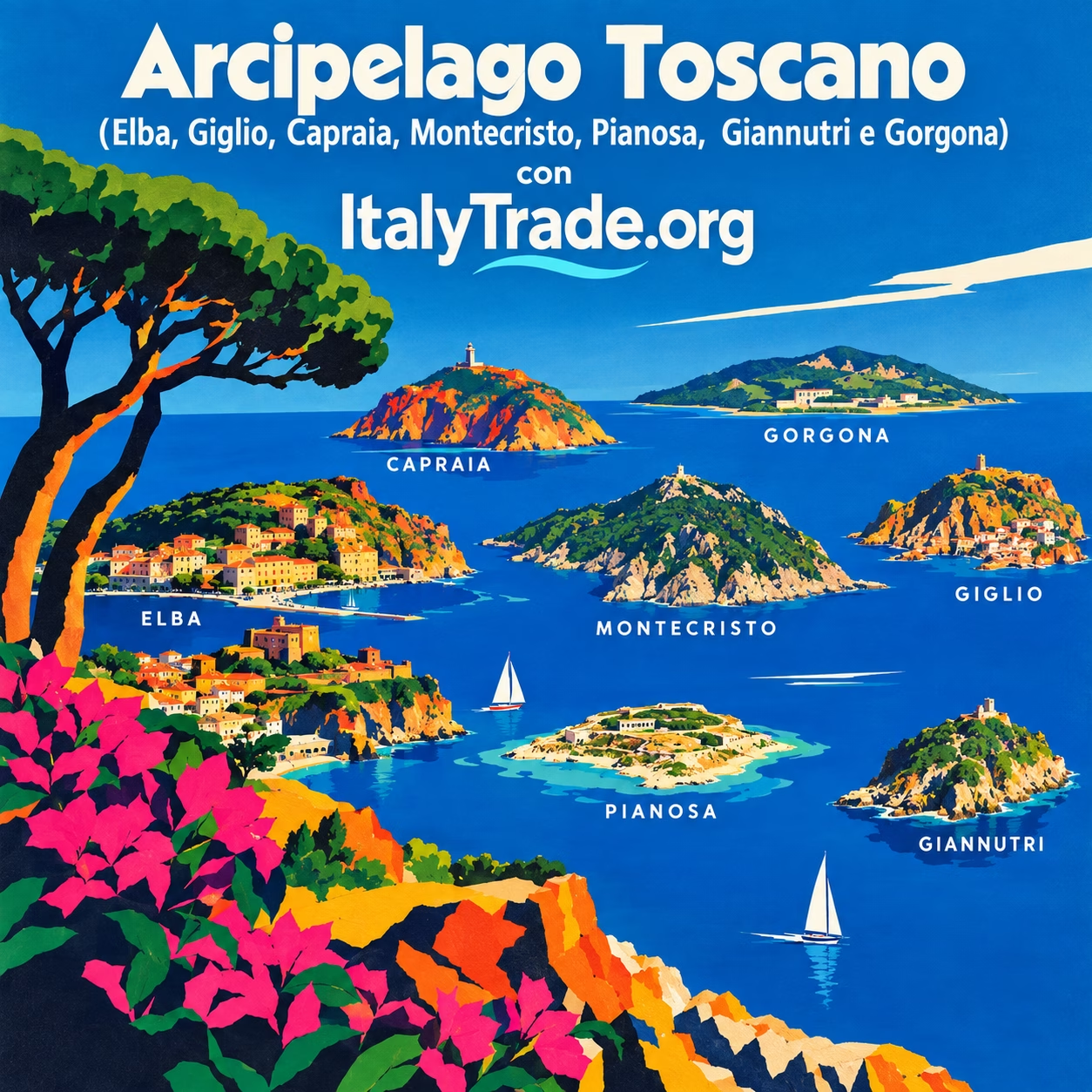
Die sieben Hauptinseln – Elba, Giglio, Giannutri, Capraia, Pianosa, Gorgona und Montecristo – stehen unter dem Schutz des Nationalparks Toskanischer Archipel, der als größter Meerespark Europas beschrieben wird. Das offizielle Tourismusportal Italiens stellt ihn als Ziel für Wanderungen in der Zwischensaison sowie für Schnorcheln, Tauchen und die Beobachtung von Walen und Delfinen im Sommer vor. Quelle: Italia.it (auf Italienisch)
Laut der Parkverwaltung umfasst das Schutzgebiet rund 177 km² Land und rund 615 km² Meer und schließt alle Inseln ein. Der Park schützt die Hälfte der Fläche von Elba und Giglio, während auf Capraia nur die kleine bebaute Fläche ausgenommen ist. Quelle: Nationalpark Toskanischer Archipel (PDF, auf Italienisch)
Die sieben Inseln im Überblick
Elba
Elba ist mit rund 224 km² die drittgrößte Insel Italiens und liegt 10 km vor der toskanischen Küste. Sie ist in sieben Gemeinden unterteilt, und ihr höchster Punkt ist der Monte Capanne (1.019 m), der höchste Gipfel des gesamten Archipels. Quelle: Nationalpark Toskanischer Archipel (PDF, auf Italienisch)
Giglio ist nach Größe und Einwohnerzahl die zweitgrößte Insel des Archipels: granitisch und bergig, mit einer Fläche von rund 21,2 km² und 28 km Küstenlinie. Quelle: Regione Toscana (auf Italienisch)
Seit 1971 staatliches Naturreservat, gehört sie zum UNESCO-Biosphärenreservat „Isole di Toscana“ und zum Pelagos-Schutzgebiet für Meeressäuger. Quelle: Quotidiano.net (auf Italienisch)
Pianosa
Pianosa ist die flachste Insel des Archipels: knapp über zehn Quadratkilometer groß, mit einer maximalen Höhe von 29 Metern. Von 1858 bis 1998 war sie eine Strafkolonie. Quelle: Visit Tuscany (auf Italienisch)
Sie bewahrt Zeugnisse, die bis in die Jungsteinzeit zurückreichen, und war in der Kaiserzeit der Verbannungsort von Agrippa Postumus, einem Enkel des Augustus. Quelle: SiViaggia (auf Italienisch)
Giannutri
Giannutri (2,6 km², 11 km felsige Küste) ist die südlichste der toskanischen Inseln. Die einzigen Anlegestellen sind Cala Spalmatoio und Cala Maestra, und die römische Villa dei Domizi kann mit spezialisierten Führern besichtigt werden. Quelle: Nationalpark Toskanischer Archipel (PDF, auf Italienisch)
Die Häftlinge leben im offenen Vollzug und bewirtschaften Gemüsegärten und Weinberge auf Terrassen; auf der Insel sieht man die Ruinen der römischen Villa und die pisanische Festung Rocca Vecchia. Quelle: Italia.it (auf Italienisch)
Natur und geschütztes Meer
Die Vegetation ist überwiegend mediterran, und die Flora ist reich an endemischen Arten. Der Archipel ist zudem Rast- und Brutplatz für viele Zugvögel, und seine Geodiversität macht die Vielfalt an Mineralien überraschend. Quelle: Nationalpark Toskanischer Archipel (PDF, auf Italienisch)
In den elbanischen Trattorien finden Sie Gurguglione (gemischtes Gemüse, in der Pfanne mit Öl, Knoblauch und Basilikum gegart), Cacciucco nach elbanischer Art (Fischeintopf) und Schiaccia briaca, ein Gebäck mit Rosinen, Pinienkernen, Walnüssen und Mandeln, das mit Aleatico-Wein getränkt wird. Quelle: Scattidigusto (auf Italienisch)
Aleatico und Elba DOC
Der Aleatico Passito von Elba, ein süßer Meditationswein aus getrockneten Trauben, erhielt 2011 den DOCG-Status; er wird auf über 32 Hektar auf Elba und auf über 3 Hektar auf Capraia angebaut. Quelle: Visit Tuscany (auf Englisch)
Auch die Verbindung der Insel zum Wein ist offiziell: Die Elba DOC besteht seit 1967, als eine der ersten in Italien. Quelle: Blu Navy (auf Englisch)
So besuchen Sie die Inseln
Montecristo, Pianosa und Gorgona sind streng geschützt, und der Zugang ist reglementiert. Auf Giannutri ist der Zutritt frei, doch auf dem größten Teil der Insel muss man von Führern begleitet werden. Quelle: Nationalpark Toskanischer Archipel (PDF, auf Italienisch)
Montecristo erreicht man nur über die von der Parkverwaltung organisierten Besuche, die vorab gebucht werden müssen, auf drei genehmigten Wegen und mit Badeverbot; Gorgona nur mit geführten Besuchen ab Livorno. Quelle: Italia.it (auf Italienisch)
Reiseroute für 4 Tage zwischen den Inseln
Die Inseln werden von verschiedenen Festlandhäfen aus erreicht: Piombino für Elba, Porto Santo Stefano für Giglio, Livorno für Capraia. Deshalb ist die Reiseroute in getrennte Etappen gegliedert, die an die Fährfahrpläne angepasst werden sollten. Quelle: Traghetti.com (auf Italienisch)
Portoferraio ist Hauptort und wichtigster Hafen von Elba. Sein heutiges Aussehen erhielt es unter Cosimo I. de‘ Medici, der ab 1548 bedeutende Befestigungsarbeiten begann. Quelle: Visit Tuscany (auf Italienisch)
Das im 16. Jahrhundert von den Medici erbaute Forte Falcone überragt die Stadt und ist heute ein Aussichtspunkt, während auf der anderen Seite das Forte Stella fünf Bastionen und einen Leuchtturm aus dem 19. Jahrhundert besitzt. Quelle: SiViaggia (auf Italienisch)
Die Palazzina dei Mulini war Napoleons Residenz während seines Exils auf Elba, vom 4. Mai 1814 bis zum 26. Februar 1815, und wird heute als Teil des Nationalmuseums der napoleonischen Residenzen besichtigt. Quelle: Visit Tuscany (auf Englisch)
Tag 2 – Elba: Villa San Martino und elbanische Weine
Außerhalb der Stadt, nahe Procchio, liegt die Villa San Martino, Napoleons zweites Domizil: Sie war die Privatresidenz des Kaisers, umgeben von Wäldern und Weinbergen, die zum Meer hin abfallen. Quelle: Regione Toscana (auf Italienisch)
Giglio liegt rund 15 km vor der Küste und wird von Porto Santo Stefano in der Maremma aus erreicht: Die Fähren brauchen etwa eine Stunde bis Giglio Porto. Quelle: SiViaggia (auf Italienisch)
In Giglio Porto steht der Sarazenenturm, 1596 auf Wunsch von Ferdinand I. von Toskana erbaut; weiter oben liegt Giglio Castello, ein befestigtes Dorf innerhalb hoher mittelalterlicher Mauern mit Türmen. Quelle: Visit Tuscany (auf Italienisch)
Auf der Westseite liegt Campese am gleichnamigen Strand, berühmt für seine Sonnenuntergänge. Ein anspruchsvollerer Weg verbindet Giglio Castello über den Monte Calvo (496 m), den höchsten Punkt der Insel, mit Campese. Quelle: SiViaggia (auf Italienisch)
Tag 4 – Zur Wahl: Pianosa, Capraia oder Giannutri
Pianosa. Die Verbindungen sind saisonal und reglementiert: Der Zugang ist begrenzt, die Plätze sind kontingentiert, und eine frühzeitige Buchung ist erforderlich. Quelle: Traghettilines (auf Italienisch)
Im Frühjahr hat der Park ganztägige Besuche mit Abfahrt per Schiff ab Piombino angeboten, den ganzen Tag über begleitet von einem Parkführer; das Paket umfasste die Hin- und Rückfahrt sowie die Eintrittskarte. Quelle: SiViaggia (auf Italienisch)
Capraia. Die Fähre ab Livorno wird ganzjährig ausschließlich von Toremar betrieben und dauert etwa 2 Stunden 45 Minuten. Quelle: Traghettilines (auf Italienisch)
Giannutri. Die Insel wird von Porto Santo Stefano aus erreicht und gilt als Paradies für Schnorchler und Taucher; nahe der Cala Maestra liegen die Überreste einer römischen Villa aus dem 2. Jahrhundert n. Chr. Quelle: Visit Tuscany (auf Italienisch)
Redaktionelle Transparenz. Autor: Giuseppe Baldassarri – ItalyTrade.org. Jeder Absatz nennt die herangezogene Quelle; Abschnitte ohne verifizierte Quelle wurden nicht veröffentlicht. Die meisten Quellen sind auf Italienisch und entsprechend gekennzeichnet. Unabhängiger redaktioneller Inhalt.
Giuseppe Baldassarri – Sales & Account Manager | Destination Marketing | Made in Italy
From Rome to Venice, via Florence and Tuscany: a practical day-by-day
guide
Editorial note. This article only includes sections for
which a public source was found and verified.
📈 Trending today — 7-Day Italy Itinerary
Autumn is driving travel searches: grape harvests in Tuscany and Piedmont,
foliage and the Alba White Truffle Fair are boosting interest in road-trip
itineraries across Italy.
A 7-day Italy itinerary is the most realistic way to cross the country
without sacrificing its soul: from Rome to Venice, via Florence and the
Tuscan countryside, each stop tells a different chapter of the same
centuries-old story. There is no need for a complicated route: a handful
of well-connected cities by train or car, plus a pace that leaves room for
the unexpected, is what several travel guides dedicated to one-week tours
of the country recommend.
Spotahome guide — Touring Italy in 7 days
Geographically, Italy stretches over 1,200 km from the Alps to Sicily, but
a one-week itinerary works best when it focuses on a North-Central axis,
reducing travel time and increasing the actual time spent in each city:
Rome, Florence and Venice remain the most recommended stops for travelers
with only seven days available.
Visititaly.eu — Italy Express, the essential 7-day itinerary
📍
61
UNESCO sites in Italy (2026)
🌡️
14–24°C
Average autumn temperatures
🗣️
Italian
Official language
✈️
Rome · Milan
Main airport hubs
Culture and nature
An unmatched artistic heritage
Italy is the country with the highest number of World Heritage Sites in
the world: as of 2026 the Ministry of Culture's official count stands at
56 historic recognitions, a record no other nation holds.
Ministry of Culture — Italian UNESCO World Heritage Sites
According to Wikipedia's update based on UNESCO data, by 2026 the total
number of inscribed heritage sites rises to 62, of which 55 are cultural
and 6 natural: a mosaic ranging from the historic centers of Rome and
Florence to the Dolomites, from the Cinque Terre to the vineyard
landscapes of Piedmont and Tuscany.
Wikipedia — World Heritage Sites of Italy
Uniqueness
Why this itinerary works in 7 days
🏛️ The country with the most UNESCO sites in the world
From Rome to Venice, the itinerary's food changes radically: carbonara
in the capital, steak in Tuscany, sarde in saor in the Venetian lagoon.
Spotahome — Touring Italy in 7 days
🎭 Centuries-old traditions, still alive
Events such as the Palio di Siena, a horse race held twice a year in
Piazza del Campo since the Middle Ages, show how Italy's calendar is
still shaped today by authentic historic rituals.
Municipality of Siena — The Palio di Siena
Places and sites
The must-see stops of the itinerary
Lazio
Rome
The Colosseum, the Imperial Forums and the Palatine Hill make up
Italy's most visited archaeological park: the standard ticket
costs €18 and is valid for 24 hours.
Colosseo.it — Official opening hours and tickets
Tuscany
Florence
Tuscany's Renaissance heart revolves around Piazza del Duomo, the
Ponte Vecchio and the Uffizi Gallery, open Tuesday to Sunday from
8:15 am to 6:30 pm.
B-ticket — Official Uffizi ticket office
Veneto
Venice
Built on 118 small islands linked by 354 bridges and crossed by
177 canals, Venice is best explored on foot and by vaporetto along
the Grand Canal.
Venezia-tourism.com — Tourist information
Tuscany
Siena
The medieval center that hosts the Palio, the traditional horse
race run in Piazza del Campo on July 2 and August 16 every year.
Municipality of Siena — The Palio
Tuscany
Val d'Orcia and Chianti
Vine-covered hills between Siena and Montalcino, best visited in
September and October during the grape harvest, when the vineyards
turn red and gold.
Freedome — Where to go on holiday in Italy in 2026
Liguria
Cinque Terre
Five villages perched over the sea — Monterosso, Vernazza,
Corniglia, Manarola and Riomaggiore — linked by scenic trails
along the Ligurian coast.
Spotahome — Touring Italy in 7 days
Trentino-Alto Adige
The Dolomites
A UNESCO World Heritage Site since 2009, the Dolomites offer a
mountain alternative for those wishing to extend the itinerary
beyond the classic seven days.
Wikipedia — World Heritage Sites of Italy
Piedmont
Langhe and Roero
The hills of Piedmont, home to Barolo and Barbaresco wines, take
center stage in autumn with the hunt for the white truffle.
Freedome — Destinations for 2026
The symbol of the Serenissima overlooks Venice's most famous
square, an ideal starting point for exploring the city's six
sestieri (districts).
Venezia-tourism.com
Two of the five Cinque Terre villages, also reachable by train
along the Ligurian coast, ideal for a stop off the beaten path.
Spotahome — Touring Italy in 7 days
Marche
Gradara and the Conero Riviera
Castle villages and scenic coastline often suggested as a less
crowded alternative to Central Italy's better-known destinations.
Tripadvisor Italy Forum — Travel advice
Food and wine
A journey through Italian flavors
Each stop of the itinerary corresponds to a different cuisine: in Rome you
eat carbonara in the Trastevere neighborhood, moving north you shift to
Tuscan cuisine and finally to Venice's lagoon flavors.
Spotahome — Touring Italy in 7 days
🍝 Regional dishes not to miss
Carbonara
The quintessential Roman dish, best tasted in Trastevere during the
Rome stop.
Bistecca alla fiorentina
A signature cut of Tuscan cuisine, typical of trattorias in central
Florence.
Pici with truffle
Handmade pasta from Siena paired with truffle, also a star in the
Piedmontese Langhe.
Sarde in saor
A sweet-and-sour Venetian dish with sardines, onions and raisins,
typical of Venice's bacari.
Venetian cicchetti
Traditional small bites served in the bacari of the Cannaregio and
Castello districts.
Chianti DOCG
The red wine that symbolizes Tuscany, produced on the hills crossed
during the itinerary.
🍷 Wines along the route
The Chianti hills between Siena and Florence remain the most popular wine
destination on the central leg of the itinerary, while travelers extending
the trip toward Piedmont can pair the autumn stop with Barolo and
Barbaresco tastings in the Langhe.
Freedome — Where to go on holiday in Italy in 2026
Grape harvest in Tuscany and Piedmont — September-October
The grape-picking season makes the hills of Chianti and the Langhe
especially picturesque, with plenty of local food-and-wine events.
Freedome — Destinations for 2026
⛪ A calendar shaped by centuries-old rites
From the historic procession that precedes the Palio di Siena to the
religious celebrations tied to the Assumption on August 16, many of the
traditions encountered along a 7-day itinerary trace their roots back to
the Middle Ages and are still managed directly by local communities.
Municipality of Siena — The Palio di Siena
Art and architecture
Art and architecture: the masterpieces not to miss
The Uffizi hold the world's largest collection of Botticelli and Raphael
works, alongside masterpieces by Giotto, Titian, Leonardo da Vinci and
Caravaggio, inherited from the Medici family's private collection.
Toscana.info — Uffizi Gallery, works and information
In Rome, the Colosseum Archaeological Park combines the Colosseum, the
Roman Forum and the Palatine Hill into a single route: ticket sales open
30 days before the visit, and online booking is recommended to avoid
queues.
Colosseo.it — Opening hours and tickets
Everyday life
The charm of the Italian lifestyle
Strolling through Trastevere in Rome, crossing the Ponte Vecchio in
Florence, or getting lost among Venice's calli means stepping into a pace
of life made of piazzas, markets and coffee stops that remains the true
added value of a one-week itinerary.
Agoda — 7 days of Italian indulgence
In Venice, local life is inseparable from the lagoon: the city is
organized into six sestieri — Cannaregio, Castello, Dorsoduro, Santa
Croce, San Marco and San Polo — and is lived mainly on foot or by water.
Venezia-tourism.com — Tourist information
Villages and routes
Villages and alternative itineraries
Travelers wanting to vary the classic Rome-Florence-Venice axis can turn
the itinerary south, alternating Rome, Naples and the Amalfi Coast, or
toward Piedmont in autumn to combine the Langhe hills with the White
Truffle Fair.
Spotahome — Touring Italy in 7 days
🗺️ Short itinerary (7 days): Rome – Florence – Venice
Days 1-2: Rome. Days 3-4: Florence and
Siena. Days 5-6: Venice. Day 7: Verona
day trip and departure.
By adding a few days, the route can be extended from Milan all the way
to Naples and the Amalfi Coast, a route often suggested by travel guides
as a complete North-South alternative.
Spotahome — Touring Italy in 7 days
In the historic centers of Rome, Florence and Venice, mid- to high-range
hotels remain the most practical option for travelers with limited time
who want to walk between the main attractions.
Apartments and holiday homes
A recommended option for families or multi-night stays in the same city,
often cheaper than a hotel in central areas.
Agriturismo (farm stays)
Ideal for the Tuscany leg, between Siena and San Gimignano, to
experience the Chianti hills described by travel guides.
Spotahome — Touring Italy in 7 days
Campsites and glamping
A more budget-friendly alternative for independent travelers, common
along the coast and in the hilly areas of Central Italy.
📅 Best time to go
The best time for a 7-day itinerary runs from late April to early June, or
from mid-September to mid-October, when the weather is mild, crowds are
thinner, and temperatures stay between 14°C and 24°C.
iRoamly — Best time to visit Italy
Local excellence
Made in Italy excellence along the route
Alba's white truffle, Tuscan Chianti DOCG and the wines of Langhe and
Roero are among the most representative products encountered right along
this itinerary, with the Alba fair drawing over 600,000 visitors every
year across the Langhe, Monferrato and Roero.
Sapori News — Alba International White Truffle Fair 2026
Destination wedding
Dream wedding locations along the itinerary
Tuscan villas between Siena and Florence, and historic Venetian palaces,
are among the most sought-after locations for international weddings in
Italy, thanks to a combination of landscape, art and hospitality services
now well established in the luxury travel sector.
Discover ItalyTrade's luxury wedding services.
Real estate
Luxury real estate along the itinerary
The areas covered by this itinerary — from the historic center of Florence
to the Chianti hills, all the way to the historic palaces of Venice —
remain among Italy's most sought-after luxury real estate markets for
international investors.
Learn more about the luxury real estate market.
Prices and budget
Accommodation prices: low and high season
🌧️ Low season (January-March, November)
€100–350
Double room in a 3-4 star hotel in the historic centers of Rome,
Florence or Venice.
☀️ High season (June-August, December)
€350–1000
Same accommodation types, with rates in historic centers that can
exceed €1,000 a night for luxury options.
🍽️ Budget restaurant
€100–200
Dinner for two at a traditional trattoria, wine included.
🦞 Gourmet restaurant
€200–1000
Tasting menu at a Michelin-starred restaurant in Rome, Florence or
Venice, wine pairing included.
Where to eat
Where to eat along the itinerary
🍝 Traditional trattoria
In Rome's Trastevere, this is the most recommended option for tasting
authentic carbonara in an informal setting.
Spotahome — Touring Italy in 7 days
🍷 Wine bar with kitchen
Common between Siena and the Chianti hills, pairing local wine tastings
with traditional Tuscan country dishes.
🥗 Agriturismo
In Tuscany, this lets you eat farm-to-table produce directly on the
estate where you are staying.
🍢 Venetian bacaro
In Venice, bacari serve cicchetti and small glasses of wine standing up
— a local habit not to miss in the Cannaregio and Castello districts.
Visitor analysis
Who visits Italy?
In the fourth quarter of 2025, foreign visitors accounted for 56.5% of
total overnight stays in Italy, up 5.1% year-on-year, while overnight
stays by Italian tourists remained broadly stable.
Confcommercio — Tourism in Italy, Q4 2025 (Istat data)
56.5% Overnight stays by foreign tourists
43.5% Overnight stays by Italian tourists
Source: Istat, Movement of clients in accommodation facilities, Q4 2025.
Full source
According to Bank of Italy data, the inbound tourism flow is fed by both
European and non-European travelers: Germany and Spain remain the leading
countries of origin, while arrivals from the Gulf states and the Far East
are growing rapidly.
Businessonline — Official Bank of Italy data on tourism in Italy,
2025
July is confirmed as the peak month for foreign tourist arrivals, with
42.7 million overnight stays recorded in summer 2025, while Italians
continue to prefer August for their own holidays.
Valigiamo — Summer 2025, Istat data on tourism in Italy
Detailed itinerary
7-day itinerary, day by day
Days 1-2
Rome
Colosseum, Roman Forum and Palatine Hill in the morning with a
pre-booked ticket; in the afternoon, the Trevi Fountain, the Pantheon
and dinner in Trastevere.
The most recommended axis is Rome-Florence-Venice, with an optional
stop in Siena or Verona.
Source: Visititaly.eu
Late April to early June, or mid-September to mid-October, when
temperatures stay between 14°C and 24°C and crowds are thinner.
Source: iRoamly
The standard 24-hour ticket for the Colosseum, Roman Forum and
Palatine Hill costs €18, with mandatory booking of the entry time
slot.
Source: Colosseo.it
Yes: the Uffizi Gallery is among the most visited museums in the
world, and booking online significantly cuts down waiting times at
the ticket office.
Source: B-ticket, official Uffizi ticket office
As of 2026, Italy holds the highest number of UNESCO sites in the
world, between 56 and 62 depending on the source and counting
method.
Source: Ministry of Culture
Yes, the City of Venice applies an Access Contribution for day
visitors on certain dates; up-to-date information is published on
the city's official portal.
Source: City of Venice
In 2024, Italy recorded a record 65 million visitors, while in Q4
2025 foreigners generated 56.5% of total overnight stays.
Source: Confcommercio/Istat
Yes: travelers visiting between October and December can extend the
route to Piedmont for the Alba International White Truffle Fair,
running from October 10 to December 6, 2026.
Source: Piemonte Expo
Conclusion
Seven days to fall in love with Italy
A well-built 7-day Italy itinerary doesn't aim to see everything, but to
leave time to truly experience every stop: the history of Rome, the
Renaissance of Florence, the Tuscan hills and the canals of Venice
together tell an identity no other destination can replicate.
Whether you choose spring, with its soft colors, or autumn, with the grape
harvest and the Truffle Fair, the result is the same: a trip capable of
staying with you long after the week on the road is over.
Italy isn't just visited: it's lived, one day at a time.
Chianti, Val d'Orcia, Langhe, Roero, Monferrato, Val di Noto, Tuscia,
Valle d'Itria, Lunigiana, Garfagnana, Casentino, Mugello, Valdichiana,
Valle Umbra, Valnerina, Murge, Sila, Aspromonte, Barbagia, Gallura,
Ogliastra, Sulcis-Iglesiente, Carnia, Brianza, Oltrepò Pavese,
Franciacorta, Colli Euganei, Sibillini Mountains.
🏛️ Top Italian Tourism Municipalities
Here is the single list featuring the 100 Italian municipalities
consistently at the top for overall tourist arrivals and overnight stays.
The order reflects official Istat data from consolidated surveys on
overnight stays in accommodation facilities (hotels, campsites, and
extra-hotel accommodations).
Roma (Lazio), Milano (Lombardia), Venezia (Veneto), Firenze (Toscana),
Rimini (Emilia-Romagna), Cavallino-Treporti (Veneto), San Michele al
Tagliamento / Bibione (Veneto), Jesolo (Veneto), Caorle (Veneto), Bologna
(Emilia-Romagna), Lazise (Veneto), Napoli (Campania), Lignano Sabbiadoro
(Friuli-Venezia Giulia), Riccione (Emilia-Romagna), Torino (Piemonte),
Verona (Veneto), Cervia (Emilia-Romagna), Cesenatico (Emilia-Romagna),
Sorrento (Campania), Peschiera del Garda (Veneto), Bardolino (Veneto),
Ravenna (Emilia-Romagna), Gatteo (Emilia-Romagna), Bellaria-Igea Marina
(Emilia-Romagna), Castelrotto / Kastelruth (Trentino-Alto Adige), Riva del
Garda (Trentino-Alto Adige), Pisa (Toscana), Sirmione (Lombardia),
Malcesine (Veneto), Comacchio (Emilia-Romagna), Genova (Liguria), Padova
(Veneto), Limone sul Garda (Lombardia), Cattolica (Emilia-Romagna), Selva
di Val Gardena (Trentino-Alto Adige), Desenzano del Garda (Lombardia),
Vieste (Puglia), Assisi (Umbria), Garda (Veneto), Montecatini Terme
(Toscana), Abano Terme (Veneto), Grado (Friuli-Venezia Giulia), Palermo
(Sicilia), Arzachena / Costa Smeralda (Sardegna), Orbetello (Toscana), San
Vincenzo (Toscana), Castiglione della Pescaia (Toscana), Livigno
(Lombardia), Badia (Trentino-Alto Adige), Corvara in Badia (Trentino-Alto
Adige), Chioggia (Veneto), Alghero (Sardegna), Olbia (Sardegna), Taormina
(Sicilia), Lucca (Toscana), Siena (Toscana), Siracusa (Sicilia), Catania
(Sicilia), Bari (Puglia), Lecce (Puglia), Otranto (Puglia), Gallipoli
(Puglia), Ugento (Puglia), Matera (Basilicata), Cortina d'Ampezzo
(Veneto), San Vito Lo Capo (Sicilia), Cefalù (Sicilia), Villasimius
(Sardegna), Sanremo (Liguria), Finale Ligure (Liguria), Trieste
(Friuli-Venezia Giulia), Trento (Trentino-Alto Adige), Bolzano
(Trentino-Alto Adige), Bergamo (Lombardia), Brescia (Lombardia), Como
(Lombardia), Stresa (Piemonte), Baveno (Piemonte), Misano Adriatico
(Emilia-Romagna), Eraclea (Veneto), Arco (Trentino-Alto Adige),
Nago-Torbole (Trentino-Alto Adige), Andalo (Trentino-Alto Adige), Canazei
(Trentino-Alto Adige), Campitello di Fassa (Trentino-Alto Adige), Marebbe
/ Enneberg (Trentino-Alto Adige), Valdaora / Olang (Trentino-Alto Adige),
Pinzolo / Madonna di Campiglio (Trentino-Alto Adige), Bormio (Lombardia),
Courmayeur (Valle d'Aosta), Ayas (Valle d'Aosta), Molveno (Trentino-Alto
Adige), Mezzana (Trentino-Alto Adige), Dobbiaco / Toblach (Trentino-Alto
Adige), Sesto / Sexten (Trentino-Alto Adige), San Candido / Innichen
(Trentino-Alto Adige), Positano (Campania), Amalfi (Campania), Ischia
(Campania), Perugia (Umbria)
Top Destinations in Italy: A Comprehensive Guide By Giuseppe Baldassarri ✓ Sales & Account Manager – Destination &
Export Marketing in Italy Italy’s Best Things to Do – Discover Italy’s Essence
Editorial transparency
Who wrote this article? Based on what?
📋 Transparency and Verifiability
Written by: Giuseppe Baldassarri — ItalyTrade.org. Based on which evidence: Official, verified sources
linked throughout the text (Ministry of Culture, Istat, Bank of Italy,
Municipality of Siena, City of Venice, Colosseo.it, Uffizi B-ticket,
Piemonte Expo). Are there other viewpoints: Yes, noted where relevant
(e.g. the exact number of UNESCO sites, which ranges from 56 to 62
depending on the source). Possible undisclosed interest: None. Independent
editorial content.