
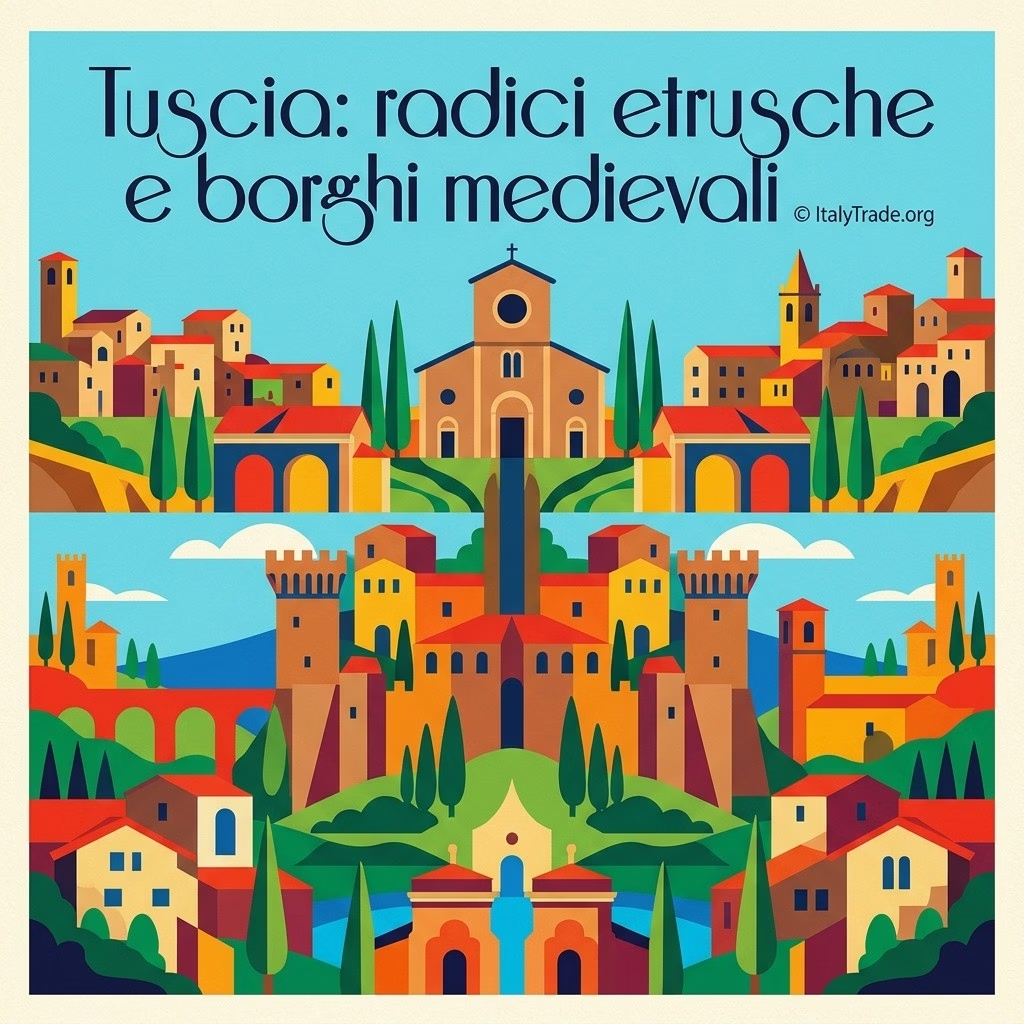
Tuscia: Etruscan Roots and Medieval Villages
Province of Viterbo, Lazio — Etruscan necropolises, the City of the Popes and Lake Bolsena
Where tuff stone guards Etruscans, popes and legends
Tuscia, in Italy, is the northern part of Lazio that many travellers discover after Rome: a territory that broadly coincides with the province of Viterbo, in the far north of the region. Etruscan heritage, medieval villages in Lazio, the historic centre of Viterbo, Etruscan necropolises and Lake Bolsena all lie within a short distance of one another, so a trip to northern Lazio can move from painted tombs to papal palaces in just a few days.
The landscape is shaped by volcanic rock: villages perched on cliffs, woods where stones take fantastical forms, Etruscan cities preserved beneath the earth. Add Lake Bolsena, described as the largest volcanic lake basin in Europe. Tuscia is easy to reach, especially from central and southern Italy.
Source: TheWom — Tuscia (in Italian) · Source: TheWom — Lake Bolsena (in Italian)
Source: Visit Lazio — Etruscan and Roman sites · Source: Visit Lazio — Machine of Santa Rosa · Source: TheWom — Lake Bolsena (in Italian)
Etruscans, popes and volcanoes: the long history of northern Lazio
Before the Romans, the Etruscans dominated the lands between Tuscany and Lazio, leaving works of art and ingenuity that still astonish today. The Viterbo area holds several of the main Etruscan cities: besides Tarquinia and Vulci, regional tourism sources also mention Blera, Bolsena, Norchia and Tuscania, while Cerveteri, Tarquinia’s partner in the UNESCO listing, lies in the province of Rome.
The Middle Ages added a second layer of history. In the thirteenth century Viterbo became a papal seat and went down in history as the City of the Popes: the Palazzo dei Papi was built between 1255 and 1266 and is linked to the origin of the papal election model, with cardinals isolated until the new pope is announced.
Nature completes the picture. According to geological accounts, Lake Bolsena formed around six hundred thousand years ago, when explosive vents created a vast depression that later filled with water; two islands rise from the lake, Bisentina and the smaller Martana. For more, read our guides to Lake Bolsena and Lake Vico.
Source: Italytraveller — Tracing the Etruscans · Source: Visit Lazio — Etruscan and Roman sites · Source: GreenMe — Viterbo (in Italian) · Source: Visit Italy — San Pellegrino (in Italian) · Source: SiViaggia — Bisentina Island (in Italian)
Why Tuscia is unique
🏛️ Etruscan necropolises, UNESCO World Heritage
The necropolises of Tarquinia, in the province of Viterbo, and Cerveteri, in the province of Rome, have been UNESCO World Heritage Sites since 2004. Tarquinia’s Monterozzi necropolis is famed for painted tombs showing everyday life, while Cerveteri’s Banditaccia is described as the largest necropolis in the Mediterranean basin.
🏰 One of Europe’s largest medieval quarters
Viterbo’s San Pellegrino quarter is described as one of the largest and best-preserved medieval quarters in Europe, with towers, thirteenth-century palaces and houses with the characteristic profferli, the external staircases typical of the city.
🗼 A festival on UNESCO’s intangible heritage list
Since 2013 the transport of the Macchina di Santa Rosa, which every 3 September carries a luminous tower through the streets of Viterbo on the shoulders of about a hundred porters, has been recognised by UNESCO among the festivals of large shoulder-borne processional structures.
Source: Visit Lazio — Etruscan and Roman sites · Source: Fanpage — San Pellegrino (in Italian) · Source: Visit Lazio — Machine of Santa Rosa
The wonders of Tuscia
Viterbo
The City of the Popes lies at the foot of the Cimini Mountains. Its historic centre is rich in towers, fountains and palaces, with Piazza San Lorenzo, the Palazzo dei Papi and the Cathedral.
Tarquinia
In the Monterozzi necropolis the painted decorations of about 150 tombs depict scenes from Etruscan daily life.
Tuscania
Cited as one of the symbols of Tuscia, a small village that seems straight out of a fairy tale; together with Tarquinia it offers a dive into the Etruscan world.
Vulci
An ancient Etruscan city-state in the Lazio Maremma, today a natural and archaeological park of about 120 hectares along the Fiora river.
Lake Bolsena
Europe’s largest lake of volcanic origin and Italy’s fifth largest, ringed by villages such as Bolsena, Marta and Capodimonte. Read the ItalyTrade guide.
Bisentina Island
The larger of the lake’s two islands, with woods, gardens and Renaissance chapels; it can only be reached by water.
Lake Vico
Another lake of volcanic origin, surrounded by villages such as Caprarola and San Martino al Cimino. Read the ItalyTrade guide.
Viterbo’s thermal baths
The area is known for its thermal waters: the Terme dei Papi take their name from Nicholas V, while the Bullicame is mentioned in the Divine Comedy.
Palazzo dei Papi
A thirteenth-century fortress-residence built between 1255 and 1266, symbol of papal Viterbo, with the Loggia delle Benedizioni and the Conclave Hall.
Palazzo Farnese
A late-Renaissance residence with a pentagonal plan, designed by Vignola, with a circular courtyard and the celebrated helicoidal Scala Regia.
François Tomb
A fourth-century BC hypogeum discovered in 1857, known for its fresco cycle on the saga of the Vibenna brothers.
Villa Lante
An Italian garden whose construction, begun in 1511, took about fifty years; the name recalls Ippolito Lante Montefeltro della Rovere.
Civita di Bagnoregio
The “dying city” rises on a spur of tuff in the Calanchi valley, amid erosion and landslides, and is one of the most photographed villages in Tuscia.
Vitorchiano
A village with medieval walls, the Fontana a Fuso and a sixteenth-century town hall.
Capodimonte
Set on a promontory on the lake’s southern shore, among cobbled lanes and red roofs, it is the departure point for boats to the islands.
Marta
An old fishing village on the lake’s southern shore, with small squares and paved lanes.
Source: Italytraveller — Tracing the Etruscans · Source: Visit Lazio — Vulci · Source: Finestre sull’Arte — Tuscia, what to see · Source: SiViaggia — Viterbo (in Italian) · Source: TheWom — Lake Bolsena (in Italian) · Source: Finestre sull’Arte — Bisentina Island (in Italian) · Source: TheWom — Villages of Tuscia (in Italian) · Source: Quotidiano.net — Pearls of Tuscia (in Italian) · Source: TheWom — What to see in Viterbo (in Italian) · Source: MuseiOnline — François Tomb (in Italian) · Source: Romeing — Best places in Tuscia
Flavours of Tuscia: oil, wine and lake fish
The cuisine of Tuscia springs from a volcanic, lakeside territory: among the most often mentioned flavours are the passito of Lake Bolsena, hazelnuts, Tuscania’s craft beer and the extra virgin olive oil of Canino, made from the native Caninese cultivar.
🍝 Dishes and products to look for
Acquacotta
A humble soup of stale bread, courgettes, onion and Tuscia PDO oil, finished with egg and Parmesan.
Lake fish
Eel, pike and tench from Lake Bolsena are cited among the freshwater fish suited to Tuscia PDO oil.
Tuscia PDO oil
Extra virgin oil produced across the province of Viterbo, with a tradition going back at least to the 6th century BC.
Hazelnuts
Hazelnuts from Tuscia are among the territory’s emblematic products.
Black truffle of Blera
The clay soil of Tuscia suits this delicacy, sought in villages such as Civita Castellana.
Est! Est!! Est!!!
A white DOC wine from Montefiascone, produced around Lake Bolsena.
🍷 The wines of the lake
The white Est! Est!! Est!!! di Montefiascone obtained DOC status in 1966, with vineyards in the municipalities of Bolsena, Capodimonte, Gradoli, Grotte di Castro, Marta, Montefiascone and San Lorenzo Nuovo. Its red counterpart is Aleatico di Gradoli, with its own DOC included in the broader Colli Etruschi.
Source: Quotidiano.net — Flavours of Tuscia (in Italian) · Source: ARSIAL — Tuscia PDO oil (in Italian) · Source: ICE — Tuscia PDO oil · Source: TheWom — Villages of Tuscia (in Italian) · Source: Le Petit Journal — Est! Est!! Est!!! (in French) · Source: Touring Club — Montefiascone (in Italian)
Traditions and festivals: the Tuscia calendar
🎉 Dates to note
San Pellegrino in Fiore — April and May
In Viterbo’s medieval quarter, houses and streets are decorated with floral compositions.
Infiorata of Bolsena — Corpus Domini (June)
The procession with the relic of the Eucharistic miracle of 1263, which took place in the Basilica of Santa Cristina, follows a long carpet of flowers laid by the townspeople.
Ludika 1234 — July
A festival dedicated to the Middle Ages in Viterbo’s historic centre, with games, parades and shows.
Macchina di Santa Rosa — 3 September
On the evening of 3 September about a hundred porters carry a luminous tower, over thirty metres high, on their shoulders; the machine is renewed every five years.
⛪ Festivals rooted in faith
Religious traditions are the thread running through the calendar. Corpus Domini was extended to all of Christendom by Pope Urban IV with the bull Transiturus of 1264, after the miracle of Bolsena. In Viterbo the Santa Rosa festival includes the historical parade on 2 September and the fair on 4 September, the patron saint’s day.
Source: Italia.it — Viterbo (in Italian) · Source: Visit Bolsena — Corpus Domini · Source: Visit Lazio — Machine of Santa Rosa · Source: Visit Italy — San Pellegrino (in Italian) · Source: Visit Italy — Santa Rosa (in Italian) · Source: Fanpage — New Macchina (in Italian) · Source: Viaggiapiccoli — Santa Rosa (in Italian) · Source: Live in Italy — Bolsena Corpus Domini
From Etruscan frescoes to the Farnese Renaissance
The art of Tuscia begins underground. The Etruscan tombs of Tarquinia are famous for wall paintings of banquets, dances and scenes of daily life, while at Vulci the François Tomb preserves one of the most important painted cycles of Etruria; the original frescoes are now kept in Rome.
Medieval architecture can be read in Viterbo’s San Pellegrino quarter, overlooked by the thirteenth-century Palazzo degli Alessandri, the Scacciaricci tower and the ancient church of San Pellegrino, dating to the eleventh century. The sixteenth century brings the great residences: Palazzo Farnese in Caprarola, the work of Vignola, and the garden of Villa Lante in Bagnaia, alongside the Sacred Grove of Bomarzo, populated by monstrous sculptures commissioned in the 16th century by Pier Francesco Orsini.
Source: Italytraveller — Tracing the Etruscans · Source: MuseiOnline — François Tomb (in Italian) · Source: Fanpage — San Pellegrino (in Italian) · Source: Quotidiano.net — Pearls of Tuscia (in Italian) · Source: SportOutdoor24 — Bomarzo (in Italian)
The most beautiful villages and recommended routes
Around Lake Bolsena you will find Montefiascone, regarded as the belvedere of Tuscia, Marta with its fishing village, Capodimonte, Valentano with its fortress, Gradoli, Grotte di Castro and San Lorenzo Nuovo, an example of eighteenth-century town planning. Around Lake Vico stand Caprarola, a Touring Club Orange Flag village, and San Martino al Cimino. Civita di Bagnoregio, thanks to tourism, is repopulating with B&Bs and restaurants.
🗺️ Short itinerary (3 days): Viterbo, villages and gardens
Three days are enough for a taste of Viterbo, Civita di Bagnoregio and the great classics such as Bomarzo and Caprarola. One suggested route puts Bagnaia (Villa Lante) and Caprarola (Palazzo Farnese and gardens) on day two, and Civita di Bagnoregio and Bomarzo’s Sacred Grove on day three.
🗺️ Extended itinerary: in the footsteps of the Etruscans
The Etruscan route starts at the Banditaccia of Cerveteri, continues with Tarquinia and the Monterozzi necropolis and ends at Canino, gateway to the Vulci Park. To extend it, add Viterbo and Lake Bolsena: you will find every stop in the detailed itinerary.
Source: TheWom — Lake Bolsena villages (in Italian) · Source: TheWom — Villages of Tuscia (in Italian) · Source: TheWom — Three days in Tuscia (in Italian) · Source: InItaly — Tuscia itinerary · Source: SportOutdoor24 — Civita di Bagnoregio (in Italian) · Source: Italytraveller — Tracing the Etruscans
How many days you need and what to check before leaving
⏱️ Recommended length
Three days allow a taste of Viterbo, Civita di Bagnoregio and the great classics such as Bomarzo and Caprarola; to add the Etruscan sites of the coast and Lake Bolsena, plan at least four days, as in the itinerary below.
🔎 What to check
Bisentina Island
Access is by water only and on specific dates, because the island is private: check the calendar on the island’s official website. Boats leave from Capodimonte and Bolsena.
Vulci
Tickets and hours vary by season and by site (park, castle and museum, nature areas): check the Park’s official website before you go. The François Tomb is visited through the park’s ticket office.
Viterbo with less climbing
The Valle Faul lifts take you in a few minutes close to the Palazzo dei Papi and reduce the climb, which is useful when travelling with children.
Source: TheWom — Three days in Tuscia (in Italian) · Source: Isola Bisentina — official site · Source: TheWom — Vulci (in Italian) · Source: MuseiOnline — François Tomb (in Italian) · Source: PianetaMamma — Viterbo with children (in Italian)
Products of excellence: Tuscia PDO oil and DOC wines
Tuscia PDO extra virgin olive oil is produced across the province of Viterbo, where the temperate climate and the volcanic origin of the soil favour high-quality production. The olive-growing tradition goes back at least to the 6th century BC, as the finds in Etruscan tombs show. Varieties used include Frantoio, Canino and Leccino, while in Canino the native Caninese cultivar is promoted.
As for wine, Est! Est!! Est!!! di Montefiascone DOC and Aleatico di Gradoli DOC tell the story of the lake territory; the Cantina di Montefiascone, founded in 1956, is described as the largest winery in the area. Visitors can book food and wine experiences directly at the winery.
Source: ICE — Tuscia PDO oil · Source: Discover Places — Montefiascone olive oil · Source: Quotidiano.net — Flavours of Tuscia (in Italian) · Source: Touring Club — Montefiascone (in Italian) · Source: Winedering — Cantina di Montefiascone
A 4-day itinerary: from the Etruscans to the lake
A suggested route that joins the verified stops: the City of the Popes, the Viterbo area’s great necropolises and Lake Bolsena.
Viterbo: San Pellegrino and the Palazzo dei Papi
Start from Piazza San Carluccio, the entrance to the medieval San Pellegrino quarter, and reach Piazza San Lorenzo with the Palazzo dei Papi, built between 1255 and 1266, and the Cathedral. To end the day there are the Terme dei Papi, named after Nicholas V.
Source: GreenMe — Viterbo (in Italian) · Source: TheWom — What to see in Viterbo (in Italian)
Tarquinia: the Monterozzi necropolis
Visit the Monterozzi necropolis, remarkable for the painted decorations of about 150 tombs depicting scenes of daily life. The site has been a UNESCO World Heritage Site since 2004, together with Cerveteri’s Banditaccia.
Source: Italytraveller — Tracing the Etruscans · Source: Visit Lazio — Etruscan and Roman sites
Vulci: park, castle and François Tomb
A few kilometres from Tarquinia, Canino is the gateway to the Vulci Natural and Archaeological Park. The park extends over about 120 hectares along the Fiora; not far away stands the Castello dell’Abbadia, a thirteenth-century fortress housing the archaeological museum, reached over the Ponte del Diavolo. Among the tombs, the François Tomb stands out.
Source: Visit Lazio — Vulci · Source: Italytraveller — Canino and Vulci
Lake Bolsena: Capodimonte and Bisentina Island
Capodimonte stands on a promontory on the lake’s southern shore, and from its harbour boats leave for Bisentina Island, which can be reached only by water and on specific dates. For more on the lake, read the ItalyTrade guide to Lake Bolsena.
Source: Quotidiano.net — Capodimonte (in Italian) · Source: SiViaggia — Bisentina Island (in Italian)
FAQ — Tuscia
Tuscia broadly corresponds to the province of Viterbo, in the far north of Lazio, and is easy to reach especially from central and southern Italy.
The necropolises of Tarquinia (Monterozzi), in the province of Viterbo, and Cerveteri (Banditaccia), in the province of Rome, have been UNESCO World Heritage Sites since 2004.
The transport takes place every year on the evening of 3 September in Viterbo; the day before there is a historical parade. Since 2013 the festival has been on UNESCO’s Intangible Cultural Heritage list.
Only by water, on boats leaving from the piers of Capodimonte and Bolsena. As the island is private, it is visited on specific dates: it is best to consult the official website.
The archaeological and nature park of about 120 hectares, the Castello dell’Abbadia with its museum, the Ponte del Diavolo and the François Tomb, discovered in 1857 and famous for its frescoes.
Three days allow a taste of Viterbo, Civita di Bagnoregio, Bomarzo and Caprarola; adding Tarquinia, Vulci and Lake Bolsena takes more days.
Est! Est!! Est!!! di Montefiascone, a white wine with DOC status since 1966, produced in the municipalities around the lake; the typical red is Aleatico di Gradoli.
On Corpus Domini, between the end of May and the first days of June: the date changes every year, so check the calendar of the Municipality or the Pro Loco.
Source: TheWom — Tuscia (in Italian) · Source: Visit Lazio — Etruscan and Roman sites · Source: Visit Lazio — Machine of Santa Rosa · Source: SiViaggia — Bisentina Island (in Italian) · Source: TheWom — Vulci (in Italian) · Source: MuseiOnline — François Tomb (in Italian) · Source: Le Petit Journal — Est! Est!! Est!!! (in French) · Source: Visit Lazio — Bolsena
A journey through stone, faith and water
In a few kilometres Tuscia brings together three worlds: the Etruscan necropolises of Tarquinia and Vulci, the papal Middle Ages of Viterbo and the villages on Lake Bolsena. Every stop has a living tradition to discover, from the Macchina di Santa Rosa to the Infiorata of Bolsena.
Whether you choose a long weekend or a four-day itinerary, northern Lazio rewards those who pause to listen to the volcanic landscape and the stories it keeps.
Tuscia is not just visited: it is crossed, from painted tombs to papal palaces and on to the shores of the lake.
Source: Italia.it — Viterbo (in Italian) · Source: TheWom — Tuscia (in Italian)
Who wrote this article? On what basis?
📋 Transparency and verifiability
Who wrote it:
Giuseppe Baldassarri — ItalyTrade.org.
What it is based on: verified sources, linked in the text.
Are there other points of view: yes, indicated where relevant.
Possible hidden interest: none. Independent editorial content.
Giuseppe Baldassarri
Giuseppe Baldassarri — Senior Revenue Manager & AI Search Specialist (AEO/GEO) | Sales & Account Manager | Destination & Export Marketing | Travel Designer | Vivi l’Italia – italytrade.org
Website: ItalyTrade.org — Travel & Business | Italy: Made in Italy
“Turning Italian excellence into global visibility in the age of artificial intelligence”
Luxury Real Estate | Export | Luxury Wedding | Travel Design
Privacy Policy » Cookie Policy » Terms of Service » Image Licenses » Sitemap » Services » Reviews » Contact » Work with us
