Riviera del Corallo in Sardinia
Alghero · Red Coral · Crystal-Clear Sea · Catalan Traditions
📈 Trending Now — Riviera del Corallo
Flights to Alghero for summer 2026 at an all-time high — the Riviera del Corallo is among the most searched Sardinian destinations on Google this spring. Snorkelling, red corals and Catalan gastronomy are all in the spotlight.
The sea has a colour you never forget
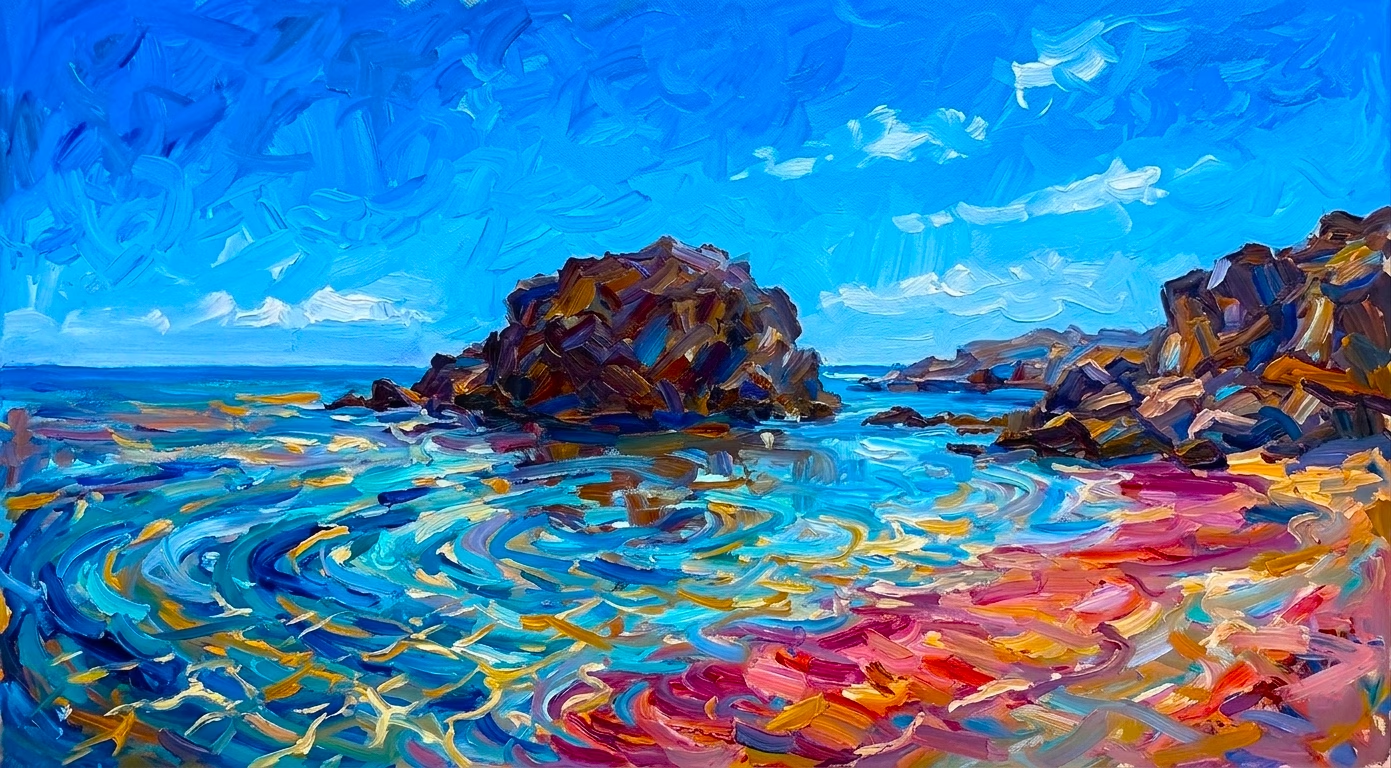
There is a moment, sailing along the Riviera del Corallo, when the sea stops being simply beautiful and becomes something else entirely: a promise. The water shifts from turquoise to cobalt blue, the cliffs blush red with the coral growing beneath the surface, and Alghero rises in the distance with its bell towers and medieval walls that seem to float on the water. You are in Sardinia, yet the voices you hear carry the scent of Catalonia, of Spain, of a cultural crossover found nowhere else in all of Italy.
This stretch of Sardinia’s north-western coast, between Alghero and Capo Caccia, safeguards one of the Mediterranean’s most precious treasures: Corallium rubrum, the noble red coral, harvested here for centuries and crafted into world-renowned jewellery. But the Riviera del Corallo is far more than a brand: it is a territory of exceptional marine biodiversity, spectacular caves, seabeds that look like paintings, and a city that still speaks Catalan and cooks lobster with the same devotion as 500 years ago.
Why the Riviera del Corallo is unique in the Mediterranean
The Riviera del Corallo stands out for an exceptionally rare convergence of excellence: natural, historical, cultural and gastronomic. Few destinations in Italy can simultaneously boast a submerged UNESCO site, a medieval Catalan-speaking city, world-class marine reserves and a coral craftsmanship tradition dating back to the 15th century.
🪸 Noble Red Coral
The Corallium rubrum from the Gulf of Alghero is the most prized in the Mediterranean. Algherese coral jewellery is internationally recognised.
🏰 Catalan Heritage
Alghero is the only Italian city where a living Catalan dialect, alguerès, is still spoken — a legacy of Aragonese rule from 1354.
🌊 Neptune’s Grotto
Accessible by boat or down the Escala del Cabirol (656 steps), Neptune’s Grotto is among the most beautiful sea caves in Europe.
🐠 Marine Reserve
The Capo Caccia–Isola Piana Marine Protected Area offers crystal-clear seabeds with posidonia, grouper, moray eels and, of course, red coral.
A regional overview of the Riviera del Corallo
The Riviera del Corallo stretches along roughly 80 km of coastline in north-western Sardinia, within the territory of the Metropolitan City of Sassari, in the historic sub-region of Logudoro-Meilogu. The main town is Alghero (approx. 44,000 inhabitants), a medieval city protected by imposing 16th-century walls, a crossroads between Sardinian and Catalan-Aragonese culture.
The territory also includes the municipalities of Villanova Monteleone, Ittiri, Uri, Olmedo and Porto Torres. The hinterland, often overlooked by tourists, offers cork oak forests, nuragic dolmens and panoramic roads crossing a landscape of limestone, vineyards and olive groves. The climate is Mediterranean, with hot dry summers (July–August up to 32°C) and mild winters — ideal for outdoor activities from April to October.
Famous places and sights
Historic Cities
Alghero is the heart of the Riviera. The 16th-century bastion walls, built by the Aragonese, embrace a historic centre of extraordinary integrity, with cobbled alleyways, Gothic-Catalan churches and stately palaces. Santa Maria Cathedral (begun in 1552) blends Gothic, Renaissance and Baroque styles in an eclecticism that narrates centuries of history. The Lungomare Dante and Lungomare Valencia promenades offer panoramic walks with views of the watchtowers mirrored in the Gulf.
Sassari, just 35 km away, is Sardinia’s second city and home to the National Sanna Museum, the island’s most important archaeological museum, with exceptional nuragic artefacts. The historic centre of Sassari, with its Town Hall and Rosello Fountain, is worth half a day.
Natural Wonders
Neptune’s Grotto (Capo Caccia) is reachable by boat from Alghero or by descending the famous 656 steps of the Escala del Cabirol. Inside, a cathedral of stalactites and stalagmites, with an underground saltwater lake of surreal colour — a world-famous heritage site.
Capo Caccia, a 170 m limestone promontory, is a breathtaking vantage point: from the belvedere you command the entire Gulf of Alghero. Isola Piana, an integral nature reserve, and the Beaches of Le Bombarde, Lido and Mugoni complete a coastal mosaic of rare beauty.
Inland, Lago Baratz is Sardinia’s only natural lake, surrounded by sand dunes and juniper forests — an ideal habitat for flamingos and herons on migration.
Art and Architecture
Alghero is an open-air art city. The Church of San Francesco (14th century), with its Gothic-Catalan cloister, is one of the most evocative spaces in Sardinia. Palazzo d’Albis, where Charles V reportedly stayed in 1541, now hosts temporary exhibitions.
The Torre di Sulis and the other watchtowers of the 16th-century walls are open to visitors and offer privileged sea views. The Coral Museum tells 600 years of local craftsmanship with unique jewellery pieces.
The Most Beautiful Villages
Villanova Monteleone, at 700 m above sea level, is a shepherds’ village with an extraordinary view over the Sardinian hinterland. Famous for traditional costumes and artisan weaving.
Ittiri, in the heart of the Meilogu, preserves a historic centre of red trachyte stone, a Romanesque church and a strong cultural identity tied to Sardinian dances and dry-stone walling. Olmedo, set on a hill among Vermentino vineyards, is perfect for a wine route through the Riviera’s hinterland.
Cuisine: a culinary journey between sea and Catalan tradition
Regional dishes
The cuisine of the Riviera del Corallo is a bridge between Sardinia and Catalonia. Lobster alla Catalana — boiled and dressed with onion, tomato, olive oil and lemon juice — is Alghero’s signature dish, essential on any visit. Equally celebrated are spaghetti with clams and mullet bottarga, and fresh sea urchins on bruschetta, served straight at the harbour.
The hinterland holds the oldest flavours: zuppa gallurese (stale bread, mutton broth, cheese), malloreddus with pork ragù, porceddu (roast suckling pig) and aged Sardinian Pecorino. Typical sweets include seadas (pastry filled with cheese, honey and lemon) and pardulas with fresh cheese, traditional at Easter.
Wine and local products
The territory produces some of Italy’s finest white wines. Vermentino di Sardegna DOC, grown in the hills around Olmedo and Alghero, is aromatic, mineral and perfect with fish. Torbato, a Catalan grape variety found only in Alghero, produces structured and long-lived whites — a true oenological rarity. Cannonau — the quintessential Sardinian red, whose antioxidant properties science has celebrated — is the ideal companion to grilled meats from the hinterland.
Traditions and festivals
Events all year round
🎭 Alghero Carnival (Feb)
Masks, allegorical floats and costume parades blending Sardinian and Spanish traditions.
🌊 Coral Night (Jun)
A night-time festival along the seafront dedicated to coral and artisan jewellery. Music, art and tastings.
🎇 Summer Music Festival (Jul–Aug)
Concerts in the cloister of San Francesco and on Alghero’s historic squares. Jazz, classical and Sardinian music.
⛵ Coral Regatta (Sep)
International sailing competition in the Gulf of Alghero, followed by thousands of enthusiasts.
Traditional festivals
The Fish Festival in August turns Alghero’s harbour into an open-air banquet, with lobster, octopus and mixed fried fish offered free to all. In September, the Feast of Sant’Agostino is the occasion to see traditional Algherese costumes, with the characteristic Catalan influence in gold embroidery and coral jewellery.
In the inland villages, the summer patron-saint festivals (June–September) keep alive the launeddas (Sardinian wind instrument, UNESCO Heritage), traditional dances and the ritual of the sartiglia in the least touristy corners of the province.
The allure of life on the Riviera del Corallo
Life in Alghero follows a slow rhythm that makes it irresistible for anyone wanting to unplug. Mornings smell of ensaïmada and coffee in the old-town pastry shops, afternoons invite a siesta or snorkelling in sheltered coves, evenings stretch out around a seafront table with lobster and ice-cold white wine. The local community is welcoming, proud of its bilingual Sardinian-Catalan identity, and the crime rate is among the lowest in Italy.
For those who choose to stay longer, the Riviera del Corallo offers an exceptional quality of life: PADI-certified diving schools, windsurfing and kite centres, weekly organic markets, and a surprisingly vibrant cultural scene for a mid-sized town. The area’s digital connectivity has attracted a wave of digital nomads, drawn by fibre-optic networks and coworking spaces overlooking the sea.
Day-by-day itinerary — 5 days on the Riviera del Corallo
Day 1 — Alghero: walls, bastions and sunset over the sea
Arrival in Alghero (Fertilia Airport, 12 km). Walk along the bastion walls, visit Santa Maria Cathedral and the medieval towers. Aperitivo at sunset on the walls overlooking the Gulf. Dinner with Catalan-style lobster in the historic harbour.
Day 2 — Neptune’s Grotto and Capo Caccia
Boat excursion (1 hr) to Neptune’s Grotto. Guided tour of the stalactites and underground lake. Climb back up the Escala del Cabirol (656 steps). Picnic at the Capo Caccia belvedere. Afternoon snorkelling in the marine reserve.
Day 3 — Beaches and coral
Morning at Le Bombarde Beach (white sand, crystal-clear water). Afternoon: visit the Coral Museum in Alghero and purchase certified artisan jewellery. Evening: fish dinner in the old harbour.
Day 4 — Hinterland: Villanova Monteleone and Vermentino vineyards
Morning departure to Villanova Monteleone (700 m a.s.l.). Visit the historic centre and meet textile artisans. Lunch at an agriturismo with porceddu and Cannonau. Afternoon at the Olmedo wineries for a tasting of Torbato and Vermentino.
Day 5 — Lago Baratz and departure
Morning at Lago Baratz and the Porto Ferro dunes: birdwatching among flamingos and herons. Stop at Alghero’s organic market to buy bottarga, pecorino and thistle honey. Transfer to the airport.
How many days, where to stay and the best time to visit
Best time to visit: May–June and September–October for the best combination of weather, swimmable sea and smaller crowds. July and August are peak months: high prices, bookings needed months in advance, but festivals and events at their peak. April is ideal for coastal hiking and cultural visits without excessive heat.
Recommended length of stay: minimum 4 days for Alghero and its immediate surroundings; 7–10 days to combine the Riviera del Corallo with the Costa Smeralda, Sassari and the nuraghi of the Logudoro.
Accommodation prices by category
per night, low season (Apr–Jun, Sep–Oct)
per night, high season (Jul–Aug)
per night, low season
per night, high season
per night, low season
per night, high season
Excellence Made-in-Italy products of the Riviera del Corallo
🪸 Noble Red Coral
Jewellery and craft objects in Corallium rubrum, certified and traceable. The highest concentration of coral goldsmiths in the historic centre of Alghero.
🍷 Vermentino di Sardegna DOC
Aromatic and mineral white wine, perfect with fish. The cellars of Olmedo and Alghero produce some of Italy’s most awarded labels.
🍷 Torbato di Alghero DOC
Catalan grape variety unique to Sardinia. A structured and long-lived white — an absolute rarity of Italian oenology.
🧀 Pecorino Sardo DOP
Aged in stone cellars, with intense aromas of Mediterranean aromatic herbs. Slow Food Presidium.
🐟 Bottarga di Muggine
Dried mullet roe, grilled or grated over pasta — the “truffle of the sea” of Sardinia.
🧺 Traditional Textiles
Hand-crafted tapestries and wool rugs by the artisan weavers of Villanova Monteleone, featuring geometric patterns emblematic of Sardinian culture.
Wedding venues on the Riviera del Corallo
The Riviera del Corallo offers fairy-tale settings for exclusive ceremonies. The bastion walls of Alghero at sunset, the Gothic cloister of San Francesco, patrician villas among Vermentino vineyards and seafront residences create a context of authentic Mediterranean romance.
The combination of exceptional seascape, signature cuisine (lobster, DOC wines, DOP cheeses), coral craftsmanship for unique wedding favours and high-end services makes the Riviera one of the Mediterranean’s most emerging wedding destinations. Civil ceremonies can be held directly on the terrace of Alghero Town Hall, with a panoramic view over the Gulf.
Luxury real estate on the Riviera del Corallo
The property market of the Riviera del Corallo is in constant growth, driven by Italian buyers (Milan, Rome) and international investors (Germany, Switzerland, France, USA). Alghero offers a varied supply: apartments in the medieval old town, seafront villas along the Costa del Corallo, wine estates in the Olmedo hinterland and panoramic hilltop residences with views over the Gulf of Alghero.
Prices start from approximately €3,500/sqm for apartments in the historic centre of Alghero and can reach €12,000–18,000/sqm for luxury seafront villas with direct beach access. The area is particularly attractive for investors seeking yield-generating properties in the luxury rental segment, with net returns of 5–8% per year in high season.
Restaurants by category
🦞 Fish & Seafood
Restaurants specialising in Catalan-style lobster, sea urchin spaghetti and mixed fried fish. Concentrated in Alghero’s historic harbour, with sea views.
🥩 Traditional Sardinian Cuisine
Porceddu, malloreddus, pecorino and Cannonau in hinterland trattorias. Authentic atmosphere, moderate prices and generous portions.
🍽 Gourmet / Fine Dining
Chefs reinterpreting Sardinian-Catalan cuisine with contemporary techniques. Tasting menus paired with Vermentino and Torbato.
🌿 Agriturismi
Organic farms offering zero-kilometre lunches among vineyards and olive groves: fresh cheese, honey, cured meats and estate wine.
🍕 Pizzerias & Trattorias
Informal spots in Alghero’s centre, ideal for families, with wood-fired pizza and handmade pasta at accessible prices.
☕ Bars & Pastry Shops
Breakfast with ensaïmada (Catalan pastry), myrtle liqueur and cheese. Aperitivo at sunset on the walls with local wines and Spanish-inspired tapas.
Visitor profile — Customer Personas
Tourist overnight stay statistics
Where do visitors come from?
Italian visitors by region
International visitors by language
FAQ — Riviera del Corallo in Sardinia
Alghero-Fertilia Airport (AHO) has direct connections to London, Dublin, Manchester, and numerous European cities with low-cost carriers (Ryanair, Wizz Air, Volotea). It is just 12 km from central Alghero. Alternatively, the port of Porto Torres (38 km) is reachable by ferry from Genoa, Civitavecchia and Barcelona.
May–June and September–October are ideal: swimmable sea (22–25°C), smaller crowds, prices 30–40% lower than in August. July–August guarantees the liveliest atmosphere and warmest temperatures (28–32°C), but requires advance bookings. April is perfect for trekking and cultural visits.
Absolutely. Alghero is compact and walkable, but to reach Neptune’s Grotto, the beaches of Porto Ferro and Mugoni, the inland villages and the wine cellars a car is essential. Airport rental prices start from around €40/day in low season. Parking in the city is available in the areas outside the walls.
The historic centre of Alghero has dozens of goldsmiths with certified and traceable coral. Always ask for the authenticity certificate and the sustainable provenance document (EU Regulation 1042/2007). Be wary of very low prices: quality authentic red coral starts from €80–150 for the simplest pieces.
Yes, the Riviera del Corallo is one of the best underwater destinations in the Mediterranean. The Capo Caccia–Isola Piana Marine Protected Area offers spectacular seabeds. Several PADI-certified dive centres operate in Alghero, with equipment hire and guides for all levels. Snorkelling is freely possible in the coves of Le Bombarde and Mugoni.
Yes. Alguerès is a Catalan dialect still spoken by part of the local community — a legacy of the Aragonese colonisation of 1354. Road signs and many shop fronts are bilingual (Italian-Catalan). It is a uniquely cultural experience: walking into a café and hearing someone order in Catalan!
Just 35 km away, Sassari has an interesting historic centre and the National Sanna Museum. 60 km distant, the Asinara National Park (reachable from Porto Torres) is one of Italy’s most beautiful nature parks. Nuraghe Palmavera (10 km from Alghero) is one of Sardinia’s best-preserved nuragic complexes. Neptune’s Grotto, Capo Caccia and Lago Baratz are unmissable.
Embracing Italian culture on the Riviera del Corallo
The Riviera del Corallo is not merely a tourist destination: it is a manifesto of everything Italy has to offer as a whole. A seascape of absolute beauty that coexists with a bilingual medieval city, a millenary craft tradition that has never been interrupted, a cuisine that narrates the history of two Mediterranean cultures fused into something unique. Coming here means stepping off the beaten track of mass tourism and into an authenticity the Mediterranean has nearly lost elsewhere.
When you head home, you will carry with you the taste of lobster at sunset, the crystal chill of Neptune’s Grotto, the warm weight of a red coral jewel in the palm of your hand — and the certainty that north-western Sardinia still has much to say to those who know how to listen.
Who wrote this article? On what basis?
📋 Transparency and Verifiability
Written by: Giuseppe Baldassarri — ItalyTrade.org.
What evidence is it based on: Verified sources, linked within the text.
Are there other viewpoints: Yes, indicated where relevant.
Possible hidden interest: None. Independent editorial content.

Giuseppe Baldassarri
Sales & Account Manager · Destination & Export Digital Marketing Manager · Travel Designer · TTO
Website: ItalyTrade.org — Travel & Business | Italy: Made in Italy
“Transforming Italian excellence into global visibility in the age of artificial intelligence”
Luxury Real Estate | Export | Luxury Wedding | Travel Design
Privacy Policy » Cookie Policy » Terms of Service » Image Licences » Sitemap » Services » Reviews » Contact » Work with us