
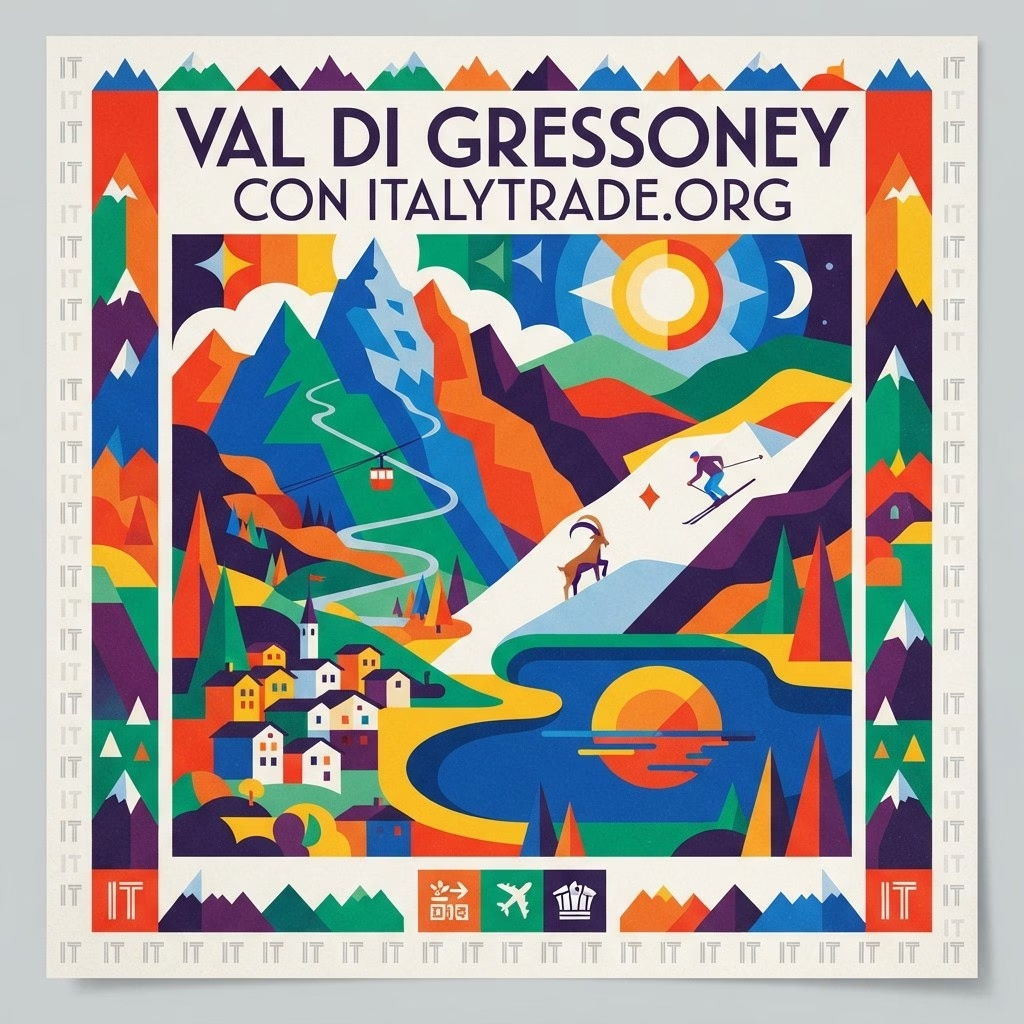
Val di Gressoney
Val di Gressoney: at the foot of Monte Rosa
Gressoney-La-Trinité stands at 1,627 metres above sea level, in a wide basin dominated by the Lyskamm glacier, part of the Monte Rosa massif. Here, in the upper Aosta Valley, mountains and Walser culture have been intertwined for more than eight centuries. Source: Gressoney Monterosa (opens in a new tab)
Gressoney-Saint-Jean lies in the Lys Valley, crossed by the Lys stream, and had 775 inhabitants at the end of 2022. Source: Wikipedia (opens in a new tab)
The valley in numbers
Walser culture
Origins and settlements
The Walser, a people of Germanic origin, reached this area more than eight centuries ago through the Theodul Pass. Source: Gressoney Monterosa (opens in a new tab)
From the mid-13th century the Walser founded small communities around the Monte Rosa massif, bringing with them their traditions and the titsch language. The stadel, wooden farm buildings raised on mushroom-shaped pillars, are one testimony to their presence. Source: Guide Turistiche VdA, in Italian (opens in a new tab)
The Ecomuseum and local traditions
In Gressoney-La-Trinité, the Walser Ecomuseum in Piazza Tache lets visitors discover this culture through three sites. On important occasions the women wear the traditional Walser costumes. Source: Gressoney Monterosa (opens in a new tab)
The language
Three languages are listed for Gressoney-Saint-Jean: French, Walser (in the local dialect Greschòneytitsch) and Arpitan. Source: Wikipedia (opens in a new tab)
Places to see in Val di Gressoney
Savoy Castle
Summer residence commissioned by Queen Margherita of Savoy and designed by architect Emilio Stramucci. It overlooks the Monte Rosa glacier and is surrounded by a park with an alpine botanical garden. Source: Guida Turistica Aosta (opens in a new tab)
Alpine botanical garden
It covers about 1,000 sq m at the foot of the castle. Mountain flowers carry labels with scientific name, common name, botanical family and origin. Source: Valle d’Aosta Guida Turistica, in Italian (opens in a new tab)
Villa Margherita
Former noble residence, now the town hall of Gressoney-Saint-Jean. Source: Wikipedia (opens in a new tab)
Lake Gover
A small lake near Gressoney-Saint-Jean: a walk of about half an hour links it to the Savoy Castle, through fir undergrowth. Source: Valle d’Aosta Guida Turistica, in Italian (opens in a new tab)
Il Cuore crag
Lake Gover is the access point to the Il Cuore crag, for sport climbing. Source: Viaggi alla fine del mondo, in Italian (opens in a new tab)
Chemin de la Vallaise
A trail open in every season, at lower altitudes, suited to walkers. Source: Guide Turistiche VdA, in Italian (opens in a new tab)
Walser Ecomuseum
In the centre of La-Trinité, next to the church of the Holy Trinity, it runs across three sites that introduce Walser culture. Source: Guide Turistiche VdA, in Italian (opens in a new tab)
Church of the Holy Trinity
Built in 1671. Source: Gressoney Monterosa (opens in a new tab)
Church of St John the Baptist
The parish church dates from 1725 and was built on an earlier structure from 1515. Source: Guida Turistica Aosta (opens in a new tab)
Punta Jolanda
The Punta Jolanda trail offers mountain bike descents. Source: Gressoney Monterosa (opens in a new tab)
Passo dei Salati
Together with Punta Jolanda, it is named as an access point for specialist descents in winter. Source: Viaggi alla fine del mondo, in Italian (opens in a new tab)
Capanna Regina Margherita
Gressoney-La-Trinité is the gateway for ascents of the Monte Rosa group, with access to the Capanna Regina Margherita at 4,459 m. Source: Gressoney Monterosa (opens in a new tab)
Savoy Castle: the queen’s residence
Construction and design
Work began on 24 August 1899, with the laying of the first brick, and was completed in 1904. The architect was Emilio Stramucci, working for Margherita of Savoy: an eclectic villa marked by five towers. Source: Wikipedia (opens in a new tab)
Architecture and interiors
The central body is rectangular, with five pointed turrets, and the eclectic style ranges from Gothic to Liberty. The local stone comes from the quarries of Chiappey, Gaby and Vert. The ground floor housed the day rooms, the main floor the royal apartments and the top floor the court. Source: Valle d’Aosta Guida Turistica, in Italian (opens in a new tab)
The castle today
Since 1981 the property has belonged to the Aosta Valley Region. The alpine botanical garden lies at the foot of the castle. Source: Wikipedia (opens in a new tab)
Food and wine: Fontina DOP and Aosta Valley wines
Fontina DOP is born only in the Aosta Valley, from whole raw milk of three local cattle breeds. Source: Fontina DOP Consortium (opens in a new tab)
Fontina DOP
Pale straw-yellow paste, soft and melting, with a sweet, aromatic taste and milky notes. Wheels weigh between 7.5 and 12 kg. Source: Fontina DOP Consortium (opens in a new tab)
Fontina DOP Alpeggio
Made from June to September with the milk of cows grazing up to 2,700 metres above sea level. Source: Fontina DOP Consortium (opens in a new tab)
Fontina DOP Long Aged
Matured in caves for at least 180 days, with a brownish to dark rind, deep yellow paste and more intense, lingering aromas. Source: Fontina DOP Consortium (opens in a new tab)
Valle d’Aosta DOC
Appellation recognised on 8 February 1971, with some of the highest vineyards in Europe. Grape varieties mentioned include Petite Rouge, Fumin, Prié Blanc and Petite Arvine. Source: Wikipedia (opens in a new tab)
Seasonal events and offers
TOR130 – Tot Dret (15–17 September 2026)
A 130 km race with 12,000 metres of positive elevation gain, starting in Gressoney-Saint-Jean and finishing in Courmayeur. The 2026 edition was scheduled for 15–17 September. Source: TORX (opens in a new tab)
Foliage in Gressoney (20 September to 30 November)
In autumn the larch forests turn orange, yellow and rust. The tourist consortium’s offer includes 2 nights in a residence or 3-star hotel, a nature guide, a guided visit to the Savoy Castle and a typical dinner in a local restaurant, from €185.00. Source: Gressoney Monterosa (opens in a new tab)
Summer and winter at altitude
In summer
Summer activities include trekking, Nordic walking, trail running and mountain biking. Among the via ferrata routes, the via ferrata delle Guide and the Jose Angster ferrata are named, and the Monte Rosa crags allow climbing. Source: Viaggi alla fine del mondo, in Italian (opens in a new tab)
In winter
In the Monterosa Ski area, only Champoluc, Gressoney-La-Trinité and Alagna Valsesia are directly connected by lifts and runs. The system has about 180 km of slopes and 37–38 lifts; the highest point is 3,275 m, at Punta Indren. Source: Wikipedia (opens in a new tab)
Besides groomed runs, ski mountaineering, mountaineering and freeride are possible. Source: Viaggi alla fine del mondo, in Italian (opens in a new tab)
Getting to Val di Gressoney
The valley is 79 km from Aosta. From Pont-Saint-Martin, follow regional road SR44 to Gressoney-Saint-Jean; Gressoney-La-Trinité is another 6 km. From Turin the distance is 125 km, which the guide describes as via the A4 and A5 motorways. Source: Viaggi alla fine del mondo, in Italian (opens in a new tab)
3-day itinerary with maps
Gressoney-Saint-Jean: Savoy Castle and Lake Gover
Visit the Savoy Castle and its alpine botanical garden, then take a walk of about half an hour to Lake Gover, through fir undergrowth. Source: Valle d’Aosta Guida Turistica, in Italian (opens in a new tab)
Gressoney-La-Trinité: Walser Ecomuseum and church
From the centre of La-Trinité, at 1,627 m, visit the Walser Ecomuseum in Piazza Tache and the church of the Holy Trinity, built in 1671. Source: Gressoney Monterosa (opens in a new tab)
Open the Walser Ecomuseum in Google Maps (opens in a new tab)
High altitude: Punta Jolanda and Lake Gabiet
A day at altitude in the Monterosa Ski area: the Punta Jolanda trail offers mountain bike descents. Source: Gressoney Monterosa (opens in a new tab)
Lake Gabiet is a reference point for ski mountaineering routes. Source: Viaggi alla fine del mondo, in Italian (opens in a new tab)
FAQ — Val di Gressoney
The valley is 79 km from Aosta. From Pont-Saint-Martin, follow regional road SR44 to Gressoney-Saint-Jean; Gressoney-La-Trinité is another 6 km. Source: Viaggi alla fine del mondo, in Italian (opens in a new tab)
Three languages are listed for Gressoney-Saint-Jean: French, Walser (in the local dialect Greschòneytitsch) and Arpitan. Source: Wikipedia (opens in a new tab)
It is the summer residence commissioned by Queen Margherita of Savoy in Gressoney-Saint-Jean, designed by Emilio Stramucci and built between 1899 and 1904. Since 1981 it has belonged to the Aosta Valley Region. Source: Wikipedia (opens in a new tab)
It has about 180 km of slopes and 37–38 lifts, with a top elevation of 3,275 m at Punta Indren. Only Champoluc, Gressoney-La-Trinité and Alagna are directly connected. Source: Wikipedia (opens in a new tab)
Trekking, Nordic walking, trail running and mountain biking, plus via ferrata routes and climbing on the Monte Rosa crags. Source: Viaggi alla fine del mondo, in Italian (opens in a new tab)
It is a cheese born only in the Aosta Valley, from whole raw milk of three local cattle breeds, with a soft, melting paste and a sweet, aromatic taste. Source: Fontina DOP Consortium (opens in a new tab)
A valley of glaciers, lakes and Walser culture
With the Lyskamm glacier, its lakes, a royal castle and more than eight centuries of Walser history, Val di Gressoney offers a journey that changes face with the seasons. For up-to-date information on events and services, the local tourist consortium is the reference point. Source: Gressoney Monterosa, in Italian (opens in a new tab)
Who wrote this article? On what basis?
📋 Transparency and verifiability
Who wrote it: Giuseppe Baldassarri — ItalyTrade.org.
What it is based on: verified sources, linked in green at the end of each paragraph.
Are there other points of view: yes, indicated where relevant.
Possible hidden interest: none. Independent editorial content.